207 kr
Chicago Guides to Writing, Editing, and Publishing – serie
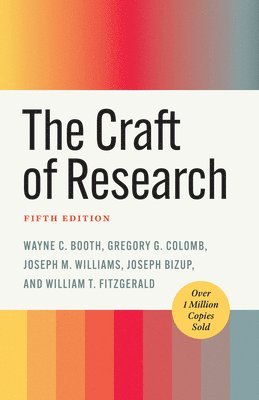
- Häftad, Engelska, 2024A thoroughly updated edition of a beloved classic that has guided generations of researchers in conducting effective and meaningful research. With more than a million copies sold since its first publication, The Craft of Research has helped generations of researchers at every level—from high-school students and first-year undergraduates to advanced graduate students to researchers in business and government. Conceived by seasoned researchers and educators Wayne C. Booth, Gregory G. Colomb, and Joseph M. Williams, this fundamental work explains how to choose significant topics, pose genuine and productive questions, find and evaluate sources, build sound and compelling arguments, and convey those arguments effectively to others.While preserving the book’s proven approach to the research process, as well as its general structure and accessible voice, this new edition acknowledges the many ways research is conducted and communicated today. Thoroughly revised by Joseph Bizup and William T. FitzGerald, it recognizes that research may lead to a product other than a paper—or no product at all—and includes a new chapter about effective presentations. It features fresh examples from a variety of fields that will appeal to today’s students and other readers. It also accounts for new technologies used in research and offers basic guidelines for the appropriate use of generative AI. And it ends with an expanded chapter on ethics that addresses researchers’ broader obligations to their research communities and audiences as well as systemic questions about ethical research practices.This new edition will be welcomed by a new and more diverse generation of researchers.
- Häftad, Engelska, 2024
248 kr
Skickas inom 5-8 vardagar
Seasoned designer Debbie Berne presents an accessible introduction to book design for authors, editors, and other book people. Design is central to the appeal, messaging, and usefulness of books, but to most readers, it’s mysterious or even invisible. Through interiors as well as covers, designers provide structure and information that shape the meaning and experience of books. In The Design of Books, Debbie Berne shines a light on the conventions and processes of her profession, revealing both the aesthetic and market-driven decisions designers consider to make books readable and beautiful. In clear, unstuffy language, Berne reveals how books are put together, with discussions of production considerations, typography and fonts, page layouts, use of images and color, special issues for ebooks, and the very face of each book: the cover. The Design of Books speaks to readers and directly to books’ creators—authors, editors, and other publishing professionals—helping them to become more informed partners in the design of their projects. Berne lays out the practical steps at each stage of the design process, providing insight into who does what when and offering advice for authors on how to be effective advocates for their ideas while also letting go and trusting their manuscripts with teams of professionals. She includes guidance as well for self-publishing authors, including where to find a designer, what to expect from that relationship, and how to art direct your own book. Throughout, Berne teaches how understanding the whats, hows, and whys of book design heightens our appreciation of these cherished objects and helps everyone involved in the process to create more functional, desirable, and wonderful books. - Häftad, Engelska, 2019
758 kr
Skickas inom 5-8 vardagar
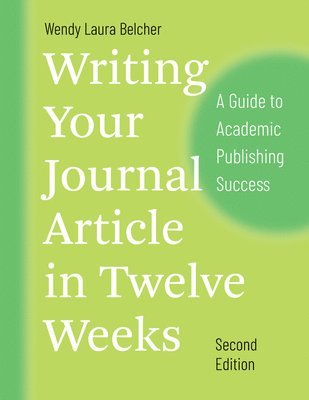
"Wow. No one ever told me this!" Wendy Laura Belcher has heard this countless times throughout her years of teaching and advising academics on how to write journal articles. Scholars know they must publish, but few have been told how to do so. So Belcher made it her mission to demystify the writing process. The result was Writing Your Journal Article in Twelve Weeks, which takes this overwhelming task and breaks it into small, manageable steps. For the past decade, this guide has been the go-to source for those creating articles for peer-reviewed journals. It has enabled thousands to overcome their anxieties and produce the publications that are essential to succeeding in their fields.With this new edition, Belcher expands her advice to reach beginning scholars in even more disciplines. She builds on feedback from professors and graduate students who have successfully used the workbook to complete their articles. A new chapter addresses scholars who are writing from scratch. This edition also includes more targeted exercises and checklists, as well as the latest research on productivity and scholarly writing.Writing Your Journal Article in Twelve Weeks is the only reference to combine expert guidance with a step-by-step workbook. Each week, readers learn a feature of strong articles and work on revising theirs accordingly. Every day is mapped out, taking the guesswork and worry out of writing. There are tasks, templates, and reminders. At the end of twelve weeks, graduate students, recent PhDs, postdoctoral fellows, adjunct instructors, junior faculty, and international faculty will feel confident they know that the rules of academic publishing and have the tools they need to succeed. - Häftad, Engelska, 2011
320 kr
Skickas inom 5-8 vardagar
In "Writing Ethnographic Fieldnotes", Robert M. Emerson, Rachel I. Fretz, and Linda L. Shaw present a series of guidelines, suggestions, and practical advice for creating useful fieldnotes in a variety of settings, demystifying a process that is often assumed to be intuitive and impossible to teach. Using actual unfinished notes as examples, the authors illustrate options for composing, reviewing, and working fieldnotes into finished texts. They discuss different organizational and descriptive strategies and show how transforming direct observations into vivid descriptions results not simply from good memory but from learning to envision scenes as written. A good ethnographer, they demonstrate, must learn to remember dialogue and movement like an actor, to see colors and shapes like a painter, and to sense moods and rhythms like a poet. This new edition reflects the extensive feedback the authors have received from students and instructors since the first edition was published in 1995. As a result, they have updated the race, class, and gender section, created new sections on coding programs and revising first drafts, and provided new examples of working notes.An essential tool for budding social scientists, the second edition of "Writing Ethnographic Fieldnotes" will be invaluable for a new generation of researchers entering the field. - Häftad, Engelska, 2011
183 kr
Skickas inom 5-8 vardagar
For more than twenty years, John Van Maanen's "Tales of the Field" has been a definitive reference and guide for students, scholars, and practitioners of ethnography and beyond. Originally published in 1988, it was the one of the first works to detail and critically analyze the various styles and narrative conventions associated with written representations of culture. This is a book about the deskwork of fieldwork and the various ways culture is put forth in print. The core of the work is an extended discussion and illustration of three forms or genres of cultural representation - realist tales, confessional tales, and impressionist tales. The novel issues raised in "Tales" concern authorial voice, style, truth, objectivity, and point-of-view. Over the years, the work has both reflected and shaped changes in the field of ethnography. In this second edition, Van Maanen's substantial new epilogue charts and illuminates changes in the field since the book's first publication. Refreshingly humorous and accessible, "Tales of the Field" remains an invaluable introduction to novices learning the trade of fieldwork and a cornerstone of reference for veteran ethnographers. - Häftad, Engelska, 2023
309 kr
Skickas inom 5-8 vardagar
The only guide dedicated solely to developmental editing, now revised and updated with new exercises and a chapter on fiction.Developmental editing—transforming a manuscript into a book that edifies, inspires, and sells—is a special skill, and Scott Norton is one of the best at it. With more than three decades of experience in the field, Norton offers his expert advice on how to approach the task of diagnosing and fixing structural problems with book manuscripts in consultation with authors and publishers. He illustrates these principles through a series of detailed case studies featuring before-and-after tables of contents, samples of edited text, and other materials to make an otherwise invisible process tangible. This revised edition for the first time includes exercises that allow readers to edit sample materials and compare their work with that of an experienced professional as well as a new chapter on the unique challenges of editing fiction. In addition, it features expanded coverage of freelance business arrangements, self-published authors, e-books, content marketing, and more. Whether you are an aspiring or experienced developmental editor or an author who works alongside one, you will benefit from Norton’s accessible, collaborative, and realistic approach and guidance. This handbook offers the concrete and essential tools it takes to help books to find their voice and their audience. - Häftad, Engelska, 2021
206 kr
Skickas inom 5-8 vardagar
So you’ve just finished writing something? Congratulations! Now revise it. Because revision is about getting from good to better, and it’s only finished when you decide to stop. But where to begin? In On Revision, William Germano shows authors how to take on the most critical stage of writing anything: rewriting it.For more than twenty years, thousands of writers have turned to Germano for his insider’s take on navigating the world of publishing. A professor, author, and veteran of the book industry, Germano knows what editors want and what writers need to know: Revising is not just correcting typos. Revising is about listening and seeing again. Revising is a rethinking of the principles from the ground up to understand why the writer is doing something, why they’re going somewhere, and why they’re taking the reader along with them.On Revision steps back to take in the big picture, showing authors how to hear their own writing voice and how to reread their work as if they didn’t write it. On Revision will show you how to know when your writing is actually done—and, until it is, what you need to do to get it there. - Häftad, Engelska, 2007
175 kr
Skickas inom 5-8 vardagar
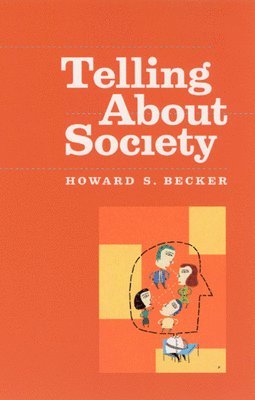
One of French writer Georges Perec's most famous pieces, "I Remember", consists of 480 numbered paragraphs - each just a few short lines recalling a memory from his childhood. The work has neither a beginning nor an end, nor does it contain any analysis. But it nonetheless reveals profound truths about French society during the 1940s and '50s. Taking Perec's book as its cue, "Telling About Society" explores the unconventional ways we communicate what we know about society to others. The third in distinguished teacher Howard S. Becker's best-selling series of writing guides for social scientists, the book explores the many ways knowledge about society can be shared and interpreted through different forms of telling - fiction, films, photographs, maps, even mathematical models - many of which remain outside the boundaries of conventional social science. Eight case studies, including the photographs of Walker Evans, the plays of George Bernard Shaw, the novels of Jane Austen and Italo Calvino, and the sociology of Erving Goffman, provide convincing support for Becker's argument: that every way of telling about society is perfect - for some purpose.The trick is, as Becker notes, to discover what purpose is served by doing it this way rather than that. With Becker's trademark humor and eminently practical advice, "Telling About Society" is an ideal guide for social scientists in all fields and for anyone interested in communicating knowledge in unconventional ways. - Häftad, Engelska, 2013
216 kr
Skickas
Bad writing is bad for science. Incomprehensible journal articles, wordy proposals, and jargon-filled theses make reading a chore for students, informed lay people, and even other scientists. As a result, years of research and hard work can be passed over or misunderstood. The problem is so significant that clear writing has become a legal requirement for federal agencies, thanks to the Plain Writing Act of 2010, which requires that writing be "accessible, consistent, written in plain language, and easy to understand." "Writing Science in Plain English" by Anne E. Greene, an experienced teacher of scientific writing, shows how to produce such clear, concise scientific prose. This is the first book to adapt the Strunk and White model for scientists and students. Designed as a short, easy-to-follow guide, it dispenses with what scientists write and focuses on how to write it well. Eleven chapters present straightforward principles based on what readers need in order to understand complex writing, including concrete subjects, active verbs, consistent terms, and well-organized paragraphs.Chapter-ending exercises and samples of real writing, both good and bad, allow readers to improve their writing immensely with little effort. This concise book is short enough that readers can gain important information in one sitting, but full of useful resources that will have them thumbing through it again and again. It can be used as the foundation for a semester-long course or a two-hour workshop. Designed to be useful to a wide range of readers, from college students to faculty, and beginning researchers to established scientists, it is the perfect resource for anyone who wants to strengthen their scientific writing. - Häftad, Engelska, 1998
166 kr
Skickas inom 5-8 vardagar
Designed to help students learn how to think about research projects, this guide offers suggestions which cover four broad areas of social science: the creation of the "imagery" to guide research; methods of "sampling" to generate maximum variety in the data; the development of "concepts" to organize findings; and the use of "logical" methods to explore systematically the implications of what is found. The advice ranges from simple tricks such as changing an interview question from "Why?" to "How?" (as a way of getting people to talk without asking for a justification) to more technical tricks such as how to manipulate truth tables. Drawing from a variety of fields such as art history, anthropology, sociology, literature and philosophy, the author ranges from James Agee to Ludwig Wittgenstein, to find the common principles which lie behind good social science work, principles that apply to both quantitative and qualitative research. - Inbunden, Engelska, 2007
460 kr
Skickas inom 5-8 vardagar
One of French writer Georges Perec's most famous pieces, "I Remember", consists of 480 numbered paragraphs - each just a few short lines recalling a memory from his childhood. The work has neither a beginning nor an end, nor does it contain any analysis. But it nonetheless reveals profound truths about French society during the 1940s and '50s. Taking Perec's book as its cue, "Telling About Society" explores the unconventional ways we communicate what we know about society to others. The third in distinguished teacher Howard S. Becker's best-selling series of writing guides for social scientists, the book explores the many ways knowledge about society can be shared and interpreted through different forms of telling - fiction, films, photographs, maps, even mathematical models - many of which remain outside the boundaries of conventional social science. Eight case studies, including the photographs of Walker Evans, the plays of George Bernard Shaw, the novels of Jane Austen and Italo Calvino, and the sociology of Erving Goffman, provide convincing support for Becker's argument: that every way of telling about society is perfect - for some purpose.The trick is, as Becker notes, to discover what purpose is served by doing it this way rather than that. With Becker's trademark humor and eminently practical advice, "Telling About Society" is an ideal guide for social scientists in all fields and for anyone interested in communicating knowledge in unconventional ways. - Häftad, Engelska, 2006
145 kr
Skickas inom 5-8 vardagar
If a picture is worth a thousand words, then it's a good bet that at least half of those words relate to the picture's copyright status. Art historians, artists, and anyone who wants to use the images of others will find themselves awash in byzantine legal terms, constantly evolving copyright law, varying interpretations by museums and estates, and despair over the complexity of the whole situation. Here, on a white - not a high - horse, Susan M. Bielstein offers her decades of experience as an editor working with illustrated books. In doing so, she unsnarls the threads of permissions that have ensnared scholars, critics, and artists for years. Organized as a series of "takes" that range from short sidebars to extended discussions, "Permissions, A Survival Guide" explores intellectual property law as it pertains to visual imagery. How can you determine whether an artwork is copyrighted? How do you procure a high-quality reproduction of an image? What does "fair use" really mean? Is it ever legitimate to use the work of an artist without permission?Bielstein discusses the many uncertainties that plague writers who work with images in this highly visual age, and she does so based on her years navigating precisely these issues. As an editor who has hired a photographer to shoot an incredibly obscure work in the Italian mountains (a plan that backfired hilariously), who has tried to reason with artists' estates in languages she doesn't speak, and who has spent her time in the archival trenches, she offers a snappy and humane guide to this difficult terrain. Filled with anecdotes, asides, and real courage, "Permissions, A Survival Guide" is a unique handbook that anyone working in the visual arts will find invaluable, if not indispensable. - Häftad, Engelska, 1989
284 kr
Skickas inom 5-8 vardagar
Written by some of the most distinguished literary translators working in English today, these essays offer new and uncommon insights into the understanding and craft of translation. The contributors not only describe the complexity of translating literature but also suggest the implications of the act of translation for critics, scholars, teachers, and students. The demands of translation, according to these writers, require both comprehensive scholarship in preparing to translate a text and broad creativity in recreating the text in a new language. Translation, thus, becomes a model for the most exacting reading and the most serious scholarship.Some of the contributors lay bare the rigorous methods of literary translation in comparisons of various translations of the same piece; some discuss the problems of translating a specific passage; others speak about the lessons learned over the course of a career in translation. As these essays make clear, translators work in the space between languages and, in so doing, provide insights into the ways in which a culture makes the world verbal. Exemplary readers both of authors and of their individual works, the translators represented in this collection demonstrate that the methodologies derived from the art and craft of translation can serve as a model to revitalize the interpretation and understanding of literary works.Readers will find the opportunity to look over the shoulders of the translators gathered together in this volume an exciting and surprising experience. The act of translation emerges both as a powerful integration of linguistic, semantic, cultural, and historical thinking and as a valuable commentary on how we communicate both within a culture and from one culture to another. - Häftad, Engelska, 2013
180 kr
Skickas inom 5-8 vardagar
When a dissertation crosses my desk, I usually want to grab it by its metaphorical lapels and give it a good shake. "You know something!" I would say if it could hear me. "Now tell it to us in language we can understand!" Since its publication in 2005, From Dissertation to Book has helped thousands of young academic authors get their books beyond the thesis committee and into the hands of interested publishers and general readers. Now revised and updated to reflect the evolution of scholarly publishing, this edition includes a new chapter arguing that the future of academic writing is in the hands of young scholars who meet the broader expectations of readers rather than the narrow requirements of academic committees. At the heart of From Dissertation to Book is the idea that revising the dissertation is fundamentally a process of shifting its focus from the concerns of a narrow audience - a committee or advisors - to those of a broader scholarly audience that wants writing to be both informative and engaging.William Germano offers clear guidance on how to do this, with advice on such topics as rethinking the table of contents, taming runaway footnotes, and confronting the limitations of jargon. Germano draws on his years of experience in both academia and publishing to show writers how to turn a dissertation into a book that an audience will actually enjoy, whether reading on a page or a screen. Germano also explores other, often overlooked, options for dissertations, such as journal articles or chapters in an edited work. With clear directions, engaging examples, and an eye for the idiosyncrasies of academic writing, From Dissertation to Book reveals to recent PhDs the secrets of careful and thoughtful revision - a skill that will be truly invaluable as they add "author" to their curriculum vitae. - Häftad, Engelska, 2017
542 kr
Skickas inom 3-6 vardagar
For more than a decade, The Chicago Guide to Communicating Science has been the go-to reference for anyone who needs to write or speak about their research. Whether a student writing a thesis, a faculty member composing a grant proposal, or a public information officer crafting a press release, Scott Montgomery's advice is perfectly adaptable to any scientific writer's needs. This new edition has been thoroughly revised to address crucial issues in the changing landscape of scientific communication, with an increased focus on those writers working in corporate settings, government, and nonprofit organizations as well as academia. Half a dozen new chapters tackle the evolving needs and paths of scientific writers. These sections address plagiarism and fraud, writing graduate theses, translating scientific material, communicating science to the public, and the increasing globalization of research.The Chicago Guide to Communicating Science recognizes that writers come to the table with different needs and audiences. Through solid examples and concrete advice, Montgomery sets out to help scientists develop their own voice and become stronger communicators.He also teaches readers to think about their work in the larger context of communication about science, addressing the roles of media and the public in scientific attitudes as well as offering advice for those whose research concerns controversial issues such as climate change or emerging viruses. More than ever, communicators need to be able to move seamlessly among platforms and styles. The Chicago Guide to Communicating Science's comprehensive coverage means that scientists and researchers will be able to expertly connect with their audiences, no matter the medium. - Inbunden, Engelska, 2014
814 kr
Skickas inom 5-8 vardagar
Today's researchers have access to more information than ever before. Yet the new material is both overwhelming in quantity and variable in quality. How can scholars survive these twin problems and produce groundbreaking research using the physical and electronic resources available in the modern university research library? In Digital Paper, Andrew Abbott provides some much-needed answers to that question. Abbott tells what every senior researcher knows: that the research process in such materials is not a mechanical, linear process, but a thoughtful and adventurous journey through a non-linear world. He breaks library research down into seven basic and simultaneous tasks: design, search, scanning/browsing, reading, analyzing, filing, and writing. He moves the reader through the phases of research, from confusion to organization, from vague idea to polished result. He teaches how to evaluate data and prior research; how to follow a trail to elusive treasures; how to organize a project; when to start over; when to ask for help.He shows how an understanding of scholarly values, a commitment to hard work, and the flexibility to change direction combine to enable the researcher to turn a daunting mass of found material into an effective paper or thesis. More than a mere how-to manual, Abbott's guidebook helps teach good habits for acquiring knowledge, the foundation of knowledge worth knowing. Those looking for ten easy steps to a perfect paper may want to look elsewhere. But serious scholars, who want their work to stand the test of time, will appreciate Abbott's unique, forthright approach and relish every page of Digital Paper. - Häftad, Engelska, 2014
219 kr
Skickas inom 5-8 vardagar
Today's researchers have access to more information than ever before. Yet the new material is both overwhelming in quantity and variable in quality. How can scholars survive these twin problems and produce groundbreaking research using the physical and electronic resources available in the modern university research library? In Digital Paper, Andrew Abbott provides some much-needed answers to that question. Abbott tells what every senior researcher knows: that the research process in such materials is not a mechanical, linear process, but a thoughtful and adventurous journey through a non-linear world. He breaks library research down into seven basic and simultaneous tasks: design, search, scanning/browsing, reading, analyzing, filing, and writing. He moves the reader through the phases of research, from confusion to organization, from vague idea to polished result. He teaches how to evaluate data and prior research; how to follow a trail to elusive treasures; how to organize a project; when to start over; when to ask for help.He shows how an understanding of scholarly values, a commitment to hard work, and the flexibility to change direction combine to enable the researcher to turn a daunting mass of found material into an effective paper or thesis. More than a mere how-to manual, Abbott's guidebook helps teach good habits for acquiring knowledge, the foundation of knowledge worth knowing. Those looking for ten easy steps to a perfect paper may want to look elsewhere. But serious scholars, who want their work to stand the test of time, will appreciate Abbott's unique, forthright approach and relish every page of Digital Paper. - Häftad, Engelska, 2015
250 kr
Skickas inom 5-8 vardagar
Whether sharing a spectacular shot from a deep-space probe, announcing a development in genetic engineering, or crafting an easy-to-reference list of cancer risk factors, science public information officers, or PIOs, serve as scientific liaisons, connecting academic, nonprofit, government, and other research organizations with the public. And as traditional media outlets cut back on their science coverage, PIOs are becoming a vital source for science news. W. Matthew Shipman's Handbook for Science Public Information Officers covers all aspects of communication strategy and tactics for members of this growing specialty. It includes how to pitch a story, how to train researchers to navigate interviews, how to use social media effectively, and how to respond to a crisis. The handbook offers a wealth of practical advice while teaching science PIOs how to think critically about what they do and how they do it, so that they will be prepared to take advantage of any situation, rather than being overwhelmed by it.For all science communicators-whether they're starting their careers, crossing over from journalism or the research community, or professional communicators looking to hone their PIO skills-Shipman's Handbook for Science Public Information Officers will become their go-to reference. - Häftad, Engelska, 2017
197 kr
Skickas inom 5-8 vardagar
All writers conduct research. For some this means poring over records and combing, archives but for many creative writers research happens in the everyday world when they scribble an observation on the subway, when they travel to get the feel for a city, or when they strike up a conversation with an interesting stranger.The Art of Creative Research helps writers take this natural inclination to explore and observe and turn it into a workable and enjoyable research plan. It shows that research shouldn't be seen as a dry, plodding aspect of writing. Instead, it's an art that all writers can master, one that unearths surprises and fuels imagination. This lends authenticity to fiction and poetry as well as nonfiction. Philip Gerard distills the process into fundamental questions: How do you conduct research? And what can you do with the information you gather? He covers both in-person research and work in archives and illustrates how the different types of research can be incorporated into stories, poems, and essays using examples from a wide range of writers in addition to those from his own projects.Throughout, Gerard brings knowledge from his seasoned background into play, drawing on his experiences as a reporter and a writer of both fiction and nonfiction. His enthusiasm for adventure is infectious and will inspire writers to step away from the keyboard and into the world. "Research can take you to that golden intersection where the personal meets the public, the private crosses the universal, where the best literature lives," Gerard writes. With his masterly guidance, anyone can become an expert in artful investigation. - Häftad, Engelska, 2016
223 kr
Skickas inom 5-8 vardagar
While successful plays tend to share certain storytelling elements, there is no single blueprint for how a play should be constructed. Instead, seasoned playwrights know how to select the right elements for their needs and organize them in a structure that best supports their particular story.Through his workshops and book The Dramatic Writer’s Companion, Will Dunne has helped thousands of writers develop successful scripts. Now, in The Architecture of Story, he helps writers master the building blocks of dramatic storytelling by analyzing a trio of award-winning contemporary American plays: Doubt: A Parable by John Patrick Shanley, Topdog/Underdog by Suzan-Lori Parks, and The Clean House by Sarah Ruhl. Dismantling the stories and examining key components from a technical perspective enables writers to approach their own work with an informed understanding of dramatic architecture.Each self-contained chapter focuses on one storytelling component, ranging from “Title” and “Main Event” to “Emotional Environment” and “Crisis Decision.” Dunne explores each component in detail, demonstrating how it has been successfully handled in each play and comparing and contrasting techniques. The chapters conclude with questions to help writers evaluate and improve their own scripts. The result is a nonlinear reference guide that lets writers work at their own pace and choose the topics that interest them as they develop new scripts. This flexible, interactive structure is designed to meet the needs of writers at all stages of writing and at all levels of experience. - Häftad, Engelska, 2015
284 kr
Skickas inom 5-8 vardagar
Earning praise from scientists, journalists, faculty, and students, The Chicago Guide to Writing about Numbers has helped thousands of writers communicate data clearly and effectively. Its publication offered a much - needed bridge between good quantitative analysis and clear expository writing, using straight forward principles and efficient prose. With this new edition, Jane E. Miller draws on a decade of additional experience and research, expanding her advice on reaching everyday audiences and further integrating non-print formats. Miller opens by introducing a set of basic principles for writing about numbers, then presents a toolkit of techniques that can be applied to prose, tables, charts, and presentations. Throughout, she emphasizes flexibility, showing writers that different approaches work for different kinds of data and different types of audiences. The second edition adds a chapter on writing about numbers for lay audiences, explaining how to avoid overwhelming readers with jargon. Also new is an appendix comparing the contents and formats of speeches, research posters, and papers, to teach writers how to create all three without starting each from scratch.An expanded companion website includes new resources such as slide shows and podcasts that illustrate the concepts and techniques, along with an updated study guide of problem sets and course extensions. This continues to be the only book that brings together all the tasks that go into writing about numbers in one volume. Field-tested with students and professionals alike, this holistic book is the go - to guide for everyone who writes or speaks about numbers. - Inbunden, Engelska, 2016
491 kr
Skickas inom 5-8 vardagar
Few people can write with as much authority on the English language as Bryan A. Garner. The author of "The" "Chicago Manual of Style" s popular Grammar and Usage chapter, Garner is adept at explaining the vagaries of English with absolute precision and utmost clarity. With "The Chicago Guide to English Grammar, Usage, and Punctuation," he has written the definitive guide for writers who want their prose to be both memorable and correct. Throughout the book Garner describes standard literary English the forms that mark writers and speakers as educated users of the language. He also offers historical context for understanding the development of these forms. The section on grammar explains how the canonical parts of speech came to be identified, while the section on syntax covers the nuances of sentence patterns as well as both traditional sentence diagramming and transformational grammar. The usage section offers an unprecedented trove of empirical evidence in the form of Google Ngrams, diagrams that illustrate the changing prevalence of specific terms over decades and even centuries of English literature.The book also covers punctuation and word formation, concluding with an exhaustive glossary of grammatical terms and a bibliography of suggested further reading and references. "The Chicago Guide to English Grammar, Usage, and Punctuation "is a magisterial work, the culmination of Garner s life-long study of the English language. The result is a landmark resource that will offer clear guidelines to students, writers, and editors alike" - Häftad, Engelska, 2016
163 kr
Skickas inom 5-8 vardagar
Longtime manuscript editor and Chicago Manual of Style guru Carol Fisher Saller has negotiated many a standoff between a writer and editor refusing to compromise on the “rights” and “wrongs” of prose styling. Saller realized that when these sides squared off, it was often the reader who lost. In her search for practical strategies for keeping the peace, The Subversive Copy Editor was born. Saller’s ideas struck a chord, and the little book with big advice quickly became a must-have reference for copy editors everywhere.In this second edition, Saller adds new chapters, on the dangers of allegiance to outdated grammar and style rules and on ways to stay current in language and technology. She expands her advice for writers on formatting manuscripts for publication, on self-editing, and on how not to be “difficult.” Saller’s own gaffes provide firsthand (and sometimes humorous) examples of exactly what not to do. The revised content reflects today’s publishing practices while retaining the self-deprecating tone and sharp humor that helped make the first edition so popular. Saller maintains that through carefulness, transparency, and flexibility, editors can build trust and cooperation with writers.The Subversive Copy Editor brings a refreshingly levelheaded approach to the classic battle between writers and editors. This sage advice will prove useful and entertaining to anyone charged with the sometimes perilous task of improving the writing of others. - Inbunden, Engelska, 2016
955 kr
Skickas inom 5-8 vardagar
Ethnography centers on the culture of everyday life. So it is ironic that most scholars who do research on the intimate experiences of ordinary people write their books in a style that those people cannot understand. In recent years, the ethnographic method has spread from its original home in cultural anthropology to fields such as sociology, marketing, media studies, law, criminology, education, cultural studies, history, geography, and political science. Yet, while more and more students and practitioners are learning how to write ethnographies, there is little or no training on how to write ethnographies well.From Notes to Narrative picks up where methodological training leaves off. Kristen Ghodsee, an award-winning ethnographer, addresses common issues that arise in ethnographic writing. Ghodsee works through sentence-level details, such as word choice and structure. She also tackles bigger-picture elements, such as how to incorporate theory and ethnographic details, how to effectively deploy dialogue, and how to avoid distracting elements such as long block quotations and in-text citations. She includes excerpts and examples from model ethnographies. The book concludes with a bibliography of other useful writing guides and nearly one hundred examples of eminently readable ethnographic books. - Häftad, Engelska, 2016
214 kr
Skickas inom 5-8 vardagar
Ethnography centers on the culture of everyday life. So it is ironic that most scholars who do research on the intimate experiences of ordinary people write their books in a style that those people cannot understand. In recent years, the ethnographic method has spread from its original home in cultural anthropology to fields such as sociology, marketing, media studies, law, criminology, education, cultural studies, history, geography, and political science. Yet, while more and more students and practitioners are learning how to write ethnographies, there is little or no training on how to write ethnographies well.From Notes to Narrative picks up where methodological training leaves off. Kristen Ghodsee, an award-winning ethnographer, addresses common issues that arise in ethnographic writing. Ghodsee works through sentence-level details, such as word choice and structure. She also tackles bigger-picture elements, such as how to incorporate theory and ethnographic details, how to effectively deploy dialogue, and how to avoid distracting elements such as long block quotations and in-text citations. She includes excerpts and examples from model ethnographies. The book concludes with a bibliography of other useful writing guides and nearly one hundred examples of eminently readable ethnographic books. - Häftad, Engelska, 2016
232 kr
Skickas inom 5-8 vardagar
For more than a decade, writers have turned to William Germano for his insider’s take on navigating the world of scholarly publishing. A professor, author, and thirty-year veteran of the book industry, Germano knows what editors want and what writers need to know to get their work published.Today there are more ways to publish than ever, and more challenges to traditional publishing. This ever-evolving landscape brings more confusion for authors trying to understand their options. The third edition of Getting It Published offers the clear, practicable guidance on choosing the best path to publication that has made it a trusted resource, now updated to include discussions of current best practices for submitting a proposal, of the advantages and drawbacks of digital publishing, and tips for authors publishing textbooks and in open-access environments.Germano argues that it’s not enough for authors to write well—they also need to write with an audience in mind. He provides valuable guidance on developing a compelling book proposal, finding the right publisher, evaluating a contract, negotiating the production process, and, finally, emerging as a published author.“This endlessly useful and expansive guide is every academic’s pocket Wikipedia: a timely, relevant, and ready resource on scholarly publishing, from the traditional monograph to the digital e-book. I regularly share it, teach it, and consult it myself, whenever I have a question on titling a chapter, securing a permission, or negotiating a contract. Professional advice simply does not get any savvier than this pitch-perfect manual on how to think like a publisher.”—Diana Fuss, Princeton University - Häftad, Engelska, 2017
306 kr
Skickas inom 5-8 vardagar
Editing is an invisible art where the very best work goes undetected. Editors strive to create books that are enlightening, seamless, and pleasurable to read, all while giving credit to the author. This makes it all the more difficult to truly understand the range of roles they inhabit while shepherding a project from concept to publication. In What Editors Do, Peter Ginna gathers essays from twenty-seven leading figures in book publishing about their work. Representing both large houses and small, and encompassing trade, textbook, academic, and children's publishing, the contributors make the case for why editing remains a vital function to writers and readers everywhere. Ironically for an industry built on words, there has been a scarcity of written guidance on how to actually approach the work of editing. This book will serve as a compendium of professional advice and will be a resource both for those entering the profession (or already in it) and for those outside publishing who seek an understanding of it.It sheds light on how editors acquire books, what constitutes a strong author-editor relationship, and the editor's vital role at each stage of the publishing process a role that extends far beyond marking up the author's text. This collection treats editing as both art and craft, and also as a career. It explores how editors balance passion against the economic realities of publishing. What Editors Do shows why, in the face of a rapidly changing publishing landscape, editors are more important than ever. - Häftad, Engelska, 2010
259 kr
Skickas inom 5-8 vardagar
The ability to communicate in print and person is essential to the life of a successful scientist. But since writing is often secondary in scientific education and teaching, there remains a significant need for guides that teach scientists how best to convey their research to general and professional audiences. "The Craft of Scientific Communication" will teach science students and scientists alike how to improve the clarity, cogency, and communicative power of their words and images. In this remarkable guide, Joseph E. Harmon and Alan G. Gross have combined their many years of experience in the art of science writing to analyze published examples of how the best scientists communicate. Organized topically with information on the structural elements and the style of scientific communications, each chapter draws on models of past successes and failures to show students and practitioners how best to negotiate the world of print, online publication, and oral presentation. - Häftad, Engelska, 2017
309 kr
Skickas inom 5-8 vardagar
Each year, tens of thousands of students who are interested in politics go through a rite of passage: they take a course in research methods. Many find the subject to be boring or confusing, and with good reason. Most of the standard books on research methods fail to highlight the most important concepts and questions. Instead, they brim with dry technical definitions and focus heavily on statistical analysis, slighting other valuable methods. This approach not only dulls potential enjoyment of the course, but prevents students from mastering the skills they need to engage more directly and meaningfully with a wide variety of research. With wit and practical wisdom, Christopher Howard draws on more than a decade of experience teaching research methods to transform a typically dreary subject and teach budding political scientists the critical skills they need to read published research more effectively and produce better research of their own. The first part of the book is devoted to asking three fundamental questions in political science: What happened? Why? Who cares?In the second section, Howard demonstrates how to answer these questions by choosing an appropriate research design, selecting cases, and working with numbers and written documents as evidence. Drawing on examples from American and comparative politics, international relations, and public policy, Thinking Like a Political Scientist highlights the most common challenges that political scientists routinely face, and each chapter concludes with exercises so that students can practice dealing with those challenges. - Häftad, Engelska, 2016
163 kr
Skickas inom 5-8 vardagar
Do your sentences sag? Could your paragraphs use a pick-me-up? If so, The Writer’s Diet is for you! It’s a short, sharp introduction to great writing that will help you energize your prose and boost your verbal fitness.Helen Sword dispenses with excessive explanations and overwrought analysis. Instead, she offers an easy-to-follow set of writing principles: use active verbs whenever possible; favor concrete language over vague abstractions; avoid long strings of prepositional phrases; employ adjectives and adverbs only when they contribute something new to the meaning of a sentence; and reduce your dependence on four pernicious “waste words”: it, this, that, and there.Sword then shows the rules in action through examples from William Shakespeare, Emily Dickinson, Martin Luther King Jr., John McPhee, A. S. Byatt, Richard Dawkins, Alison Gopnik, and many more. A writing fitness test encourages you to assess your own writing and get immediate advice on addressing problem areas. While The Writer’s Diet is as sleek and concise as the writing ideals contained within, this slim volume packs a powerful punch.With Sword’s coaching writers of all levels can strengthen and tone their sentences with the stroke of a pen or the click of a mouse. As with any fitness routine, adhering to the rules requires energy and vigilance. The results, however, will speak for themselves.