• Fri frakt över 249 kr
  • •
  • Snabba leveranser
  • •
  • Billiga böcker
Kundservice

Du är på sajten för privatpersoner.

Företag, bibliotek eller offentlig verksamhet?

Du handlar på classic.bokus.com, där alla dina funktioner finns intakta.
Till classic.bokus.com
Bokus logotyp. Gå till startsidan.
  • Erbjudanden
  • Nyheter
  • Student
  • Topplistor
  • Barn & ungdom
  • Bokus Play
  • E-böcker
  • Pocketböcker
  • Spel & pussel

10% rabatt på allt med kod: NYSTART10 →

Sidfot

Mina sidor

    Hjälp

    • Kundservice
    • Vanliga frågor och svar
    • Frakt och leverans
    • Retur vid ångerrätt
    • Reklamera vara
    • Betalning
    • Köpvillkor
    • Allmänna villkor
    • Information om webbplatsens tillgänglighet

    Om Bokus

    • Om oss
    • Pressrum
    • För studenter
    • För företag
    • För bibliotek och offentlig verksamhet
    • För leverantörer
    • Hållbarhet

    Populärt

    • Aktuella erbjudanden
    • Presentkort
    • Studentlitteratur
    • Nya böcker
    • Topplistor
    • Signerade böcker
    • Engelska böcker

    Inspiration

    • Boktips
    • BookTok
    • Populära bokserier
    • Barnbokskaraktärer
    • Populära författare
    Logotyp för Bokus
    Följ oss på Facebook (extern länk)Följ oss på Instagram (extern länk)Följ oss på YouTube (extern länk)Följ oss på TikTok (extern länk)
    bokus @ CookiesAnpassa cookiesIntegritetspolicyKöpvillkor
    Till Citymail hemsida (extern länk)Till Budbee hemsida (extern länk)Till Postnord hemsida (extern länk)Till Schenker hemsida (extern länk)Till Early Bird hemsida (extern länk)Till Walleys hemsida (extern länk)
    1. Samhälle och politik
    2. Samhälle och kultur
    3. Kultur och medier
    4. Referensverk och tvärvetenskap
    • 10% rabatt på allt

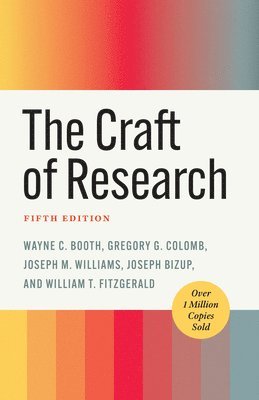
    Craft of Research, Fifth Edition

    AvWayne C. Booth,Gregory G. Colomb

    Häftad, Engelska, 2024

    Del i serien Chicago Guides to Writing, Editing, and Publishing

    221 kr

    Beställningsvara. Skickas inom 5-8 vardagar. Fri frakt över 249 kr.

    Fler format och utgåvor

    Inbunden

    401 kr

    Beskrivning

    A thoroughly updated edition of a beloved classic that has guided generations of researchers in conducting effective and meaningful research.  With more than a million copies sold since its first publication, The Craft of Research has helped generations of researchers at every level—from high-school students and first-year undergraduates to advanced graduate students to researchers in business and government. Conceived by seasoned researchers and educators Wayne C. Booth, Gregory G. Colomb, and Joseph M. Williams, this fundamental work explains how to choose significant topics, pose genuine and productive questions, find and evaluate sources, build sound and compelling arguments, and convey those arguments effectively to others.While preserving the book’s proven approach to the research process, as well as its general structure and accessible voice, this new edition acknowledges the many ways research is conducted and communicated today. Thoroughly revised by Joseph Bizup and William T. FitzGerald, it recognizes that research may lead to a product other than a paper—or no product at all—and includes a new chapter about effective presentations. It features fresh examples from a variety of fields that will appeal to today’s students and other readers.  It also accounts for new technologies used in research and offers basic guidelines for the appropriate use of generative AI. And it ends with an expanded chapter on ethics that addresses researchers’ broader obligations to their research communities and audiences as well as systemic questions about ethical research practices.This new edition will be welcomed by a new and more diverse generation of researchers.

    Produktinformation

    • Utgivningsdatum:2024-06-25
    • Mått:142 x 216 x 20 mm
    • Vikt:400 g
    • Format:Häftad
    • Språk:Engelska
    • Serie:Chicago Guides to Writing, Editing, and Publishing
    • Antal sidor:368
    • Upplaga:5
    • Förlag:The University of Chicago Press
    • ISBN:9780226826677

    Ingår i kampanjer

    10% rabatt på allt

    Utforska kategorier

    • Referensverk och tvärvetenskap inom Samhälle och politik

    Mer om författaren

    Wayne C. Booth (1921–2005) was the George M. Pullman Distinguished Service Professor Emeritus in English Language and Literature at the University of Chicago. His many books include The Rhetoric of Fiction and For the Love of It:Amateuring and Its Rivals, both published by the University of Chicago Press. Gregory G. Colomb (1951–2011) was professor of English at the University of Virginia and the author of Designs on Truth: The Poetics of the Augustan Mock-Epic. Joseph M. Williams (1933–2008) was professor in the Department of English Language and Literature at the University of Chicago and the author of Style: Lessons in Clarity and Grace. Joseph Bizup is associate professor in the Department of English at Boston University. He revised the last three editions of Williams’s Style: Lessons in Clarity and Grace. William T. FitzGerald is associate professor in the Department of English and Communication at Rutgers University–Camden and has published widely on writing and research, the rhetoric of prayer, and style.

    Recensioner i media

    "While the underlying principles of research have changed little, its related sources, processes, and applications have changed significantly since the 1995 publication of this book’s classic first edition. Even since the fourth edition (2016), a greater variety of tools—such as generative artificial intelligence—and methodologies have emerged. Changes in this book’s edition reflect the authors’ responses to these advances and changing attitudes; for example, the purposes, genres, and formats of research products have expanded. The growing recognition of collectiveintelligence and the need for sound argumentation are also addressed in this edition. What has not changed is the authors’ overall approach to research: as a conceptual framework with generic practical advice."

    Innehållsförteckning

    • Preface: The Aims of This Edition  Introduction: Your Research and Your AudienceI.1. What Is Research?I.2. Connecting with Your AudienceI.3. Understanding Your RoleI.4. Imagining the Role of Your AudienceI.5. How to Use This BookQuick Tip: A Checklist for Understanding Your Audience  Part I. Asking Questions, Seeking AnswersPrologue: Planning Your Project—An OverviewQuick Tip: Sustaining a Writing Project Alone and in Groups1. From Topics to Questions1.1. From an Interest to a Topic1.2. From Focused Topic to Research Question1.3. The Most Significant Question: So What?Quick Tip: Finding Topics2. From Questions to a Problem2.1. Understanding Research Problems2.2. Distinguishing “Pure” and “Applied” Research2.3. Connecting Research to Practical Consequences2.4. Finding a Good Research Problem2.5. Learning to Work with ProblemsQuick Tip: Making an Opportunity of Inexperience  Part II. Sources and ResourcesPrologue: Sources and Authentic Research3. Finding and Evaluating Sources3.1. Understanding Three Types of Sources3.2. Making the Most of the Library3.3. Locating Sources Online3.4. Evaluating Sources for Relevance and Reliability3.5. Looking Beyond Predictable Sources3.6. Using People to Further Your ResearchQuick Tip: Using Generative Artificial Intelligence4. Engaging Sources4.1. Recording Complete Bibliographic Information4.2. Engaging Sources Actively4.3. Reading for a Problem4.4. Reading for Arguments4.5. Reading for Data and Support4.6. Taking Notes Systematically4.7. Annotating Your SourcesQuick Tip: Managing Moments of Uncertainty  Part III. Making Your ArgumentPrologue: Assembling a Research Argument5. Making Good Arguments: An Overview5.1. Argument as Conversation5.2. Assembling the Core of Your Argument5.3. Explaining Your Reasoning with Warrants5.4. Acknowledging and Responding to Anticipated Questions and Objections5.5. Planning Your Research Argument5.6. Creating Your EthosQuick Tip: A Common Mistake—Falling Back on What You Know6. Making Claims6.1. Determining the Kind of Claim You Should Make6.2. Evaluating Your Claim6.3. Qualifying Claims to Enhance Your CredibilityQuick Tip: Make Your Claim Contestable7. Assembling Reasons and Evidence7.1. Using Reasons to Plan Your Argument7.2. Distinguishing Evidence from Reasons7.3. Determining the Kind of Evidence You Need7.4. Distinguishing Evidence from Reports of It7.5. Evaluating Your EvidenceQuick Tip: Assess Your Evidence as You Gather It8. Warrants8.1. Warrants in Everyday Reasoning8.2. Warrants in Research Arguments8.3. Testing Warrants8.4. Knowing When to State a Warrant8.5. Using Warrants to Test Your Argument8.6. Challenging Others’ WarrantsQuick Tip: Reasons, Evidence, and Warrants9. Acknowledgments and Responses9.1. Questions about Your Research Problem9.2. Questions about the Soundness of Your Argument9.3. Imagining Alternatives to Your Argument9.4. Deciding What to Acknowledge9.5. Framing Your Responses as Sub-arguments9.6. The Vocabulary of Acknowledgment and ResponseQuick Tip: Three Predictable Disagreements  Part IV. Delivering Your ArgumentPrologue: Planning, Writing, and Thinking10. Planning and Drafting10.1. Why a Formal Paper?10.2. Planning Your Paper10.3. Avoiding Three Common but Flawed Patterns10.4. Turning Your Plan into a DraftQuick Tip: Managing Anxiety as a Writer11. Revising and Organizing11.1. Thinking Like a Reader11.2. Revising Your Frame11.3. Revising Your Argument11.4. Revising Your Organization11.5. Checking Your Paragraphs11.6. Letting Your Draft Cool, Then Revisiting ItQuick Tip: Abstracts12. Incorporating Sources12.1. Summarizing, Paraphrasing, and Quoting12.2. Creating a Fair Summary12.3. Creating a Fair Paraphrase12.4. Using Direct Quotations12.5. Mixing Summary, Paraphrase, and Quotation12.6. Showing Readers How Evidence Is Relevant12.7. The Social Importance of Citing Sources12.8. Four Common Citation Styles12.9. Guarding against Inadvertent PlagiarismQuick Tip: Indicating Citations in Your Paper13. Communicating Evidence Visually13.1. Choosing Visual or Verbal Representations13.2. Choosing the Most Effective Graphic13.3. Designing Tables, Charts, and Graphs13.4. Specific Guidelines for Tables, Bar Charts, and Line Graphs13.5. Representing Data EthicallyQuick Tip: Look for Opportunities to Include Visual Evidence14. Introductions and Conclusions14.1. The Common Structure of Introductions14.2. Step 1: Stating a Context14.3. Step 2: Stating Your Problem14.4. Step 3: Stating Your Response14.5. Setting the Right Pace14.6. Finding Your First Few Words14.7. Writing Your ConclusionQuick Tip: Use Key Terms in Titles15. Revising Style: Telling Your Story Clearly15.1. Judging Style15.2. The First Two Principles of Clear Writing15.3. A Third Principle: Old before New15.4. Choosing between the Active and Passive Voice15.5. A Final Principle: Complexity Last15.6. Editorial PolishQuick Tip: The Quickest Revision Strategy16. Research Presentations16.1. Presenting to Auditors16.2. Giving a Preliminary Presentation16.3. Giving a Final PresentationQuick Tip: Treat Your Presentation as a Performance  Part V. Some Last Considerations17. The Ethics of Research17.1. Ethical Obligation to Yourself17.2. Ethical Obligation to Your Audience and Fellow Researchers17.3. Research and Social Responsibility17.4. A Final Thought18. Advice for Teachers18.1. The Risks of Imposing Formal Rules18.2. On Assignment Scenarios: Creating a Ground for Curiosity18.3. Recognizing and Tolerating the Inevitable Messiness of Learning  Our DebtsAppendix: A Brief Guide to Bibliographic and Other ResourcesIndex