• Fri frakt över 249 kr
  • •
  • Snabba leveranser
  • •
  • Billiga böcker
Kundservice

Du är på sajten för privatpersoner.

Företag, bibliotek eller offentlig verksamhet?

Du handlar på classic.bokus.com, där alla dina funktioner finns intakta.
Till classic.bokus.com
Bokus logotyp. Gå till startsidan.
  • Erbjudanden
  • Nyheter
  • Student
  • Topplistor
  • Barn & ungdom
  • Bokus Play
  • E-böcker
  • Pocketböcker
  • Spel & pussel

10% rabatt på allt med kod NYSTART10 →

Sidfot

Mina sidor

    Hjälp

    • Kundservice
    • Vanliga frågor och svar
    • Frakt och leverans
    • Retur vid ångerrätt
    • Reklamera vara
    • Betalning
    • Köpvillkor
    • Allmänna villkor
    • Information om webbplatsens tillgänglighet

    Om Bokus

    • Om oss
    • Pressrum
    • För studenter
    • För företag
    • För bibliotek och offentlig verksamhet
    • För leverantörer
    • Hållbarhet

    Populärt

    • Aktuella erbjudanden
    • Presentkort
    • Studentlitteratur
    • Nya böcker
    • Topplistor
    • Signerade böcker
    • Engelska böcker

    Inspiration

    • Boktips
    • BookTok
    • Populära bokserier
    • Barnbokskaraktärer
    • Populära författare
    Logotyp för Bokus
    Följ oss på Facebook (extern länk)Följ oss på Instagram (extern länk)Följ oss på YouTube (extern länk)Följ oss på TikTok (extern länk)
    bokus @ CookiesAnpassa cookiesIntegritetspolicyKöpvillkor
    Till Citymail hemsida (extern länk)Till Budbee hemsida (extern länk)Till Postnord hemsida (extern länk)Till Schenker hemsida (extern länk)Till Early Bird hemsida (extern länk)Till Walleys hemsida (extern länk)
    1. Filosofi och religion
    2. Filosofi
    3. Filosofiska discipliner

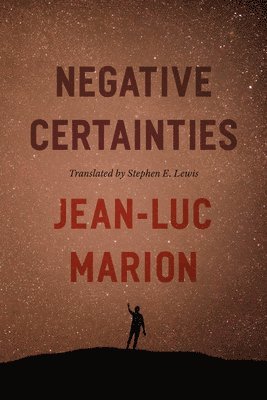
    Negative Certainties

    AvJean-Luc Marion

    Häftad, Engelska, 2024

    Del i serien Religion and Postmodernism

    292 kr

    Beställningsvara. Skickas inom 5-8 vardagar. Fri frakt över 249 kr.

    Fler format och utgåvor

    Inbunden

    398 kr

    Beskrivning

    Now in paperback, Jean-Luc Marion's groundbreaking philosophy of human uncertainty.In Negative Certainties, renowned philosopher Jean-Luc Marion challenges some of the most fundamental assumptions we have developed about knowledge: that it is categorical, predicative, and positive. Following Descartes, Kant, and Heidegger, he looks toward our finitude and the limits of our reason. He asks an astonishingly simple—but profoundly provocative—question in order to open up an entirely new way of thinking about knowledge: Isn’t our uncertainty, our finitude, and rational limitations, one of the few things we can be certain about?Marion shows how the assumption of knowledge as positive demands a reductive epistemology that disregards immeasurable or disorderly phenomena. He shows that we have experiences every day that have no identifiable causes or predictable reasons and that these constitute a very real knowledge—a knowledge of the limits of what can be known. Establishing this “negative certainty,” Marion applies it to four aporias, or issues of certain uncertainty: the definition of man; the nature of God; the unconditionality of the gift; and the unpredictability of events. Translated for the first time into English, Negative Certainties is an invigorating work of epistemological inquiry that will take a central place in Marion’s oeuvre.

    Produktinformation

    • Utgivningsdatum:2024-01-04
    • Mått:152 x 229 x 20 mm
    • Vikt:399 g
    • Format:Häftad
    • Språk:Engelska
    • Serie:Religion and Postmodernism
    • Antal sidor:288
    • Förlag:The University of Chicago Press
    • ISBN:9780226829487
    • Översättare:Stephen E. Lewis

    Utforska kategorier

    • Filosofiska discipliner inom Filosofi och religion

    Mer om författaren

    Jean-Luc Marion, member of the Académie française, is emeritus professor of philosophy at the Université Paris-Sorbonne (Paris IV). He is the Andrew Thomas Greeley and Grace McNichols Greeley Professor of Catholic Studies, professor of the philosophy of religions and theology, and professor in the Committee on Social Thought and the Department of Philosophy at the University of Chicago. He also holds the Dominique Dubarle chair at the Institut Catholique of Paris. He is the author of many books, including The Erotic Phenomenon and God without Being, both also published by the University of Chicago Press. Stephen E. Lewis is professor and chair of the English Department at the Franciscan University of Steubenville. He has translated several works by Jean-Luc Marion.

    Recensioner i media

    "Marion argues that being clear about what one cannot know is philosophically important, because such acknowledgement makes one realize that even some properly formed questions will remain unanswerable.”

    Innehållsförteckning

    • ForewordTranslator’s AcknowledgmentsIntroduction§ 1 Attempt to Introduce the Concept of Negative Certainties into PhilosophyI The Undefinable, or the Face of Man§ 2 “What Is Man?”§ 3 “Ipse mihi magna quaestio”§ 4 What It Costs to Know (Oneself)§ 5 Proscription§ 6 The Fund of Incomprehensibility§ 7 The Indefinite and the UnstableII The Impossible, or What Is Proper to God§ 8 The Impossible Phenomenon§ 9 The Irreducible§ 10 Possibility without Conditions§ 11 The (Im)possible: From Contradiction to Event§ 12 The (Im)possible from My Point of View§ 13 The (Im)possible from God’s Point of ViewIII The Unconditioned, or the Strength of the Gift§ 14 The Contradictions of the Gift§ 15 The Terms of Exchange§ 16 Reducing the Gift to Givenness§ 17 Without the Principle of Identity§ 18 Without the Principle of Sufficient ReasonIV The Unconditioned and the Variations of the Gift§ 19 Sacrifice According to the Terms of Exchange§ 20 Regiving, Beginning from the Recipient§ 21 The Confirmation of Abraham§ 22 Forgiveness According to the Terms of Exchange§ 23 Regiving, Beginning from the Giver§ 24 The Return of the Prodigal SonV The Unforeseeable, or the Event§ 25 What the Object Excludes§ 26 The Condition of the Object§ 27 Concerning the Distinction of Phenomena into Objects and Events§ 28 Without Cause§ 29 The Original Unknown§ 30 The Double InterpretationConclusion§ 31 In Praise of the ParadoxBibliographical NoteNotesIndex