326 kr
Jean-Luc Marion – författare
- Häftad, Engelska, 2012In the Self's Place is an original phenomenological reading of Augustine that considers his engagement with notions of identity in Confessions. Using the Augustinian experience of confessio, Jean-Luc Marion develops a model of selfhood that examines this experience in light of the whole of the Augustinian corpus. Towards this end, Marion engages with noteworthy modern and postmodern analyses of Augustine's most "experiential" work, including the critical commentaries of Jacques Derrida, Martin Heidegger, and Ludwig Wittgenstein. Marion ultimately concludes that Augustine has preceded postmodernity in exploring an excess of the self over and beyond itself, and in using this alterity of the self to itself, as a driving force for creative relations with God, the world, and others. This reading establishes striking connections between accounts of selfhood across the fields of contemporary philosophy, literary studies, and Augustine's early Christianity.
- Häftad, Engelska, 2012
388 kr
Skickas inom 5-8 vardagar
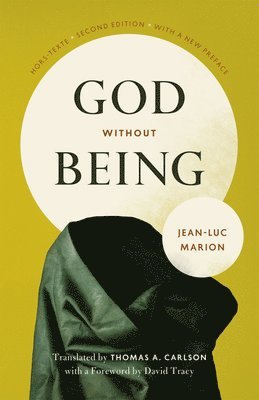
Jean-Luc Marion is one of the world's foremost philosophers of religion as well as one of the leading Catholic thinkers of modern times. In "God Without Being", Marion challenges a fundamental premise of traditional philosophy, theology, and metaphysics: that God, before all else, must be. Taking a characteristically postmodern stance and engaging in passionate dialogue with Heidegger, he locates a "God without Being" in the realm of agape, or Christian charity and love. If God is love, Marion contends, then God loves before he actually is. First translated into English in 1991, "God Without Being" continues to be a key book for discussions of the nature of God. This second edition contains a new preface by Marion as well as his 2003 essay on Thomas Aquinas. Offering a controversial, contemporary perspective, "God Without Being" will remain essential reading for scholars and students of philosophy and religion. - Häftad, Engelska, 2021
219 kr
Skickas inom 5-8 vardagar
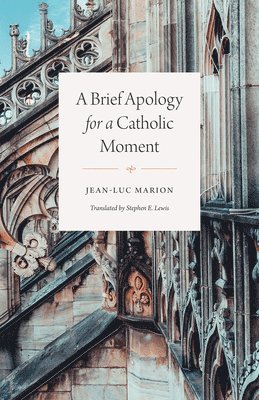
A timely new work by one of France’s premier philosophers, A Brief Apology for a Catholic Moment offers insight into what “catholic” truly means. In this short, accessible book, Jean-Luc Marion braids the sense of catholic as all-embracing and universal into conversation about what it is to be Catholic in the present moment. A Brief Apology for a Catholic Moment tackles complex issues surrounding church-state separation and addresses a larger Catholic audience that transcends national boundaries, social identities, and linguistic differences. Marion insists that Catholic universalism, with its core of communion and community, is not an outmoded worldview, but rather an outlook that has the potential to counter the positivist rationality and nihilism at the core of our current political moment, and can help us address questions surrounding liberalism and religion and what is often presented as tension between “Islam and the West.” As an inviting and sophisticated Catholic take on current political and social realities—realities that are not confined to France alone—A Brief Apology for a Catholic Moment is a valuable contribution to a larger conversation. - Häftad, Engelska, 2024
366 kr
Skickas
Jean-Luc Marion has long endeavored to broaden our view of truth. In this illuminating new book—his deepest engagement with theology to date—Marion proposes a rigorous new understanding of human and divine revelation in a deeply phenomenological key.Although today considered the central theme of theology, the concept of Revelation was almost entirely unknown to the first millennium of Christian thought. In a penetrating historical deconstruction, Marion traces the development of this term to the rise of metaphysics from Aquinas through Suárez, Descartes, and Kant; formalized into an epistemological framework, this understanding of Revelation has restricted philosophical and theological thinking ever since. To break free from these limits, Marion takes hints from theologians including Barth and Balthasar while mobilizing the phenomenology of givenness to provide a rigorous new understanding of revelation as a mode of uncovering. His extensive study of the Jewish and Christian Scriptures unfolds a logic of Trinitarian phenomenality, worked out in conversation with Basil, Augustine, Hegel, Schelling, and others, that ultimately transforms our very notions of being and time.The result is precisely what we have come to expect from this acclaimed philosopher: masterful historical scholarship working in tandem with daring originality. - E-bokPDF, Engelska, 2016
332 kr
Läs direkt efter köp
Givenness and Revelation represents both the unity and the deep continuity of Jean-Luc Marions thinking over many decades. This investigation into the origins and evolution of the concept of revelation arises from an initial reappraisal of the tension between natural theology and the revealed knowledge of God or sacra doctrina. Marion draws on the re-definition of the notions of possibility and impossibility, the critique of the reification of the subject, and the unpredictability of the ''event'' in its relationship to the phenomenology of the gift. This work begins and ends in the concept of revelation, thus addressing the very heart and soul of Marion''s theology, concluding with a phenomenological approach to the Trinity that rests in the Spirit as gift. Givenness and Revelation enhances not only our understanding of religious experience, but enlarges the horizon of possibility of phenomenology itself. - E-bokEngelska, 2016
332 kr
Läs direkt efter köp
Givenness and Revelation represents both the unity and the deep continuity of Jean-Luc Marions thinking over many decades. This investigation into the origins and evolution of the concept of revelation arises from an initial reappraisal of the tension between natural theology and the revealed knowledge of God or sacra doctrina. Marion draws on the re-definition of the notions of possibility and impossibility, the critique of the reification of the subject, and the unpredictability of the ''event'' in its relationship to the phenomenology of the gift. This work begins and ends in the concept of revelation, thus addressing the very heart and soul of Marion''s theology, concluding with a phenomenological approach to the Trinity that rests in the Spirit as gift. Givenness and Revelation enhances not only our understanding of religious experience, but enlarges the horizon of possibility of phenomenology itself. - Inbunden, Engelska, 2016
619 kr
Skickas inom 7-10 vardagar
Givenness and Revelation represents both the unity and the deep continuity of Jean-Luc Marions thinking over many decades. This investigation into the origins and evolution of the concept of revelation arises from an initial reappraisal of the tension between natural theology and the revealed knowledge of God or sacra doctrina. Marion draws on the re-definition of the notions of possibility and impossibility, the critique of the reification of the subject, and the unpredictability of the event in its relationship to the gift in order to assess the respective capacities of dogmatic theology, modern metaphysics, contemporary phenomenology, and the biblical texts, especially the New Testament, to conceive the paradoxical phenomenality of a revelation.This work thus brings us to the very heart and soul of Marions theology, concluding with a phenomenological approach to the Trinity that uncovers the logic of gift performed in the scriptural manifestation of Jesus Christ as Son of the Father. Givenness and Revelation enhances not only our understanding of religious experience, but enlarges the horizon of possibility of phenomenology itself.With a Foreword by Ramona Fotiade, Senior Lecturer in French, and David Jasper, Professor of Literature and Theology, both at the University of Glasgow. - Häftad, Engelska, 2018
460 kr
Skickas inom 5-8 vardagar
Givenness and Revelation represents both the unity and the deep continuity of Jean-Luc Marions thinking over many decades. This investigation into the origins and evolution of the concept of revelation arises from an initial reappraisal of the tension between natural theology and the revealed knowledge of God or sacra doctrina. Marion draws on the re-definition of the notions of possibility and impossibility, the critique of the reification of the subject, and the unpredictability of the 'event' in its relationship to the phenomenology of the gift. This work begins and ends in the concept of revelation, thus addressing the very heart and soul of Marion's theology, concluding with a phenomenological approach to the Trinity that rests in the Spirit as gift. Givenness and Revelation enhances not only our understanding of religious experience, but enlarges the horizon of possibility of phenomenology itself. - Inbunden, Engelska, 2018
447 kr
Skickas inom 5-8 vardagar
On Descartes’ Passive Thought is the culmination of a life-long reflection on the philosophy of Descartes by one of the most important living French philosophers. In it, Jean-Luc Marion examines anew some of the questions left unresolved in his previous books about Descartes, with a particular focus on Descartes’s theory of morals and the passions.Descartes has long been associated with mind-body dualism, but Marion argues here that this is a historical misattribution, popularized by Malebranche and popular ever since both within the academy and with the general public. Actually, Marion shows, Descartes held a holistic conception of body and mind. He called it the meum corpus, a passive mode of thinking, which implies far more than just pure mind—rather, it signifies a mind directly connected to the body: the human being that I am. Understood in this new light, the Descartes Marion uncovers through close readings of works such as Passions of the Soul resists prominent criticisms leveled at him by twentieth-century figures like Husserl and Heidegger, and even anticipates the non-dualistic, phenomenological concepts of human being discussed today. This is a momentous book that no serious historian of philosophy will be able to ignore. - E-bokEngelska, 2018
884 kr
Läs direkt efter köp
On Descartes’ Passive Thought is the culmination of a life-long reflection on the philosophy of Descartes by one of the most important living French philosophers. In it, Jean-Luc Marion examines anew some of the questions left unresolved in his previous books about Descartes, with a particular focus on Descartes’s theory of morals and the passions. Descartes has long been associated with mind-body dualism, but Marion argues here that this is a historical misattribution, popularized by Malebranche and popular ever since both within the academy and with the general public. Actually, Marion shows, Descartes held a holistic conception of body and mind. He called it the meum corpus, a passive mode of thinking, which implies far more than just pure mind—rather, it signifies a mind directly connected to the body: the human being that I am. Understood in this new light, the Descartes Marion uncovers through close readings of works such as Passions of the Soul resists prominent criticisms leveled at him by twentieth-century figures like Husserl and Heidegger, and even anticipates the non-dualistic, phenomenological concepts of human being discussed today. This is a momentous book that no serious historian of philosophy will be able to ignore. - Inbunden, Engelska, 2006
813 kr
Skickas inom 5-8 vardagar
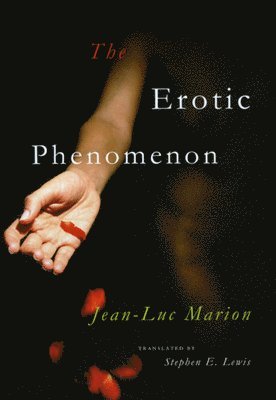
While humanists have pondered the subject of love to the point of obsessiveness, philosophers have steadfastly ignored it. The word philosophy means "love of wisdom," but the absence of love from philosophical discourse is curiously glaring. In "The Erotic Phenomenon", Jean-Luc Marion attends to this dearth with an inquiry into the concept of love itself.Marion begins with a critique of Descartes' equation of the ego's ability to doubt with the certainty that one exists. We encounter love, he says, when we first step forward as a lover: I love therefore I am, and my love is the reason I care whether I exist or not. This philosophical base allows Marion to probe several manifestations of love and its variations, including carnal excitement, self-hate, lying and perversion, fidelity, the generation of children, and the love of God. Throughout, Marion stresses that all erotic phenomena stem not from the ego as popularly understood but instead from love. - Häftad, Engelska, 2008
251 kr
Skickas inom 5-8 vardagar
While humanists have pondered the subject of love to the point of obsessiveness, philosophers have steadfastly ignored it. The word philosophy means "love of wisdom," but the absence of love from philosophical discourse is curiously glaring. In "The Erotic Phenomenon", Jean-Luc Marion attends to this dearth with an inquiry into the concept of love itself.Marion begins with a critique of Descartes' equation of the ego's ability to doubt with the certainty that one exists. We encounter love, he says, when we first step forward as a lover: I love therefore I am, and my love is the reason I care whether I exist or not. This philosophical base allows Marion to probe several manifestations of love and its variations, including carnal excitement, self-hate, lying and perversion, fidelity, the generation of children, and the love of God. Throughout, Marion stresses that all erotic phenomena stem not from the ego as popularly understood but instead from love. - Häftad, Engelska, 1999
406 kr
Skickas inom 5-8 vardagar
Does Descartes belong to metaphysics? What do we mean when we say "metaphysics"? These questions form the point of departure for Jean-Luc Marion's study of Cartesian thought. Analyses of Descartes' notion of the "ego" and his idea of God show that if Descartes represents the fullest example of metaphysics, he nonetheless transgresses its limits. Writing as philosopher and historian of philosophy, Marion uses Heidegger's concept of metaphysics to interpret the Cartesian corpus - an interpretation strangely omitted from Heidegger's own history of philosophy. This interpretation complicates and deepens the Heideggerian concept of metaphysics, a concept that has dominated 20th-century philosophy. Examinations of Descartes' predecessors (Aristotle, Augustine, Aquinas, and Suarez) and his successors (Leibniz, Spinoza, and Hegel) clarify the meaning of the Cartesian revolution in philosophy. Translated by Jeffrey Kosky, this work should appeal to historians of philosophy, students of religion, and anyone interested in the genealogy of contemporary thought and its contradictions. - Inbunden, Engelska, 2015
398 kr
Skickas inom 5-8 vardagar
In Negative Certainties, renowned philosopher Jean-Luc Marion challenges some of the most fundamental assumptions we have developed about knowledge: that it is categorical, predicative, and positive. Following Descartes, Kant, and Heidegger, he looks toward our finitude and the limits of our reason. He asks an astonishingly simple-but profoundly provocative-question in order to open up an entirely new way of thinking about knowledge: Isn't our uncertainty, our finitude and rational limitations, one of the few things we can be certain about? Marion shows how the assumption of knowledge as positive demands a reductive epistemology that disregards immeasurable or disorderly phenomena. He shows that we have experiences every day that have no identifiable causes or predictable reasons, and that these constitute a very real knowledge-a knowledge of the limits of what can be known. Establishing this "negative certainty," Marion applies it to four aporias, or issues of certain uncertainty: the definition of man; the nature of God; the unconditionality of the gift; and the unpredictability of events.Translated for the first time into English, Negative Certainties is an invigorating work of epistemological inquiry that will take a central place in Marion's oeuvre. - E-bokEngelska, 2012
606 kr
Läs direkt efter köp
Jean-Luc Marion is one of the world’s foremost philosophers of religion as well as one of the leading Catholic thinkers of modern times. In God Without Being, Marion challenges a fundamental premise of traditional philosophy, theology, and metaphysics: that God, before all else, must be. Taking a characteristically postmodern stance and engaging in passionate dialogue with Heidegger, he locates a “God without Being” in the realm of agape, or Christian charity and love. If God is love, Marion contends, then God loves before he actually is.
First translated into English in 1991, God Without Being continues to be a key book for discussions of the nature of God. This second edition contains a new preface by Marion as well as his 2003 essay on Thomas Aquinas. Offering a controversial, contemporary perspective, God Without Being will remain essential reading for scholars and students of philosophy and religion. “Daring and profound. . . . In matters most central to his thesis, [Marion]’s control is admirable, and his attunement to the nuances of other major postmodern thinkers is impressive.”—Theological Studies “A truly remarkable work.”—First Things “Very rewarding reading.”—Religious Studies Review - Inbunden, Engelska, 2021
845 kr
Skickas inom 5-8 vardagar
A timely new work by one of France’s premier philosophers, A Brief Apology for a Catholic Moment offers insight into what “catholic” truly means. In this short, accessible book, Jean-Luc Marion braids the sense of catholic as all-embracing and universal into conversation about what it is to be Catholic in the present moment. A Brief Apology for a Catholic Moment tackles complex issues surrounding church-state separation and addresses a larger Catholic audience that transcends national boundaries, social identities, and linguistic differences. Marion insists that Catholic universalism, with its core of communion and community, is not an outmoded worldview, but rather an outlook that has the potential to counter the positivist rationality and nihilism at the core of our current political moment, and can help us address questions surrounding liberalism and religion and what is often presented as tension between “Islam and the West.” As an inviting and sophisticated Catholic take on current political and social realities—realities that are not confined to France alone—A Brief Apology for a Catholic Moment is a valuable contribution to a larger conversation. - E-bokEngelska, 2021
426 kr
Läs direkt efter köp
A timely new work by one of France’s premier philosophers, A Brief Apology for a Catholic Moment offers insight into what “catholic” truly means. In this short, accessible book, Jean-Luc Marion braids the sense of catholic as all-embracing and universal into conversation about what it is to be Catholic in the present moment. A Brief Apology for a Catholic Moment tackles complex issues surrounding church-state separation and addresses a larger Catholic audience that transcends national boundaries, social identities, and linguistic differences. Marion insists that Catholic universalism, with its core of communion and community, is not an outmoded worldview, but rather an outlook that has the potential to counter the positivist rationality and nihilism at the core of our current political moment, and can help us address questions surrounding liberalism and religion and what is often presented as tension between “Islam and the West.” As an inviting and sophisticated Catholic take on current political and social realities—realities that are not confined to France alone—A Brief Apology for a Catholic Moment is a valuable contribution to a larger conversation. - Häftad, Engelska, 2024
292 kr
Skickas inom 5-8 vardagar
Now in paperback, Jean-Luc Marion's groundbreaking philosophy of human uncertainty.In Negative Certainties, renowned philosopher Jean-Luc Marion challenges some of the most fundamental assumptions we have developed about knowledge: that it is categorical, predicative, and positive. Following Descartes, Kant, and Heidegger, he looks toward our finitude and the limits of our reason. He asks an astonishingly simple—but profoundly provocative—question in order to open up an entirely new way of thinking about knowledge: Isn’t our uncertainty, our finitude, and rational limitations, one of the few things we can be certain about?Marion shows how the assumption of knowledge as positive demands a reductive epistemology that disregards immeasurable or disorderly phenomena. He shows that we have experiences every day that have no identifiable causes or predictable reasons and that these constitute a very real knowledge—a knowledge of the limits of what can be known. Establishing this “negative certainty,” Marion applies it to four aporias, or issues of certain uncertainty: the definition of man; the nature of God; the unconditionality of the gift; and the unpredictability of events. Translated for the first time into English, Negative Certainties is an invigorating work of epistemological inquiry that will take a central place in Marion’s oeuvre. - Inbunden, Engelska, 2003
1 062 kr
Skickas inom 10-15 vardagar
Painting, according to Jean-Luc Marion, is a central topic of concern for philosophy, particularly phenomenology. For the question of painting is, at its heart, a question of visibility—of appearance. As such, the painting is a privileged case of the phenomenon; the painting becomes an index for investigating the conditions of appearance—or what Marion describes as "phenomenality" in general.In The Crossing of the Visible, Marion takes up just such a project. The natural outgrowth of his earlier reflections on icons, these four studies carefully consider the history of painting—from classical to contemporary—as a fund for phenomenological reflection on the conditions of (in)visibility. Ranging across artists from Raphael to Rothko, Caravaggio to Pollock, The Crossing of the Visible offers both a critique of contemporary accounts of the visual and a constructive alternative. According to Marion, the proper response to the "nihilism" of postmodernity is not iconoclasm, but rather a radically iconic account of the visual and the arts that opens them to the invisible. - Häftad, Engelska, 2003
239 kr
Skickas inom 5-8 vardagar
Painting, according to Jean-Luc Marion, is a central topic of concern for philosophy, particularly phenomenology. For the question of painting is, at its heart, a question of visibility—of appearance. As such, the painting is a privileged case of the phenomenon; the painting becomes an index for investigating the conditions of appearance—or what Marion describes as "phenomenality" in general.In The Crossing of the Visible, Marion takes up just such a project. The natural outgrowth of his earlier reflections on icons, these four studies carefully consider the history of painting—from classical to contemporary—as a fund for phenomenological reflection on the conditions of (in)visibility. Ranging across artists from Raphael to Rothko, Caravaggio to Pollock, The Crossing of the Visible offers both a critique of contemporary accounts of the visual and a constructive alternative. According to Marion, the proper response to the "nihilism" of postmodernity is not iconoclasm, but rather a radically iconic account of the visual and the arts that opens them to the invisible. - Inbunden, Engelska, 2002
1 540 kr
Skickas inom 5-8 vardagar
Along with Husserl's Ideas and Heidegger's Being and Time, Being Given is one of the classic works of phenomenology in the twentieth century. Through readings of Kant, Husserl, Heidegger, Derrida, and twentieth-century French phenomenology (e.g., Merleau-Ponty, Levinas, and Henry), it ventures a bold and decisive reappraisal of phenomenology and its possibilities. Its author's most original work to date, the book pushes phenomenology to its limits in an attempt to redefine and recover the phenomenological ideal, which the author argues has never been realized in any of the historical phenomenologies. Against Husserl's reduction to consciousness and Heidegger's reduction to Dasein, the author proposes a third reduction to givenness, wherein phenomena appear unconditionally and show themselves from themselves at their own initiative. Being Given is the clearest, most systematic response to questions that have occupied its author for the better part of two decades. The book articulates a powerful set of concepts that should provoke new research in philosophy, religion, and art, as well as at the intersection of these disciplines.Some of the significant issues it treats include the phenomenological definition of the phenomenon, the redefinition of the gift in terms not of economy but of givenness, the nature of saturated phenomena, and the question "Who comes after the subject?" Throughout his consideration of these issues, the author carefully notes their significance for the increasingly popular fields of religious studies and philosophy of religion. Being Given is therefore indispensable reading for anyone interested in the question of the relation between the phenomenological and the theological in Marion and emergent French phenomenology. - Häftad, Engelska, 2002
359 kr
Skickas inom 10-15 vardagar
Along with Husserl's Ideas and Heidegger's Being and Time, Being Given is one of the classic works of phenomenology in the twentieth century. Through readings of Kant, Husserl, Heidegger, Derrida, and twentieth-century French phenomenology (e.g., Merleau-Ponty, Levinas, and Henry), it ventures a bold and decisive reappraisal of phenomenology and its possibilities. Its author's most original work to date, the book pushes phenomenology to its limits in an attempt to redefine and recover the phenomenological ideal, which the author argues has never been realized in any of the historical phenomenologies. Against Husserl's reduction to consciousness and Heidegger's reduction to Dasein, the author proposes a third reduction to givenness, wherein phenomena appear unconditionally and show themselves from themselves at their own initiative. Being Given is the clearest, most systematic response to questions that have occupied its author for the better part of two decades. The book articulates a powerful set of concepts that should provoke new research in philosophy, religion, and art, as well as at the intersection of these disciplines.Some of the significant issues it treats include the phenomenological definition of the phenomenon, the redefinition of the gift in terms not of economy but of givenness, the nature of saturated phenomena, and the question "Who comes after the subject?" Throughout his consideration of these issues, the author carefully notes their significance for the increasingly popular fields of religious studies and philosophy of religion. Being Given is therefore indispensable reading for anyone interested in the question of the relation between the phenomenological and the theological in Marion and emergent French phenomenology. - Inbunden, Engelska, 2012
1 321 kr
Skickas inom 5-8 vardagar
In the Self's Place is an original phenomenological reading of Augustine that considers his engagement with notions of identity in Confessions. Using the Augustinian experience of confessio, Jean-Luc Marion develops a model of selfhood that examines this experience in light of the whole of the Augustinian corpus. Towards this end, Marion engages with noteworthy modern and postmodern analyses of Augustine's most "experiential" work, including the critical commentaries of Jacques Derrida, Martin Heidegger, and Ludwig Wittgenstein. Marion ultimately concludes that Augustine has preceded postmodernity in exploring an excess of the self over and beyond itself, and in using this alterity of the self to itself, as a driving force for creative relations with God, the world, and others. This reading establishes striking connections between accounts of selfhood across the fields of contemporary philosophy, literary studies, and Augustine's early Christianity. - E-bokEngelska, 2012
386 kr
Läs direkt efter köp
In the Self's Place is an original phenomenological reading of Augustine that considers his engagement with notions of identity in Confessions. Using the Augustinian experience of confessio, Jean-Luc Marion develops a model of selfhood that examines this experience in light of the whole of the Augustinian corpus. Towards this end, Marion engages with noteworthy modern and postmodern analyses of Augustine's most "experiential" work, including the critical commentaries of Jacques Derrida, Martin Heidegger, and Ludwig Wittgenstein. Marion ultimately concludes that Augustine has preceded postmodernity in exploring an excess of the self over and beyond itself, and in using this alterity of the self to itself, as a driving force for creative relations with God, the world, and others. This reading establishes striking connections between accounts of selfhood across the fields of contemporary philosophy, literary studies, and Augustine's early Christianity. - E-bokEngelska, 2002
453 kr
Läs direkt efter köp
Along with Husserl's Ideas and Heidegger's Being and Time, Being Given is one of the classic works of phenomenology in the twentieth century. Through readings of Kant, Husserl, Heidegger, Derrida, and twentieth-century French phenomenology (e.g., Merleau-Ponty, Levinas, and Henry), it ventures a bold and decisive reappraisal of phenomenology and its possibilities. Its author's most original work to date, the book pushes phenomenology to its limits in an attempt to redefine and recover the phenomenological ideal, which the author argues has never been realized in any of the historical phenomenologies. Against Husserl's reduction to consciousness and Heidegger's reduction to Dasein, the author proposes a third reduction to givenness, wherein phenomena appear unconditionally and show themselves from themselves at their own initiative. Being Given is the clearest, most systematic response to questions that have occupied its author for the better part of two decades. The book articulates a powerful set of concepts that should provoke new research in philosophy, religion, and art, as well as at the intersection of these disciplines.Some of the significant issues it treats include the phenomenological definition of the phenomenon, the redefinition of the gift in terms not of economy but of givenness, the nature of saturated phenomena, and the question "Who comes after the subject?" Throughout his consideration of these issues, the author carefully notes their significance for the increasingly popular fields of religious studies and philosophy of religion. Being Given is therefore indispensable reading for anyone interested in the question of the relation between the phenomenological and the theological in Marion and emergent French phenomenology. - Häftad, Engelska, 1998
377 kr
Skickas inom 5-8 vardagar
Through careful analysis of phenomenological texts by Husserl and Heidegger, Marion argues for the necessity of a third phenomenological reduction that concerns what is fully implied but left largely unthought by the phenomenologies of both Husserl and Heidegger: the unconditional "givenness" of the phenomenon. At once historically grounded and radically new, this phenomenology of givenness has revitalized phenomenological debate in Europe and the U.S. - Inbunden, Engelska, 2024
938 kr
Skickas inom 5-8 vardagar
At the end of the nineteenth century, German theologians and philosophers rediscovered the Renaissance cardinal Nicholas of Cusa (1401-1464). Immediately they hailed Cusanus as the first modern thinker, a brilliant German rival to the French Descartes. But since the founding of the Cusanus critical edition in 1927 up to its conclusion in 2005, historians have gradually learned that Nicholas was more of a medieval preacher and contemplative than a modern philosopher.Yet over the same century, modern German and French readers were already digging into Nicholas's many works. There they encountered an exciting voice with fresh perspectives about God's immanence in the cosmos and the awesome capacities of the human mind. Leading philosophers and theologians from Erich Przywara to Karl Jaspers to Hans-Georg Gadamer, and from Gilles Deleuze to Jacques Lacan to Michel de Certeau, found their own thinking stimulated by the cardinal's innovative concepts and interdisciplinary style. Even as Nicholas shifted from modern to medieval among historians, he was emerging as a contemporary interlocutor for moderns and postmoderns. Who could have guessed that the first debate between Jean-Luc Marion and Emmanuel Falque would take place over the fifteenth-century mystical dialogue, De visione dei?If Meister Eckhart found his moment amidst Deconstruction in prior decades, Nicholas of Cusa is our thinker for today. His interests anticipate themes in continental philosophy of religion, whether alterity, invisibility, the fold, or the icon. His habit of interweaving philosophy and theology anticipates current debates on the thresholds of phenomenology. Our volume first maps the contours of modern receptions of Nicholas of Cusa in French and German spheres, and then beyond Europe to the Americas and Japan. Then we host the next chapter of engagement by some of today's most original Christian thinkers: Emmanuel Falque, John Milbank, and David Bentley Hart. - E-bokEngelska, 2011
518 kr
Läs direkt efter köp
This book represents a continuation of Jean-Luc Marion’s work on givenness as a foundational concept. A former student of Jacques Derrida, Marion is known for his work in seventeenth-century French philosophy, for his theory of "God without being," and for his reformulation of phenomenology. Marion’s groundbreaking work on givenness is articulated through attentive readings in a striking array of philosophical texts. The four pieces collected here, based on the fall 2008 Richard Lectures at the University of Virginia, expand upon and go beyond the lines of Marion’s previous work and exemplify the intersection of his own constructive brilliance with his talent and rigor as a historian of philosophy. Reengaging philosophers long central to Marion’s own work (Husserl, Heidegger, Levinas) and highlighting the significance of lesser-known but decisive influences (Natorp, Rickert, Meinong), these lectures will be valuable to readers interested in the ongoing conversation seeking to bridge the divide between Continental and analytic philosophies, particularly through the exploration of common points of origin. These pieces tackle some of the most pressing debates in contemporary European philosophy and offer students of Marion material to ponder as they seek to further understand his influences. Taken together, these essays form an important volume by a major figure in contemporary philosophy.
- Häftad, Engelska, 2001
521 kr
Skickas inom 10-15 vardagar
Marked sharply by its time and place (Paris in the 1970s), this early theological text by Jean-Luc Marion nevertheless maintains a strikingly deep resonance with his most recent, groundbreaking, and ever more widely discussed phenomenology. And while Marion will want to insist on a clear distinction between the theological and phenomenological projects, to read each in light of the other can prove illuminating for both the theological and the philosophical reader - and perhaps above all for the reader who wants to read in both directions at once, the reader concerned with those points of interplay and undecidability where theology and philosophy inform, provoke, and challenge one another in endlessly complex ways." "In both his theological and his phenomenological projects Marion's central effort to free the absolute or unconditional (be it theology's God or phenomenology's phenomenon) from the various limits and preconditions of human thought and language will imply a thoroughgoing critique of all metaphysics, and above all of the modern metaphysics centered on the active, spontaneous subject who occupies modern philosophy from Descartes through Hegel and Nietzsche. - Inbunden, Engelska, 2002
1 089 kr
Skickas inom 5-8 vardagar
In seven essays that draw from metaphysics, phenomenology, literature, Christological theology, and Biblical exegesis,Marion sketches several prolegomena to a future fuller thinking and saying of love's paradoxical reasons, exploring evil, freedom, bedazzlement, and the loving gaze; crisis, absence, and knowing.