• Fri frakt över 249 kr
  • •
  • Snabba leveranser
  • •
  • Billiga böcker
Kundservice

Du är på sajten för privatpersoner.

Företag, bibliotek eller offentlig verksamhet?

Du handlar på classic.bokus.com, där alla dina funktioner finns intakta.
Till classic.bokus.com
Bokus logotyp. Gå till startsidan.
  • Erbjudanden
  • Nyheter
  • Student
  • Topplistor
  • Barn & ungdom
  • Bokus Play
  • E-böcker
  • Pocketböcker
  • Spel & pussel

10% rabatt på allt med kod NYSTART10 →

Sidfot

Mina sidor

    Hjälp

    • Kundservice
    • Vanliga frågor och svar
    • Frakt och leverans
    • Retur vid ångerrätt
    • Reklamera vara
    • Betalning
    • Köpvillkor
    • Allmänna villkor
    • Information om webbplatsens tillgänglighet

    Om Bokus

    • Om oss
    • Pressrum
    • För studenter
    • För företag
    • För bibliotek och offentlig verksamhet
    • För leverantörer
    • Hållbarhet

    Populärt

    • Aktuella erbjudanden
    • Presentkort
    • Studentlitteratur
    • Nya böcker
    • Topplistor
    • Signerade böcker
    • Engelska böcker

    Inspiration

    • Boktips
    • BookTok
    • Populära bokserier
    • Barnbokskaraktärer
    • Populära författare
    Logotyp för Bokus
    Följ oss på Facebook (extern länk)Följ oss på Instagram (extern länk)Följ oss på YouTube (extern länk)Följ oss på TikTok (extern länk)
    bokus @ CookiesAnpassa cookiesIntegritetspolicyKöpvillkor
    Till Citymail hemsida (extern länk)Till Budbee hemsida (extern länk)Till Postnord hemsida (extern länk)Till Schenker hemsida (extern länk)Till Early Bird hemsida (extern länk)Till Walleys hemsida (extern länk)
    1. Naturvetenskap och teknik
    2. Matematik och naturvetenskap
    3. Biologi
    4. Biovetenskap

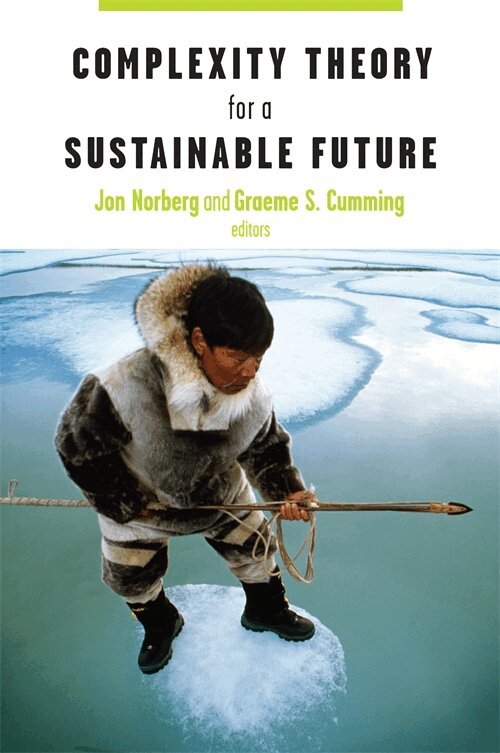
    Complexity Theory for a Sustainable Future

    AvJon Norberg,Graeme Cumming

    Inbunden, Engelska, 2008

    Del i serien Complexity in Ecological Systems

    1 107 kr

    Beställningsvara. Skickas inom 5-8 vardagar. Fri frakt över 249 kr.

    Fler format och utgåvor

    Häftad

    698 kr

    Beskrivning

    Complexity theory illuminates the many interactions between natural and social systems, providing a better understanding of the general principles that can help solve some of today's most pressing environmental issues. Complexity theory was developed from key ideas in economics, physics, biology, and the social sciences and contributes to important new concepts for approaching issues of environmental sustainability such as resilience, scaling, and networks. Complexity Theory for a Sustainable Future is a hands-on treatment of this exciting new body of work and its applications, bridging the gap between theoretical and applied perspectives in the management of complex adaptive systems. Focusing primarily on natural resource management and community-based conservation, the book features contributions by leading scholars in the field, many of whom are among the leaders of the Resilience Alliance. Theoreticians will find a valuable synthesis of new ideas on resilience, sustainability, asymmetries, information processing, scaling, and networks.Managers and policymakers will benefit from the application of these ideas to practical approaches and empirical studies linked to social-ecological systems. Chapters present new twists on such existing approaches as scenario planning, scaling analyses, and adaptive management, and the book concludes with recommendations on how to manage natural resources, how to involve stakeholders in the dynamics of a system, and how to explain the difficult topic of scale. A vital reference for an emerging discipline, this volume provides a clearer understanding of the conditions required for systems self-organization, since the capacity of any system to self-organize is crucial for its sustainability over time.

    Produktinformation

    • Utgivningsdatum:2008-07-11
    • Mått:152 x 229 x undefined mm
    • Format:Inbunden
    • Språk:Engelska
    • Serie:Complexity in Ecological Systems
    • Antal sidor:312
    • Förlag:Columbia University Press
    • ISBN:9780231134606

    Utforska kategorier

    • Biovetenskap inom Naturvetenskap och teknik

    Mer om författaren

    Jon Norberg is assistant professor of systems ecology at Stockholm University and is affiliated as a researcher with the Stockholm Resilience Center. Coming from a background in ecology, Norberg has become more transdisciplinary, studying the role of social phenomena such as information sharing and trust building for resource management. He completed his post-doc at Princeton University with Simon Levin and has been a long term participant in the resilience alliance. Graeme S. Cumming is Pola Pasvolsky Chair in Conservation Biology at the University of Cape Town. He runs a wide-ranging research program that focuses on the broad-scale spatial and temporal dynamics of ecological communities and ecosystems, with particular interests in conservation, resilience, and sustainability.

    Innehållsförteckning

    • Preface Introduction, by Jon Norberg and Graeme S. Cumming Part 1: Diversity and Heterogeneity Introduction 1. Environmental Asymmetries, by Graeme S. Cumming, Grenville Barnes, and Jane Southworth 2. Diversity and Resilience of Social-Ecological Systems, by Jon Norberg, James Wilson, Brian Walker, and Elinor Ostrom Part 2: Networks Introduction 3. A Network Perspective on Modularity and Control of Flow in Robust Systems, by Colleen Webb and Orjan Bodin 4: Social Networks as Sources of Resilience in Social-Ecological Systems, by Thomas Hahn, Lisen Schultz, Carl Folke, and Per Olsson Part 3: Information Processing Introduction 5. Theoretical Challenges: Information Processing and Navigation in Social-Ecological Systems, by John M. Anderies and Jon Norberg 6. Regime Shifts, Environmental Signals, Uncertainty, and Policy Choice, by William A. Brock, Stephen R. Carpenter, and Marten Scheffer Part 4: Practical Approaches Introduction 7. Participation in Building Scenarios of Regional Development, by Louis Lebel and Elena Bennett 8. Practicing Adaptive Management in Complex Social-Ecological Systems, by Lance Gunderson, Garry Peterson, and C. S. Holling 9. Scale and Complex Systems, by Graeme Cumming and Jon Norberg Complexity Theory for a Sustainable Future: Conclusions and Outlook, by Jon Norberg and Graeme Cumming Index