

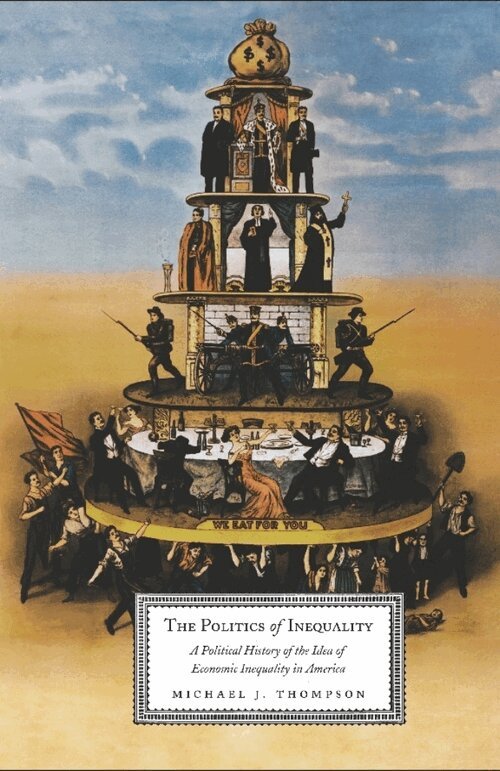
Politics of Inequality
A Political History of the Idea of Economic Inequality in America
Häftad, Engelska, 2012
277 kr
Beställningsvara. Skickas inom 5-8 vardagar. Fri frakt över 249 kr.
Fler format och utgåvor
Beskrivning
Since the early days of the American republic, political thinkers have maintained that a grossly unequal division of property, wealth, and power would lead to the erosion of democratic life. Yet over the past thirty-five years, neoconservatives and neoliberals alike have redrawn the tenets of American liberalism. Nowhere is this more evident than in our current mainstream political discourse, in which the politics of economic inequality are rarely discussed. In this impassioned book, Michael J. Thompson reaches back into America's rich intellectual history to reclaim the politics of inequality from the distortion of recent American conservatism. He begins by tracing the development of the idea of economic inequality as it has been conceived by political thinkers throughout American history. Then he considers the change in ideas and values that have led to the acceptance and occasional legitimization of economic divisions. Thompson argues that American liberalism has made a profound departure from its original practice of egalitarian critique. It has all but abandoned its antihierarchical and antiaristocratic discourse.Only by resuscitating this tradition can democracy again become meaningful to Americans. The intellectuals who pioneered egalitarian thinking in America believed political and social relations should be free from all forms of domination, servitude, and dependency. They wished to expose the antidemocratic character of economic life under capitalism and hoped to prevent the kind of inequalities that compromise human dignity and freedom-the core principles of early American politics. In their wisdom is a much broader, more compelling view of democratic life and community than we have today, and with this book, Thompson eloquently and adamantly fights to recover this crucial strand of political thought. In this impassioned book, Michael J. Thompson reaches back into America's rich intellectual history to reclaim the politics of inequality from the distortion of recent American conservatism. He begins by tracing the development of the idea of economic inequality as it has been conceived by political thinkers throughout American history. Then he considers the change in ideas and values that have led to the acceptance and occasional legitimization of economic divisions.Thompson argues that American liberalism has made a profound departure from its original practice of egalitarian critique; it has all but abandoned its antihierarchical and antiaristocratic discourse. Only by resuscitating this tradition can democracy again become meaningful to Americans. The intellectuals who pioneered egalitarian thinking in America believed political and social relations should be free from all forms of domination, servitude, and dependency. They wished to expose the antidemocratic character of economic life under capitalism and hoped to prevent the kind of inequalities that compromise human dignity and freedom-the core principles of early American politics. In their wisdom is a much broader, more compelling view of democratic life and community than we have today, and with this book, Thompson eloquently and adamantly fights to recover this crucial strand of political thought.
Produktinformation
Utforska kategorier
Mer om författaren
Recensioner i media
Innehållsförteckning
Hoppa över listan







Mer från samma författare
A New History of Spanish Writing, 1939 to the 1990s
Chris Perriam, Michael Thompson, Susan Frenk, Vanessa Knights
Inbunden, 2000
2 956 kr
A New History of Spanish Writing, 1939 to the 1990s
Chris Perriam, Michael Thompson, Susan Frenk, Vanessa Knights
Häftad, 2000
473 kr
Speaking of Boys: Answers to the Most-Asked Questions about Raising Sons
Michael Thompson, Teresa Barker
Häftad, 2000
208 kr
Hoppa över listan








Du kanske också är intresserad av
- Nyhet
- Signerad!
- Signerad!
Del 3
- Nyhet
Del 11
- -21%
- -30%
- -19%
- Nyhet
- Nyhet