• Fri frakt över 249 kr
  • •
  • Snabba leveranser
  • •
  • Billiga böcker
Kundservice

Du är på sajten för privatpersoner.

Företag, bibliotek eller offentlig verksamhet?

Du handlar på classic.bokus.com, där alla dina funktioner finns intakta.
Till classic.bokus.com
Bokus logotyp. Gå till startsidan.
  • Erbjudanden
  • Student
  • Topplistor
  • Barn & ungdom
  • Bokus Play
  • E-böcker
  • Ljudböcker
  • Pocketböcker
  • Spel & pussel

Upp till 25% på utvalda nyheter →

Sidfot

Mina sidor

    Hjälp

    • Kundservice
    • Vanliga frågor och svar
    • Frakt och leverans
    • Retur vid ångerrätt
    • Reklamera vara
    • Betalning
    • Köpvillkor
    • Allmänna villkor
    • Information om webbplatsens tillgänglighet

    Om Bokus

    • Om oss
    • Pressrum
    • För studenter
    • För företag
    • För bibliotek och offentlig verksamhet
    • För leverantörer
    • Hållbarhet

    Populärt

    • Aktuella erbjudanden
    • Presentkort
    • Studentlitteratur
    • Nya böcker
    • Topplistor
    • Signerade böcker
    • Engelska böcker

    Inspiration

    • Boktips
    • BookTok
    • Populära bokserier
    • Barnbokskaraktärer
    • Populära författare
    Logotyp för Bokus
    Följ oss på Facebook (extern länk)Följ oss på Instagram (extern länk)Följ oss på YouTube (extern länk)Följ oss på TikTok (extern länk)
    bokus @ CookiesAnpassa cookiesIntegritetspolicyKöpvillkor
    Till Citymail hemsida (extern länk)Till Budbee hemsida (extern länk)Till Postnord hemsida (extern länk)Till Schenker hemsida (extern länk)Till Early Bird hemsida (extern länk)Till Walleys hemsida (extern länk)
    1. Filosofi och religion
    2. Filosofi
    3. Filosofiska discipliner

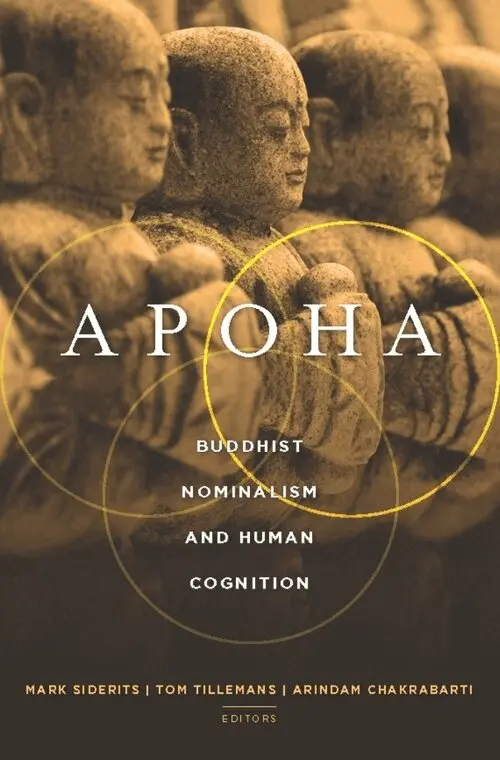
    Apoha

    Buddhist Nominalism and Human Cognition

    AvMark Siderits,Tom Tillemans

    Inbunden, Engelska, 2011

    982 kr

    Tillfälligt slut

    Beskrivning

    When we understand that something is a pot, is it because of one property that all pots share? This seems unlikely, but without this common essence, it is difficult to see how we could teach someone to use the word "pot" or to see something as a pot. The Buddhist apoha theory tries to resolve this dilemma, first, by rejecting properties such as "potness" and, then, by claiming that the element uniting all pots is their very difference from all non-pots. In other words, when we seek out a pot, we select an object that is not a non-pot, and we repeat this practice with all other items and expressions. Writing from the vantage points of history, philosophy, and cognitive science, the contributors to this volume clarify the nominalist apoha theory and explore the relationship between apoha and the scientific study of human cognition. They engage throughout in a lively debate over the theory's legitimacy. Classical Indian philosophers challenged the apoha theory's legitimacy, believing instead in the existence of enduring essences. Seeking to settle this controversy, essays explore whether apoha offers new and workable solutions to problems in the scientific study of human cognition.They show that the work of generations of Indian philosophers can add much toward the resolution of persistent conundrums in analytic philosophy and cognitive science.

    Produktinformation

    • Utgivningsdatum:2011-09-13
    • Mått:152 x 229 x undefined mm
    • Format:Inbunden
    • Språk:Engelska
    • Antal sidor:344
    • Förlag:Columbia University Press
    • ISBN:9780231153607

    Utforska kategorier

    • Filosofiska discipliner inom Filosofi och religion

    Mer om författaren

    Mark Siderits is professor of philosophy at Seoul National University and the author of Indian Philosophy of Language, Personal Identity and Buddhist Philosophy, and Buddhism as Philosophy. Tom Tillemans is professor of Buddhist studies at the University of Lausanne, Switzerland. His books include Scripture, Logic, Language: Essays on Dharmakirti and His Tibetan Successors.Arindam Chakrabarti is professor of philosophy at the University of Hawai'i. He is the author of Denying Existence: The Logic, Epistemology, and Pragmatics of Negative Existentials and Fictional Discourse.

    Recensioner i media

    This is a landmark work in apoha theory and Indian epistemology and logic. The most distinguished contemporary scholars in this field have collaborated on a set of essays notable not only for their philological erudition and philosophical acuity but also for the fact that they engage one another so productively. Together they illuminate this topic more than any previous scholarship. Essential reading. -- Jay Garfield, author of Pointing at the Moon: Buddhism, Logic, Analytic Philosophy This volume hugely advances our understanding of one of the most complex and elusive doctrines of the Indo-Tibetan Buddhist tradition while at the same time giving contemporary philosophers and cognitive scientists some novel resources for thinking through basic problems in the understanding of language and cognition. These essays represent not only exemplary philological interpretations of Sanskrit and Tibetan philosophical texts but also venturesome and philosophically sophisticated attempts to understand what this first-millennium doctrine might teach us today. This collection is sure to be a touchstone for future work in several fields, including Buddhist philosophy, the philosophy of language and philosophy of mind, and studies in Buddhism and cognitive science. -- Dan Arnold, author of Buddhists, Brahmins, and Belief: Epistemology in South Asian Philosophy of Religion A generous addition to the field of Buddhist logic and epistemology as well as a brilliant exemplar of the virtues and incalculable value of rigorous scholarly discourse... South method and impeccable style. Philosophy East and West Every entry shows an impressive degree of scholarship and sophistication in thinking, and all the entries are well written. Journal of American Oriental Society

    Innehållsförteckning

    • Preface Introduction, by Arindam Chakrabarti and Mark Siderits 1. How to Talk About Ineffable Things: Dignaga and Dharmakirti on Apoha, by Tom Tillemans 2. Dignaga's Apoha Theory: Its Presuppositions and Main Theoretical Implications, by Ole Pind 3. Key Features of Dharmakirti's Apoha Theory, by John D. Dunne 4. Dharmakirti's Discussion of Circularity, by Pascale Hugon 5. Apoha Theory as an Approach to Understanding Human Cognition, by Shoryu Katsura 6. The Apoha Theory as Referred to in the Nyayamanjari, by Masaaki Hattori 7. Constructing the Content of Awareness Events, by Parimal G. Patil 8. The Apoha Theory of Meaning: A Critical Account, by Prabal Kumar Sen 9. Apoha as a Naturalized Account of Concept Formation, by Georges Dreyfus 10. Apoha, Feature-Placing, and Sensory Content, by Jonardon Ganeri 11. Funes and Categorization in an Abstraction-Free World, by Amita Chatterjee 12. Apoha Semantics: Some Simpleminded Questions and Doubts, by Bob Hale 13. Classical Semantics and Apoha Semantics, by Brendan S. Gillon 14. Srughna by Dusk, by Mark Siderits Bibliography List of Contributors Index