• Fri frakt över 249 kr
  • •
  • Snabba leveranser
  • •
  • Billiga böcker
Kundservice

Du är på sajten för privatpersoner.

Företag, bibliotek eller offentlig verksamhet?

Du handlar på classic.bokus.com, där alla dina funktioner finns intakta.
Till classic.bokus.com
Bokus logotyp. Gå till startsidan.
  • Erbjudanden
  • Student
  • Topplistor
  • Barn & ungdom
  • Bokus Play
  • E-böcker
  • Ljudböcker
  • Pocketböcker
  • Spel och pussel

5% studentrabatt – använd koden KURSBOK27 →

Sidfot

Mina sidor

    Hjälp

    • Kundservice
    • Vanliga frågor och svar
    • Frakt och leverans
    • Retur vid ångerrätt
    • Reklamera vara
    • Betalning
    • Köpvillkor
    • Allmänna villkor
    • Information om webbplatsens tillgänglighet

    Om Bokus

    • Om oss
    • Pressrum
    • För studenter
    • För företag
    • För bibliotek och offentlig verksamhet
    • För leverantörer
    • Hållbarhet

    Populärt

    • Aktuella erbjudanden
    • Presentkort
    • Studentlitteratur
    • Nya böcker
    • Topplistor
    • Signerade böcker
    • Engelska böcker

    Inspiration

    • Boktips
    • BookTok
    • Barnbokskaraktärer
    • Populära författare
    Logotyp för Bokus
    Följ oss på Facebook (extern länk)Följ oss på Instagram (extern länk)Följ oss på YouTube (extern länk)Följ oss på TikTok (extern länk)
    bokus @ CookiesAnpassa cookiesIntegritetspolicyKöpvillkor
    Till Citymail hemsida (extern länk)Till Budbee hemsida (extern länk)Till Postnord hemsida (extern länk)Till Schenker hemsida (extern länk)Till Early Bird hemsida (extern länk)Till Walleys hemsida (extern länk)
    1. Språk och ordböcker
    2. Språkundervisning och språkinlärning

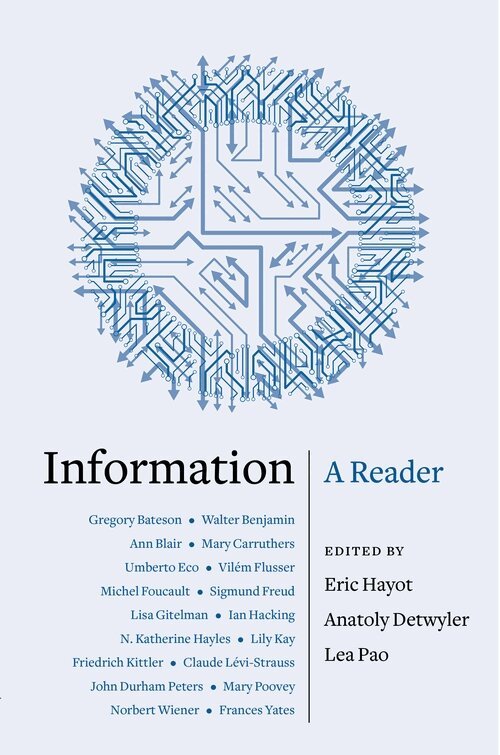
    Information

    A Reader

    AvEric Hayot,Lea Pao

    Inbunden, Engelska, 2021

    1 505 kr

    Beställningsvara. Skickas inom 5-8 vardagar. Fri frakt över 249 kr.

    Beskrivning

    For decades, we have been told we live in the “information age”—a time when disruptive technological advancement has reshaped the categories and social uses of knowledge and when quantitative assessment is increasingly privileged. Such methodologies and concepts of information are usually considered the provenance of the natural and social sciences, which present them as politically and philosophically neutral. Yet the humanities should and do play an important role in interpreting and critiquing the historical, cultural, and conceptual nature of information.This book is one of two companion volumes that explore theories and histories of information from a humanistic perspective. They consider information as a long-standing feature of social, cultural, and conceptual management, a matter of social practice, and a fundamental challenge for the humanities today.Information: A Reader provides an introduction to the concept of information in historical, literary, and cultural studies. It features excerpts from more than forty texts by theorists and critics—including Walter Benjamin, Umberto Eco, Lisa Gitelman, Ian Hacking, N. Katherine Hayles, Friedrich Kittler, and Norbert Wiener—who have helped establish the notion of the “information age” or expand upon it. The reader establishes a canonical framework for thinking about information in humanistic terms. Together with Information: Keywords, it sets forth a major humanistic vision of the concept of information.

    Produktinformation

    • Utgivningsdatum:2021-11-30
    • Mått:156 x 235 x 31 mm
    • Vikt:796 g
    • Format:Inbunden
    • Språk:Engelska
    • Antal sidor:408
    • Förlag:Columbia University Press
    • ISBN:9780231186209

    Utforska kategorier

    • Språkundervisning och språkinlärning inom Språk och ordböcker
    • Litteraturteori inom Skönlitteratur
    • Referensverk och tvärvetenskap inom Samhälle och politik

    Mer om författaren

    Eric Hayot is distinguished professor of comparative literature and Asian studies at the Pennsylvania State University.Anatoly Detwyler is assistant professor of modern Chinese literature at the University of Wisconsin-Madison.Lea Pao is assistant professor of German studies at Stanford University.

    Recensioner i media

    Information: A Reader is a compelling read both for those familiar with the concept of information and those new to the field. Keen editorial intelligence suffuses each section and selection of the anthology, along with generous, insightful commentaries that reframe our understandings of these foundational texts. I found myself reading the book from cover to cover, revising my understanding of what I thought were familiar writings and happily surprised by textual juxtapositions that manifest the secret history of information.

    Innehållsförteckning

    • An IntroductionThe Shannon Knot1. Claude Shannon, from A Mathematical Theory of Communication (1948)2. Norbert Wiener, from Cybernetics; or, Control and Communication in the Animal and the Machine (1948)3. Harold Garfinkel, from Toward a Sociological Theory of Information (1952)4. Donald MacKay, from “The Place of ‘Meaning’ in the Theory of Information” (1955)5. Claude Shannon, “The Bandwagon” (1956)6. Gregory Bateson, from “The Cybernetics of ‘Self ’: A Theory of Alcoholism” (1972)7. John Durham Peters, from “Information: Notes Toward a Critical History” (1988)8. N. Katherine Hayles, from “Contesting for the Body of Information: The Macy Conferences on Cybernetics” (1999)9. Peter Janich, from What Is Information? (2006)10. Matthieu Triclot, from The Cybernetic Moment (2008)Order, Number1. Michel Foucault, from The Order of Things: An Archaeology of the Human Sciences (1966)2. Mary Poovey, from A History of the Modern Fact: Problems of Knowledge in the Sciences of Wealth and Society (1998)3. Ian Hacking, from The Taming of Chance (1990)4. Thomas Richards, from The Imperial Archive: Knowledge and the Fantasy of Empire (1994)5. Friedrich Hayek, from “The Use of Knowledge in Society” (1945)6. Claude Lévi-Strauss, from “The Mathematics of Man” (1954)7. Lily Kay, from Who Wrote the Book of Life? A History of the Genetic Code (2000)The Work of Art1. Martin Heidegger, from “The Origin of the Work of Art” (1950)2. Walter Benjamin, from “The Storyteller: Reflections on the Works of Nikolai Leskov” (1936)3. Yuri M. Lotman, “The Future for Structural Poetics” (1979)4. Abraham Moles, from Information Theory and Esthetic Perception (1958)5. Haroldo De Campos, from “The Informational Temperature of the Text” (1960)6. Umberto Eco, from The Open Work (1962)7. William R. Paulson, from The Noise of Culture: Literary Texts in a World of Information (1988)Media Ecologies1. Frances Yates, from The Art of Memory (1966)2. Mary J. Carruthers, from “Ars oblivionalis, ars inveniendi: The Cherub Figure and the Arts of Memory” (2009)3. Michael E. Hobart and Zachary S. Schiffman, from Information Ages: Literacy, Numeracy, and the Computer Revolution (1998)4. Walter Ong, from Orality and Literacy: The Technologizing of the Word (1982)5. Sigmund Freud, from “A Note Upon the ‘Mystic Writing-Pad’ ” (1925)6. Vannevar Bush, from “As We May Think” (1945)7. Marshall McLuhan, from Understanding Media: The Extensions of Man (1964)8. Friedrich Kittler, from “There Is No Software” (1993)9. Vilém Flusser, from Form and Material (1993) and Recoding (1987)10. Lisa Gitelman, from Paper Knowledge: Toward a Media History of Documents (2014)Informed Society1. James Beniger, from The Control Revolution: Technological and Economic Origins of the Information Society (1986)2. Yoneji Masuda, from The Information Society as Post-Industrial Society (1981)3 Paul Virilio, from The Information Bomb (1999)4. C. A. Bayly, from Empire and Information: Intelligence Gathering and Social Communication in India, 1780–1870 (1996)5. Mary Elizabeth Berry, from Japan in Print: Information and Nation in the Early Modern Period (2006)6. Ann Blair, from Too Much to Know: Managing Scholarly Information Before the Modern Age (2010)7. Elias Muhanna, from “Why Was the Fourteenth Century a Century of Arabic Encyclopaedism?” (2013)8. Steven Marks, from The Information Nexus: Global Capitalism from the Renaissance to the Present (2016)AcknowledgmentsIndex