• Fri frakt över 249 kr
  • •
  • Snabba leveranser
  • •
  • Billiga böcker
Kundservice

Du är på sajten för privatpersoner.

Företag, bibliotek eller offentlig verksamhet?

Du handlar på classic.bokus.com, där alla dina funktioner finns intakta.
Till classic.bokus.com
Bokus logotyp. Gå till startsidan.
  • Erbjudanden
  • Nyheter
  • Student
  • Topplistor
  • Barn & ungdom
  • Bokus Play
  • E-böcker
  • Pocketböcker
  • Spel & pussel

Må bättre, för mindre! Upp till 50% rabatt på hälsoböcker

Sidfot

Mina sidor

    Hjälp

    • Kundservice
    • Vanliga frågor och svar
    • Frakt och leverans
    • Retur vid ångerrätt
    • Reklamera vara
    • Betalning
    • Köpvillkor
    • Allmänna villkor
    • Information om webbplatsens tillgänglighet

    Om Bokus

    • Om oss
    • Pressrum
    • För studenter
    • För företag
    • För bibliotek och offentlig verksamhet
    • För leverantörer
    • Hållbarhet

    Populärt

    • Aktuella erbjudanden
    • Presentkort
    • Studentlitteratur
    • Nya böcker
    • Topplistor
    • Signerade böcker
    • Engelska böcker

    Inspiration

    • Boktips
    • BookTok
    • Populära bokserier
    • Barnbokskaraktärer
    • Populära författare
    Logotyp för Bokus
    Följ oss på Facebook (extern länk)Följ oss på Instagram (extern länk)Följ oss på YouTube (extern länk)Följ oss på TikTok (extern länk)
    bokus @ CookiesAnpassa cookiesIntegritetspolicyKöpvillkor
    Till Citymail hemsida (extern länk)Till Budbee hemsida (extern länk)Till Postnord hemsida (extern länk)Till Schenker hemsida (extern länk)Till Early Bird hemsida (extern länk)Till Walleys hemsida (extern länk)
    1. Historia och arkeologi
    2. Historia
    3. Historia: särskilda händelser och ämnen

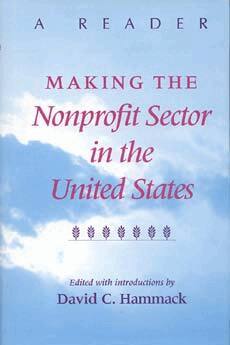
    Making the Nonprofit Sector in the United States

    A Reader

    AvDavid C. Hammack

    Häftad, Engelska, 2000

    Del i serien Indiana University Press

    279 kr

    Beställningsvara. Skickas inom 10-15 vardagar. Fri frakt över 249 kr.

    Beskrivning

    "It is a delight to seen an anthology on nonprofit history done so well."—Barry Karl, John F. Kennedy School of Government, Harvard University"This is a volume that everyone concerned about nonprofits—scholar, practitioner, and citizen—will find useful and illuminating."—Peter Dobkin Hall, Program on Non-Profit OrganizationsYale Divinity School"A remarkable book."—Robert Putnam, John F. Kennedy School of Government, Harvard University[One to come from John Simon, School of Law, Yale University by Jan. 13th and others are being solicited.] Unique among nations, America conducts almost all of its formally organized religious activity, and many cultural, arts, human service, educational, and research activities through private nonprofit organizations. Though partially funded by government, as well as by fees and donations, American nonprofits have pursued their missions with considerable independence. Many have amassed remarkable resources and acquired some of the most impressive hospital, university, performing arts, and museum facilities in the world. While some have amassed large endowments, many that surpass one billion dollars, there are also hundreds of thousands of small nonprofits, most with no tangible resources at all. How did the United States come to rely so heavily on nonprofits? Why has it continued to do so? What purposes do Americans seek to advance through nonprofits? How have Americans sought to control them? How have nonprofits been effected by the growth of government in the twentieth century? These questions suggest the complexity of the history of nonprofits in the United States. To help explore that history, this reader presents some of the classic documents in the development of the nonprofit sector along with important interpretations by recent scholars. The selections can be considered a representative part of a single extended conversation by the men and women who have taken part in the effort to define America and the American dream, even as they shaped what we now call the nonprofit sector. The statements by participants in the growth and development of the nonprofit sector are accompanied by essays written by historians and social scientists that provide concise surveys of important issues and periods. The essays give voice to those whose contributions to the American debate about voluntary associations and private institutions would otherwise be difficult to find or comprehend.The selections can be considered a representative part of a single extended conversation by the men and women who have taken part in the effort to define America and the American dream, even as they shaped what we now call the nonprofit sector. The statements by participants in the growth and development of the nonprofit sector are accompanied by essays written by historians and social scientists that provide concise surveys of important issues and periods. The essays give voice to those whose contributions to the American debate about voluntary associations and private institutions would otherwise be difficult to find or comprehend. Each selection has been chosen to define or illuminate important questions in the development of the nonprofit sector in the United States. Many include criticisms of particular nonprofit efforts, or of nonprofit activity in general. The intention is to provoke thought, not to establish an official list of readings. Though not every point of view could be included, the reader does reflect a general understanding of the nature of the nonprofit sector and its significance in the development of the United States. Philanthropic Studies—Dwight F. Burlingame and David C. Hammack, general editors

    Produktinformation

    • Utgivningsdatum:2000-06-22
    • Mått:156 x 235 x 26 mm
    • Vikt:712 g
    • Format:Häftad
    • Språk:Engelska
    • Serie:Indiana University Press
    • Antal sidor:504
    • Förlag:Indiana University Press
    • ISBN:9780253214102

    Utforska kategorier

    • Historia: särskilda händelser och ämnen inom Historia och arkeologi
    • Socialt arbete och välfärd inom Samhälle och politik

    Mer om författaren

    DAVID C. HAMMACK is Hiram C. Haydn Professor of History and Chair of the Committee on Educational Programs of the Mandel Center for Nonprofit Organizations at Case Western Reserve University. Previously he taught in the City University of New York and at Princeton University. Hammack has held a Guggenheim Fellowship and was a Resident Fellow at the Russell Sage Foundation. His research has also been supported by grants from the American Council of Learned Societies and the Aspen Institute Nonprofit Sector Research Fund. He is the author of Power and Society: Greater New York at the Turn of the Century and Social Science in the Making: Essays on the Russell Sage Foundation, 1907-1972, and editor with Dennis Young, of Nonprofit Organizations in Market Economy.

    Recensioner i media

    "This is a volume that everyone concerned about nonprofits--scholar, practitioner, and citizen--will find useful and illuminating." --ARNOVA News "What David C. Hammack conveys most vividly in his new book is how deeply the roots of the nonprofit sector are intertwined with this nation's earliest history and with its most fundamental political principles." --Museum News "A remarkable book."--Robert Putnam, John F. Kennedy School of Government, Harvard University

    Innehållsförteckning

    • Introduction: Growth of the Nonprofit Sector in the United StatesI. British and Colonial PatternsOne. Colonial Theory: Established Churches1. Statute of Charitable Uses2. Elizabethan Poor Law3. Brother Juan deEscalona, Report to the Viceroy of Mexico on Conditions at Santa Fe, 16014. John Winthrop, Model of Christian Charity5. Virginia General Assembly, Laws Regulating Conduct and Religion6. Hugh Peter and Thomas Weld, New England's First Fruits7. Claude Jean Allouz, S.J., Account of the Ceremony Proclaiming New FranceTwo. Colonial Reality: Religious Diversity8. Inhabitants of Flushing, Long Island, Remonstrance against the Law against Quakers9. Roger Greene, Virginia's Cure10. William Penn, Great Case of Liberty of Conscience11. Cotton Mather, Bonifacius: Essays to Do Good12. William Livingston, Argument against Anglican Control of King's College13. Charles Woodmason, Journal of the Carolina Backcountry14. Benjamin Franklin, Autobiography: Recollections of Institution-BuildingII. American Revolution: Sources of the Nonprofit SectorThree. To the Constitution: Limited Government and Disestablishment15. John Trenchard and Thomas Gordon, Cato's Letters: Arguments against a Strong Central Government16. Isaac Backus, Argument against Taxes for Religious Purposes in Massachusetts17. Thomas Jefferson, Virginia Act Establishing Religious Freedom18. James Madison, Federalist, No. 1019. Constitution of the United States, excerpts, and The First and Tenth AmendmentsFour. Voluntarism under the Constitution20. Lyman Beecher, Autobiographical Statement on the 1818 Disestablishment of the "Standing Order" in Connecticut21. The Dartmouth College Case: Daniel Webster, Argument before the U.S. Supreme Court; Chief Justice John Marshall, Decision, and Joseph Story, Concurring Opinion22. Alexis de Tocqueville, Political Associations in the United States, and Of the Use Which Americans Make of Public Associations in Civil SocietyIII. Uses of Nonprofit OrganizationsFive. Varieties of Religious Nonprofits23. Organized Activity among Slaves: Henry Bibb, Suppression of Religion among Slaves, and Daniel A. Payne, Account of Slave Preachers24. Robert Baird, Voluntary Principle in American Christianity25. Peter Dobkin Hall, Institutions, Autonomy, and National Networks26. Jay P. Dolan, Social Catholicism27. Arthur A. Goren, Jewish Tradition of CommunitySix. Nonprofit Organizations as Alternative Power Structures28. Suzanne Lebsock, Women Together: Organizations in Antebellum Petersburg, Va.29. Kathleen D. McCarthy, Parallel Power Structures: Women and the Voluntary Sphere30. W.E.B. DuBois, Cooperation Among Negro AmericansIV. Nonprofit Structures for the Twentieth CenturySeven. Science, Professionalism, Foundations, Federations31. Debate over Government Subsidies: Amos G. Warner, Argument against Public Subsidies to American Charities, and Everett P. Wheeler, Unofficial Government of Cities32. David Rosner, Business at the Bedside: Health Care in Brooklyn, 1890-191533. Frederick T. Gates, Address on the Tenth Anniversary of the Rockefeller Institute34. David C. Hammack, Community Foundations: The Delicate Question of Purpose35. John R. Seeley et al., Community Chest36. David L. Sills, March of Dimes: Origins and ProspectsEight. Federal Regulation and Federal Funds37. Pierce v. Society of the Sisters: William D. Guthrie and Bernard Hershkopf, Brief for Private Schools, and Justice McReynolds, Decision of the U.S. Supreme Court38. Debate over a Nonprofit Organization in Mississippi: Senator John Stennis and Attorney Marian Wright, Testimony on the Child Development Group of Mississippi and the Head Start Program39. Filer Commission, The Third Sector40. Steven Rathgeb Smith and Michael Lipsky, Political Economy of Nonprofit Revenues41. Rust v. Sullivan: Chief Justice William Rehnquist, Decision of the U.S. Supreme CourtIndex