• Fri frakt över 249 kr
  • •
  • Snabba leveranser
  • •
  • Billiga böcker
Kundservice

Du är på sajten för privatpersoner.

Företag, bibliotek eller offentlig verksamhet?

Du handlar på classic.bokus.com, där alla dina funktioner finns intakta.
Till classic.bokus.com
Bokus logotyp. Gå till startsidan.
  • Erbjudanden
  • Nyheter
  • Student
  • Topplistor
  • Barn & ungdom
  • Bokus Play
  • E-böcker
  • Pocketböcker
  • Spel & pussel

10% rabatt på allt med kod: NYSTART10 →

Sidfot

Mina sidor

    Hjälp

    • Kundservice
    • Vanliga frågor och svar
    • Frakt och leverans
    • Retur vid ångerrätt
    • Reklamera vara
    • Betalning
    • Köpvillkor
    • Allmänna villkor
    • Information om webbplatsens tillgänglighet

    Om Bokus

    • Om oss
    • Pressrum
    • För studenter
    • För företag
    • För bibliotek och offentlig verksamhet
    • För leverantörer
    • Hållbarhet

    Populärt

    • Aktuella erbjudanden
    • Presentkort
    • Studentlitteratur
    • Nya böcker
    • Topplistor
    • Signerade böcker
    • Engelska böcker

    Inspiration

    • Boktips
    • BookTok
    • Populära bokserier
    • Barnbokskaraktärer
    • Populära författare
    Logotyp för Bokus
    Följ oss på Facebook (extern länk)Följ oss på Instagram (extern länk)Följ oss på YouTube (extern länk)Följ oss på TikTok (extern länk)
    bokus @ CookiesAnpassa cookiesIntegritetspolicyKöpvillkor
    Till Citymail hemsida (extern länk)Till Budbee hemsida (extern länk)Till Postnord hemsida (extern länk)Till Schenker hemsida (extern länk)Till Early Bird hemsida (extern länk)Till Walleys hemsida (extern länk)
    1. Samhälle och politik
    2. Samhälle och kultur
    3. Kultur och medier
    4. Referensverk och tvärvetenskap

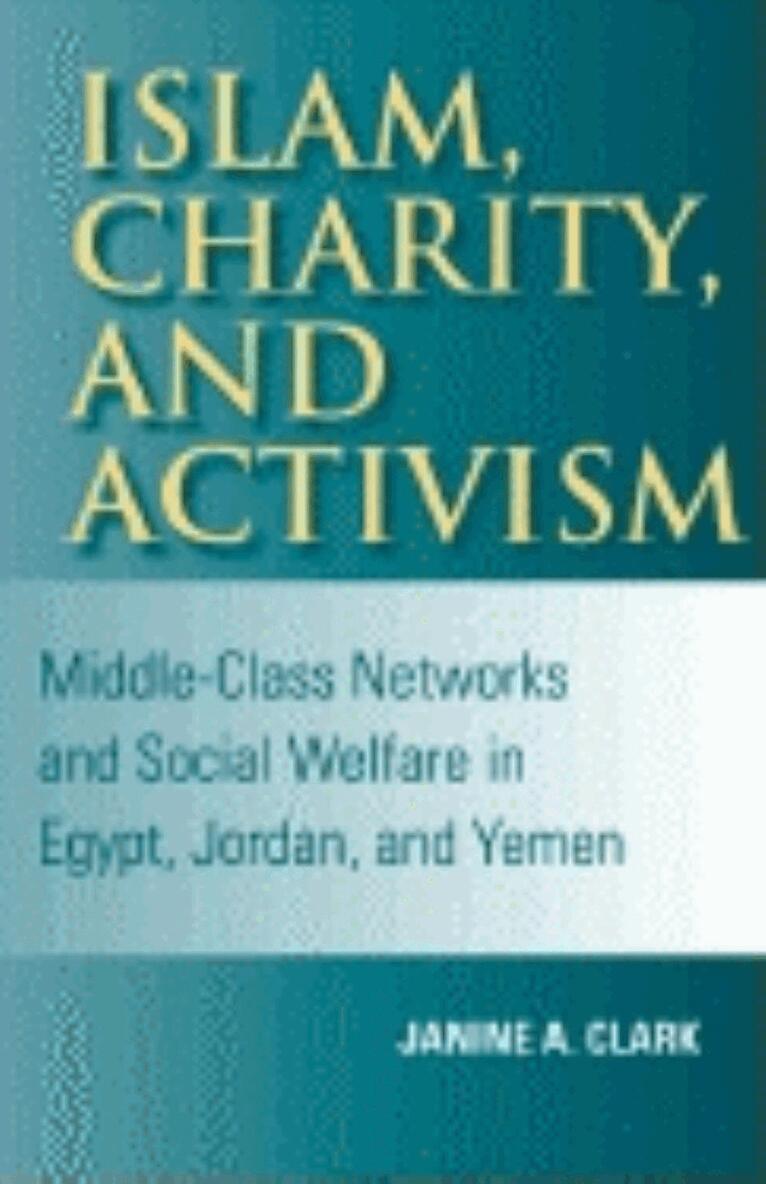
    Islam, Charity, and Activism

    Middle-Class Networks and Social Welfare in Egypt, Jordan, and Yemen

    AvJanine A. Clark,Mark Tessler

    Häftad, Engelska, 2004

    Del i serien Middle East Studies

    257 kr

    Beställningsvara. Skickas inom 10-15 vardagar. Fri frakt över 249 kr.

    Beskrivning

    Throughout the Middle East, Islamist charities and social welfare organizations play a major role in addressing the socioeconomic needs of Muslim societies, independently of the state. Through case studies of Islamic medical clinics in Egypt, the Islamic Center Charity Society in Jordan, and the Islah Women's Charitable Society in Yemen, Janine A. Clark examines the structure and dynamics of moderate Islamic institutions and their social and political impact. Questioning the widespread assumption that such organizations primarily serve the poorer classes, Clark argues that these organizations in fact are run by and for the middle class. Rather than the vertical recruitment or mobilization of the poor that they are often presumed to promote, Islamic social institutions play an important role in strengthening social networks that bind middle-class professionals, volunteers, and clients. Ties of solidarity that develop along these horizontal lines foster the development of new social networks and the diffusion of new ideas.

    Produktinformation

    • Utgivningsdatum:2004-01-01
    • Mått:156 x 235 x 14 mm
    • Vikt:408 g
    • Format:Häftad
    • Språk:Engelska
    • Serie:Middle East Studies
    • Antal sidor:256
    • Förlag:Indiana University Press
    • ISBN:9780253216267

    Utforska kategorier

    • Referensverk och tvärvetenskap inom Samhälle och politik
    • Islam inom Filosofi och religion
    • Socialt arbete och välfärd inom Samhälle och politik

    Mer om författaren

    Janine A. Clark is Associate Professor of Political Science at the University of Guelph and co-editor (with Remonda Bensabat-Kleinberg) of Economic Liberalization, Democratization, and Civil Society in the Developing World.

    Recensioner i media

    "Much of the literature on Islamic Social Institutions (ISIs) has argued that these institutions are recruiting grounds for the poor. Clark (Univ. of Guelph, Ca.), through case studies of ISIs in Egypt, Yemen, and Jordan takes this notion to task. She argues that the vertical networks (i.e. across classes) created through ISIs are weak, that the important social networks are the horizontal ones within the middle class, and that this is in keeping with social movement theories. In addition, she demonstrates how a strategy of solidifying middle class networks,one that is demanded by the operational needs of ISIs, may actually work to discredit Islamic movements that support these ISIs in the long run. Finally, she argues that ISIs do not necessarily seek radical transformation of society and that there is nothing obviously Islamic in their provision of services. Her argument is clear and easy to follow, and the case studies are rich with supportive data. However, in some respects, the case study of the Islah Charitable Society in Yemen, differs from the others and raises questions about her contentions, particularly about the Islamic nature of ISI activities. Summing Up: Recommended. Advanced—level undergraduates and graduates, specifically those interested in civil society in the region and Islamism."—F. J. Adely, Columbia University, Choice, July 2004"Much of the literature on Islamic Social Institutions (ISIs) has argued that these institutions are recruiting grounds for the poor. Clark (Univ. of Guelph, Ca.), through case studies of ISIs in Egypt, Yemen, and Jordan takes this notion to task. . . . Her argument is clear and easy to follow, and the case studies are rich with supportive data. . . . Recommended. July 2004"—Choice

    Innehållsförteckning

    • Preliminary Table of Contents: List of Tables and ChartsPreface and Acknowledgments1. Islamic Social Institutions, Social Movement Theory, and the Middle Classes2. Islamic Medical Clinics in Egypt: The Operational Imperatives of ISIs and the Role of Middle Class Networks3. The Islamic Center Charity Society in Jordan: The Benefits to the Middle Class4. The Islah Charitable Society in Yemen: Women's Social Networks, Charity and Da'wa5. The Significance of Being Middle ClassNotesBibliographyIndex