• Fri frakt över 249 kr
  • •
  • Snabba leveranser
  • •
  • Billiga böcker
Kundservice

Du är på sajten för privatpersoner.

Företag, bibliotek eller offentlig verksamhet?

Du handlar på classic.bokus.com, där alla dina funktioner finns intakta.
Till classic.bokus.com
Bokus logotyp. Gå till startsidan.
  • Erbjudanden
  • Nyheter
  • Student
  • Topplistor
  • Barn & ungdom
  • Bokus Play
  • E-böcker
  • Pocketböcker
  • Spel & pussel

10% rabatt på allt med kod: NYSTART10 →

Sidfot

Mina sidor

    Hjälp

    • Kundservice
    • Vanliga frågor och svar
    • Frakt och leverans
    • Retur vid ångerrätt
    • Reklamera vara
    • Betalning
    • Köpvillkor
    • Allmänna villkor
    • Information om webbplatsens tillgänglighet

    Om Bokus

    • Om oss
    • Pressrum
    • För studenter
    • För företag
    • För bibliotek och offentlig verksamhet
    • För leverantörer
    • Hållbarhet

    Populärt

    • Aktuella erbjudanden
    • Presentkort
    • Studentlitteratur
    • Nya böcker
    • Topplistor
    • Signerade böcker
    • Engelska böcker

    Inspiration

    • Boktips
    • BookTok
    • Populära bokserier
    • Barnbokskaraktärer
    • Populära författare
    Logotyp för Bokus
    Följ oss på Facebook (extern länk)Följ oss på Instagram (extern länk)Följ oss på YouTube (extern länk)Följ oss på TikTok (extern länk)
    bokus @ CookiesAnpassa cookiesIntegritetspolicyKöpvillkor
    Till Citymail hemsida (extern länk)Till Budbee hemsida (extern länk)Till Postnord hemsida (extern länk)Till Schenker hemsida (extern länk)Till Early Bird hemsida (extern länk)Till Walleys hemsida (extern länk)
    1. Samhälle och politik
    2. Samhälle och kultur
    3. Sociala grupper och identitet
    4. Genusvetenskap

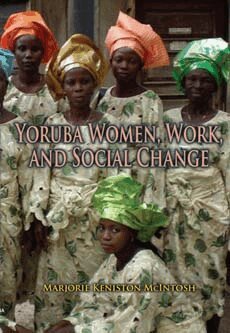
    Yoruba Women, Work, and Social Change

    AvMarjorie Keniston McIntosh,Marjorie K. McIntosh

    Häftad, Engelska, 2009

    Del i serien Indiana University Press (IPS)

    294 kr

    Beställningsvara. Skickas inom 5-8 vardagar. Fri frakt över 249 kr.

    Beskrivning

    The Yoruba, one of the largest and most historically important ethnic groups in Nigeria, are noted for the economic activity, confidence, and authority of their women. Yoruba Women, Work, and Social Change traces the history of women in Yorubaland from around 1820 to 1960 and Nigerian independence. Integrating fresh material from local court records and four decades of existing scholarship, Marjorie Keniston McIntosh shows how and why women's roles and status changed during the 19th century and the colonial era. McIntosh emphasizes connections between their duties within the household, their income-generating work, and their responsibilities in religious, cultural, social, and political contexts. She highlights the forms of patriarchy found within Yorubaland and explores the impact of Christianity, colonialism, and international capitalism. This keen and insightful work offers a unique view of Yoruba women's initiative, adaptability, and skill at working in groups.

    Produktinformation

    • Utgivningsdatum:2009-03-18
    • Mått:156 x 235 x 18 mm
    • Vikt:499 g
    • Format:Häftad
    • Språk:Engelska
    • Serie:Indiana University Press (IPS)
    • Antal sidor:352
    • Förlag:Indiana University Press
    • ISBN:9780253220547

    Utforska kategorier

    • Genusvetenskap inom Samhälle och politik
    • Etnicitet inom Samhälle och politik

    Mer om författaren

    Marjorie Keniston McIntosh is Distinguished Professor of History Emerita at the University of Colorado, Boulder. Her work on Africa includes Women, Work, and Domestic Virtue in Uganda, 1900–2003, written with Grace Bantebya Kyomuhendo, which received the 2007 Aidoo-Snyder Prize awarded by the Women's Caucus of the African Studies Association. She is also author of Working Women in English Society, 1300–1620 and Controlling Misbehavior in England,1370–1600.

    Recensioner i media

    "Clearly written and cogently argued, this book is the first comprehensive survey of Yoruba women's lives from the precolonial period until independence. The period 1820-1960 was one of fundamental political, economic, and social change, during which the Yoruba of southwestern Nigeria selectively adopted foreign ideas, customs, and technologies and adapted them to their own needs. Focusing on marriage, motherhood, economic and political activities, and religious roles, McIntosh (emer., Univ. of Colorado, Boulder) shows how Yoruba women resisted detrimental practices and took advantage of new openings in economic, educational, and legal realms. Her study is nuanced and textured, making distinctions between women of different regions and socioeconomic backgrounds, and between those practicing Islam, Christianity, and indigenous religions. Women's agency is a major focal point. McIntosh's wide-ranging sources include the writings of 19th-century travelers, missionaries, and Western-educated Yoruba elites, oral histories and interviews, local newspapers, photographs, and native court records. The latter are particularly revealing in terms of women's voices and perspectives. A major contribution to Nigerian and African women's history, this book should be included in all college and university libraries. Summing Up: Highly recommended. Upper-division undergraduates and above. —Choice"—E. S. Schmidt, Loyola University Maryland, September 2009". . . well researched and based on a vast array of sources, such as missionary accounts, records of native courts, British colonial office documents, newspapers, diaries, letters, and financial accounts of Yoruba women as well as oral histories and interviews. The work is nicely written, clearly discussing the author's themes of gender and patriarchy, women and colonialism, and female agency in Yorubaland. It is a welcome addition to texts on gender history in Africa as well as West African history.April 2009"—Cyrelene Amoah, Southern Illinois University"This book is recommended for courses in African women's history, African history, and Gender and Women's Studies courses. It is well-researched and documented and it covers a span of history that is invaluable to the broader understanding of Nigeria in general and the Yoruba in particular before, during, and after colonial rule. The book is well-written and organised and would interest readers who are new to African studies or African women's history."—Feminist Africa"Yoruba Women is valuable as a reflection of the state of knowledge on the Yoruba and as the benchmark from which the future of Yoruba studies can proceed. It will be well referred to for a long time."—Journal of African History"McIntosh's approach makes her book a valuable addition to introductory and survey courses of Africa. Volume 73/3, 2010"—Bulletin of the School of Oriental and African Studies"[T]his comprehensively researched and compellingly rendered study is sure to be valued by Africanists and will prove of considerable interest to non-Africanists concerned with its themes. June 2010"—American Historical Review"Yoruba Women, Work, and Social Change provides an excellent overview of Yoruba history and culture as well as illuminating descriptions of the activities of Yoruba women . . . it is an essential place to start for anyone interested in the history and culture of Yoruba women in south-western Nigeria. Its descriptive nature, chronological organisation, and flowing prose make this work highly accessible . . . .Vol. 34.1 March 2010"—Ann Genova, Roanoke College"[This] book provides highly interesting insights into Yoruba history and culture, including the effects of slave trade and colonialism, the arrival of Islam and Christianity, changes through the introduction of British legal system, and Western schooling. . . . a good read for anybody interested in African culture, history, or women's roles.#41 April 2009"—MISSIOLOGY: Intnl Review"Clearly written and cogently argued, this book is the first comprehensive survey of Yoruba women's lives from the precolonial period until independence. . . . A major contribution to Nigerian and African women's history, this book should be included in all college and university libraries. . . . Highly recommended.September 2009"—Choice"An important contribution to knowledge about women and the relations of gender in Yorubaland and other African societies."—Philomena Okek-Ihejirika, University of Alberta, Edmonton"Based on a careful reading of the existing scholarship on Yoruba women, this will be an important text for scholars in Yoruba studies, African studies, and especially women's and gender studies."—Judith Byfield, Cornell University

    Innehållsförteckning

    • ContentsPreface and AcknowledgmentsNote on Language and OrthographyAbbreviations, Terms, and ExplanationsPart 1. Introduction1. Opening2. Sources and QuestionsPart 2. The Context of Women's Lives3. Yorubaland, 1820–18934. Colonial Yorubaland, 1893–19605. Family and MarriagePart 3. Women's Economic Activities6. Labor, Property, and Agriculture7. Income-Generating Activities in the Nineteenth Century8. New Approaches to Familiar Roles during the Colonial Period9. Western Skills and Service CareersPart 4. Other Public Roles and Broader Issues10. Religion, Cultural Forms, and Associations11. Regents and Chiefs, Economic Organizations, and Politics12. Patriarchy, Colonialism, and Women's AgencyGlossary of Yoruba WordsNotesList of ReferencesIndex