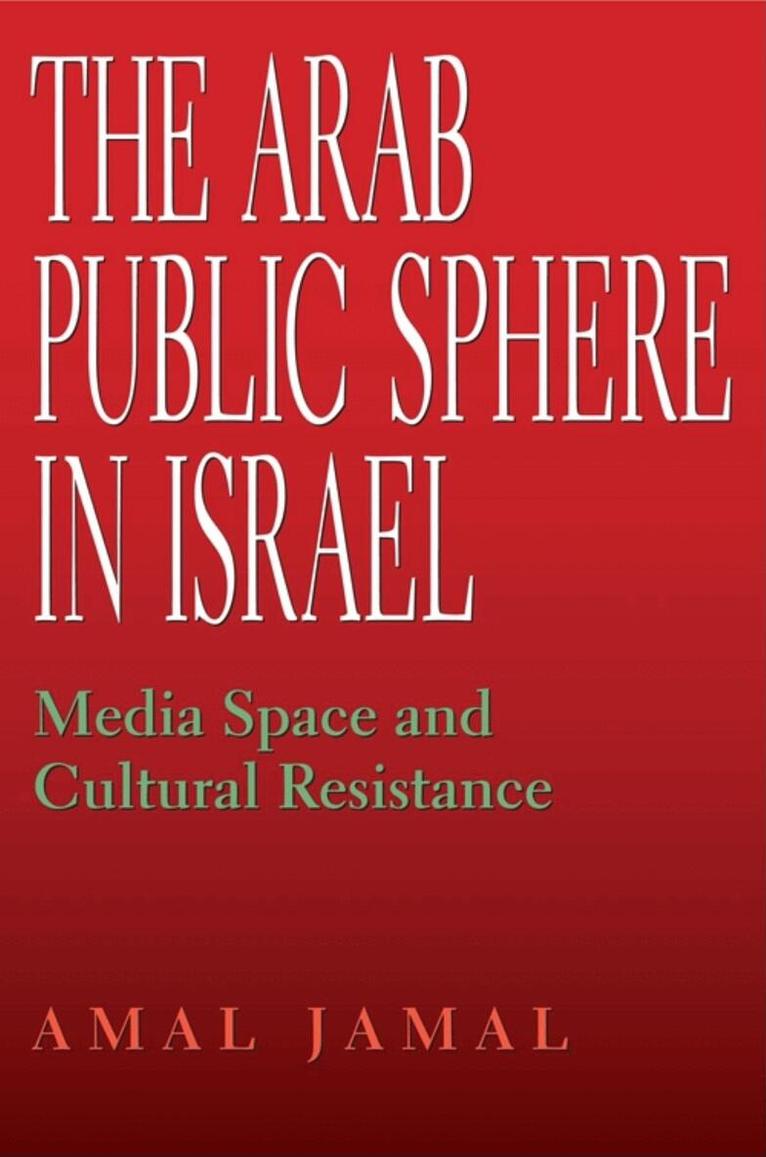
Arab Public Sphere in Israel
Media Space and Cultural Resistance
271 kr
Beställningsvara. Skickas inom 5-8 vardagar. Fri frakt över 249 kr.
Du är på sajten för privatpersoner.
271 kr
Beställningsvara. Skickas inom 5-8 vardagar. Fri frakt över 249 kr.
Amal Jamal is Senior Lecturer and Chair of the Department of Political Science at Tel Aviv University. He is author of The Palestinian National Movement: Politics of Contention, 1967–2005 (IUP, 2005) and Media Politics and Democracy in Palestine: Political Culture, Pluralism, and the Palestinian Authority.
"The growth of media technologies in the Arab world has generated scholarship concerned with how developments in the media sector impact political, social, and cultural patterns in the region. Jamal's contribution to this scholarship is excellent because he uses changes in the media sector to illuminate key questions about state-minority relations and media consumption in the Arab world. In focusing on the communicative and media-consumption behavior of Palestinian citizens of Israel, Jamal (political science, Tel Aviv Univ.) demonstrates how minorities negotiate power relations and confront political exclusion. Arab media in Israel has always been subject to state censorship. However, with the advent of new technologies and the liberalization of Israeli press laws in the 1990s, which led to growth in both the Hebrew and Arabic presses, the Palestinian citizens of Israel have displayed media-consumption patterns that traverse both their Israeli reality and their wider Arab cultural world. Thus, this minority community has developed a 'double consciousness,' reflecting connections to both the Arab and Israeli public spheres. Jamal's book provides an excellent and engaging account of how this community negotiates these two spheres and how it exercises agency through its communicative behavior. Summing Up: Highly recommended. Lower-division undergraduates through faculty. — Choice"—S. N. Abboud, Susquehanna University, April 2010"The author . . . through this highly readable historical and empirical study, has advanced the definition of the nature of the public sphere in Israel.Volume 29, No. 1, 2010"—Communication Research Trends"The Arab Public Sphere in Israel is an important book. It focuses on an almost invisible minoirty, the Arab citizens of Israel, and offers an unprecedented account—indeed, a historical benchmark—of media production and consumption among them. Vol. 28, 2011"—Political Communication"[A] compelling account that deftly mixes historical, theoretical, and empirical approaches, creating a multidimensional study that should be of interest to both scholars of the region and those concerned with minority media practice across the globe."—Cinema Journal"This study is of vital importance to scholars interested in Israeli media, Palestinians inside Israel, the far-reaching and diverse impact of Arab satellite news, and minorities' patterns of media consumption, especially in situations in which they are in conflict with state authorities.August 2011"—INTNL JRNL MID EAST STD - IJMES"An acute and sensitive account of how Palestinian Arabs' use of and access to media within Israel and in wider Arab space has evolved. There is no study of comparable quality for any other Arab country."—Dale F. Eickelman, Dartmouth College
Justin Gengler
Inbunden, 2015
866 kr
Justin Gengler
Häftad, 2015
336 kr
Du är på sajten för privatpersoner.
271 kr
Beställningsvara. Skickas inom 5-8 vardagar. Fri frakt över 249 kr.
Amal Jamal is Senior Lecturer and Chair of the Department of Political Science at Tel Aviv University. He is author of The Palestinian National Movement: Politics of Contention, 1967–2005 (IUP, 2005) and Media Politics and Democracy in Palestine: Political Culture, Pluralism, and the Palestinian Authority.
"The growth of media technologies in the Arab world has generated scholarship concerned with how developments in the media sector impact political, social, and cultural patterns in the region. Jamal's contribution to this scholarship is excellent because he uses changes in the media sector to illuminate key questions about state-minority relations and media consumption in the Arab world. In focusing on the communicative and media-consumption behavior of Palestinian citizens of Israel, Jamal (political science, Tel Aviv Univ.) demonstrates how minorities negotiate power relations and confront political exclusion. Arab media in Israel has always been subject to state censorship. However, with the advent of new technologies and the liberalization of Israeli press laws in the 1990s, which led to growth in both the Hebrew and Arabic presses, the Palestinian citizens of Israel have displayed media-consumption patterns that traverse both their Israeli reality and their wider Arab cultural world. Thus, this minority community has developed a 'double consciousness,' reflecting connections to both the Arab and Israeli public spheres. Jamal's book provides an excellent and engaging account of how this community negotiates these two spheres and how it exercises agency through its communicative behavior. Summing Up: Highly recommended. Lower-division undergraduates through faculty. — Choice"—S. N. Abboud, Susquehanna University, April 2010"The author . . . through this highly readable historical and empirical study, has advanced the definition of the nature of the public sphere in Israel.Volume 29, No. 1, 2010"—Communication Research Trends"The Arab Public Sphere in Israel is an important book. It focuses on an almost invisible minoirty, the Arab citizens of Israel, and offers an unprecedented account—indeed, a historical benchmark—of media production and consumption among them. Vol. 28, 2011"—Political Communication"[A] compelling account that deftly mixes historical, theoretical, and empirical approaches, creating a multidimensional study that should be of interest to both scholars of the region and those concerned with minority media practice across the globe."—Cinema Journal"This study is of vital importance to scholars interested in Israeli media, Palestinians inside Israel, the far-reaching and diverse impact of Arab satellite news, and minorities' patterns of media consumption, especially in situations in which they are in conflict with state authorities.August 2011"—INTNL JRNL MID EAST STD - IJMES"An acute and sensitive account of how Palestinian Arabs' use of and access to media within Israel and in wider Arab space has evolved. There is no study of comparable quality for any other Arab country."—Dale F. Eickelman, Dartmouth College
Justin Gengler
Inbunden, 2015
866 kr
Justin Gengler
Häftad, 2015
336 kr