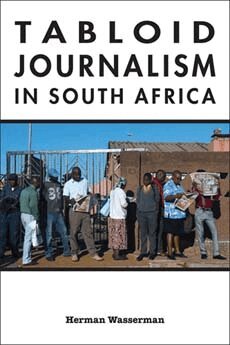
Tabloid Journalism in South Africa
True Story!
260 kr
Beställningsvara. Skickas inom 5-8 vardagar. Fri frakt över 249 kr.
Beskrivning
Produktinformation
- Utgivningsdatum:2010-05-31
- Mått:152 x 229 x 24 mm
- Vikt:363 g
- Format:Häftad
- Språk:Engelska
- Serie:African Expressive Cultures
- Antal sidor:240
- Förlag:Indiana University Press
- ISBN:9780253222114
Utforska kategorier
Mer om författaren
Herman Wasserman is Professor in Journalism and Media/Cultural Studies at Rhodes University in South Africa. He is co-editor of At the End of the Rainbow: Power, Politics, and Identity in the Post-Apartheid South African Media and editor of Ecquid Novi: African Journalism Studies.
Recensioner i media
"Wasserman's sound research and keen analysis make this book valuable as a sociological source on race and ethnicity in South Africa, as well as a resource on communication and journalism. Studying the tiers of racial communication in a country emerging from decades of apartheid, Wasserman (Univ. of Sheffield, UK, and Univ. of Stellenbosch, South Africa) includes insights into political strife on the African continent in general and how that strife correlates with a high illiteracy rate among the indigenous population. One gains understanding of the status and value of tabloid papers in the recently democratized country, and also of their connection to the marginalized black majority. The author addresses the question of whether tabloids are a lesser form of journalism and argues convincingly that they are not, at least in South Africa. Wasserman's close study and comparison of the various styles in, and changes to, newspapers in general expand the volume's usefulness to those interested in print journalism in the 21st century generally. And his discussion of various well-known newspapers and formats provides solid journalistic background for those interested in international communication trends. An excellent study that is easy to read and understand. Summing Up: Highly recommended. Lower-division undergraduates and above. — Choice"—L. D. Talit, Central Connecticut State University, February 2011"Wasserman's engagement with tabloid journalism in South Africa is comprehensive and critical, at all times attentive to detail and provides sound research and well-rounded critical inquiary into the recent rise of tabloids within the post-apartheid media sphere. Anyone who reads this book will be compelled to take South African tabloids seriously, and will be urged to consider the important socio-semiotic work they carry out for their vast numbers of readers today."—Ecquid Novi: African Journalism Studies"This is a thoughtful, refreshing and timely contribution to the South African and international media literature. It attempts to grasp tabloid journalism in all its dimensions: in its blatant commercialism, its social justice implications, its unpalatable eccentricity and sensationalism, its challenge to hierarchies of taste and cultural capital, and its role vis-à-vis the national journalistic field on the one hand and broader society on the other."—Journal of Modern African Studies"Wasserman's sound research and keen analysis make this book valuable as a sociological source on race and ethnicity in South Africa, as well as a resource on communication and journalism. . . . An excellent study that is easy to read and understand. . . . Highly recommended."—Choice"In all, Wasserman makes a convincing case that South African tabloids should not be dismissed as 'trash journalism' but, in the socio-historical context, should be read politically and viewed as part of the local-regional-global dynamic. 32(2)"—Australian Journalism Review"As a whole, Tabloid Journalism in South Africa is a must read for media historians, journalists, and perhpas just about anyone who is interested in ongoing questions about a post-apartheid South Africa. Wasserman's work deserves great respect for encouraging a localized standpoint of tabloids in South Africa. Perhaps most importantly, Herman Wasserman's work shows that tabloid newspaper readers like Rapabi Boithatelo illuminate the failure of the post-apartheid government and mainstream media in South Africa to address the needs of all citizens."—JHistory"The book makes easy reading . . . [and is] interesting for its novel approach . . . to the examination of tabloid journalism in South Africa.Vol. 32, No. 1, Winter 2011"—Newspaper Research Journal"Convincing, bold, and provocative. The rise of mass circulating tabloids and their popularity with the poor and working class black majority are indicative of a post-apartheid South Africa determined to renegotiate an ethics of inclusion and a common humanity in journalism."—Francis B. Nyamnjoh, University of Cape Town"A much needed media history and political and social assessment of a genre that is currently very much the subject of conjecture."—Sean Jacobs, The New School"Hugely important for students, journalists, scholars, policy-makers, and practitioners. A much needed book that will contribute, both empirically and theoretically, to ongoing debates about popular culture, media globalization, and changing news discourses."—Winston Mano, University of Westminster
Innehållsförteckning
- ContentsAcknowledgments1. Shock! Horror! Scandal! The Tabloid Controversy and Journalism Studies in Post-Apartheid South Africa2. Attack of the Killer Newspapers! Tabloids Arrive in South Africa3. Black and White and Read All Over: Tabloids and the Glocalization of Popular Media4. Not Really Newspapers: Tabloids and the South African Journalistic Paradigm5. The Revolution Will Be Printed: Tabloids, Citizenship, and Democratic Politics in Post-Apartheid South Africa6. Truth or Trash? Understanding Tabloid Journalism and Lived Experience7. Often They Cry with the People: The Professional Identities of Tabloid Journalists8. Conclusion: Telling StoriesNotesReferencesIndex
Du kanske också är intresserad av
Sàngó in Africa and the African Diaspora
Joel E. Tishken, Toyin Falola, Akintunde Akinyemi
Häftad, 2009
326 kr