• Fri frakt över 249 kr
  • •
  • Snabba leveranser
  • •
  • Billiga böcker
Kundservice

Du är på sajten för privatpersoner.

Företag, bibliotek eller offentlig verksamhet?

Du handlar på classic.bokus.com, där alla dina funktioner finns intakta.
Till classic.bokus.com
Bokus logotyp. Gå till startsidan.
  • Erbjudanden
  • Nyheter
  • Student
  • Topplistor
  • Barn & ungdom
  • Bokus Play
  • E-böcker
  • Pocketböcker
  • Spel & pussel

10% rabatt på allt med kod: NYSTART10 →

Sidfot

Mina sidor

    Hjälp

    • Kundservice
    • Vanliga frågor och svar
    • Frakt och leverans
    • Retur vid ångerrätt
    • Reklamera vara
    • Betalning
    • Köpvillkor
    • Allmänna villkor
    • Information om webbplatsens tillgänglighet

    Om Bokus

    • Om oss
    • Pressrum
    • För studenter
    • För företag
    • För bibliotek och offentlig verksamhet
    • För leverantörer
    • Hållbarhet

    Populärt

    • Aktuella erbjudanden
    • Presentkort
    • Studentlitteratur
    • Nya böcker
    • Topplistor
    • Signerade böcker
    • Engelska böcker

    Inspiration

    • Boktips
    • BookTok
    • Populära bokserier
    • Barnbokskaraktärer
    • Populära författare
    Logotyp för Bokus
    Följ oss på Facebook (extern länk)Följ oss på Instagram (extern länk)Följ oss på YouTube (extern länk)Följ oss på TikTok (extern länk)
    bokus @ CookiesAnpassa cookiesIntegritetspolicyKöpvillkor
    Till Citymail hemsida (extern länk)Till Budbee hemsida (extern länk)Till Postnord hemsida (extern länk)Till Schenker hemsida (extern länk)Till Early Bird hemsida (extern länk)Till Walleys hemsida (extern länk)
    1. Samhälle och politik
    2. Samhälle och kultur
    3. Kultur och medier
    4. Referensverk och tvärvetenskap

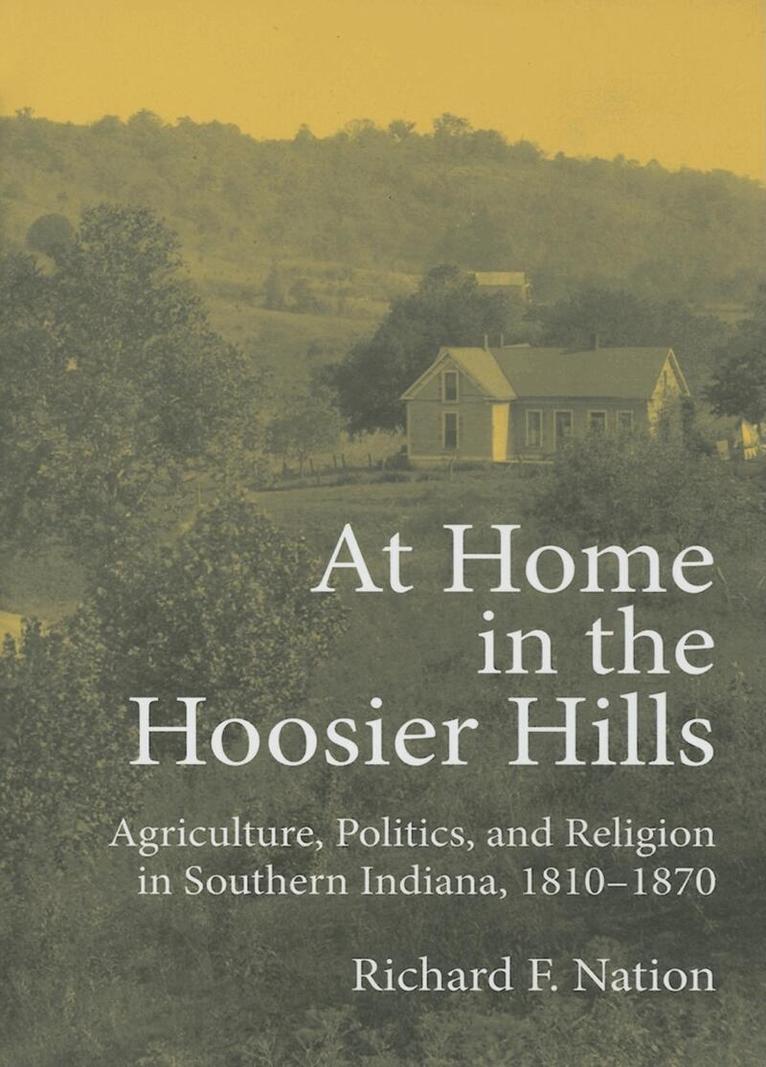
    At Home in the Hoosier Hills

    Agriculture, Politics, and Religion in Southern Indiana, 1810-1870

    AvRichard F. Nation

    Inbunden, Engelska, 2005

    Del i serien Midwestern History and Culture

    407 kr

    Beställningsvara. Skickas inom 10-15 vardagar. Fri frakt över 249 kr.

    Beskrivning

    This book explores the lives and worldviews of Indiana's southern hill-country residents during much of the 19th century. Focusing on local institutions, political, economic, and religious, it gives voice to the plain farmers of the region and reveals the world as they saw it. For them, faith in local institutions reflected a distrust of distant markets and politicians. Localism saw its expression in the Democratic Party's anti-federalist strain, in economic practices such as "safety-first" farming which focused on taking care of the family first, and in non-perfectionist Christianity. Localism was both a means of resisting changes and the basis of a worldview that helped Hoosiers of the hill country negotiate these changes.

    Produktinformation

    • Utgivningsdatum:2005-08-25
    • Mått:156 x 235 x 18 mm
    • Vikt:585 g
    • Format:Inbunden
    • Språk:Engelska
    • Serie:Midwestern History and Culture
    • Antal sidor:288
    • Förlag:Indiana University Press
    • ISBN:9780253345912

    Utforska kategorier

    • Referensverk och tvärvetenskap inom Samhälle och politik
    • Amerikas historia inom Historia och arkeologi

    Mer om författaren

    Richard F. Nation is Assistant Professor of History at Eastern Michigan University.

    Recensioner i media

    "[1]. Important family studies include Anya Jabour, Marriage in the Early Republic: Elizabeth and William Wirt and the Companionate Ideal (Baltimore: Johns Hopkins, 1998); Shawn Johansen, Family Men: Middle—Class Fatherhood in Industrializing America (New York: Routledge, 2001); Steven Mintz and Susan Kellogg, Domestic Revolutions: A Social History of American Family Life (New York: Free Press, 1988). For an overview and assessment of changing family relations in the early republic, with references to early Indiana, see Ginette Aley, Westward Expansion, John Tipton, and the Emergence of the American Midwest, 180"—1839" (Ph.D. diss., Iowa State University, 2005), chapter 5; Ginette Aley, "Grist, Grit, and Rural Society in the Early"As for politics, southern Indiana farmers found support for their vision of egalitarianism and a localist world in the Democratic Party. Here, the multifaceted nature of hill country localism is more clearly identifiable. For example, Nation points out the complexities surrounding the Temperance movement, explaining that the issue went beyond wet versus dry. It was infused not only with moral overtones, but also with economic anxiety when it came down to the potential for lost income in the move to remove whiskey as one way to market corn. In this and other fights, southern Hoosiers sought unremittingly to ensure that localism was maintained (p. 185). Yet, transformative changes were in the offing that would chip away at the power of localism to hold sway over the hill country including the railroad, renewed westward expansion, and, ultimately, the Civil War. Overall, At Home in the Hoosier Hills offers important insight on an overlooked aspect of Indiana and Midwest history and should be read eagerly with this in mind. Indeed Nation's research is admirable, regardless of this reviewer's quarrels with the book's format and some depictions. This volume will be a valuable part of any number of different course reading lists."—Indiana, May 2006"Moreover, scholars would do well to avoid employing phraseology that separates women from being farmers. To say, for example, the farmer and his wife (p. 111) is somewhat sexist and implies that the wife is not a farmer even though her agricultural activities have just been detailed by the author. They are farm people—farm men and farm wome"—or farmers, or husbands and wives. Unfortunately this problematic language is more common in academic scholarshi"More problematic is the treatment of farm women. The field of rural women's history has expanded to include far more insight than is acknowledged here. Can it really be that it was simple materialism and not a sense of accomplishment, farming knowledge, or partnership in the family farming enterprise that actuated women toward market interaction and determined their economic activities? To purchase more cotton goods, Nation states, Hoosier women seem to have shifted the emphasis of their production onto butter and eggs (p. 110, emphasis added). This almost sounds like the pi"—money" justification for women's work in the early twentieth century and sadly overlooks many important studies on rural women. While farm women clearly enjoyed the fruits of the market when they were available, to state that materialism drove their agricultural activity is to deny them a sense of (family) ente"Nation contends that the pursuit and preference of local moral regulation was even more apparent in the hill country's agricultural economy which centered on hog and corn farming. Hoosiers' primary, risk—averse strategy was safet"—first agriculture" in which the family's needs were met first. Surplus produce could be sent to distant markets, although Nation frequently asserts that the hill country "feared" these markets because they were ou"Using land, census, and tax records, several personal accounts, and county sampling, Nation begins by carefully relating the centrality of land to the early Indiana (and Midwest) story. Almost all these early settlers came to farm, he correctly points out (p. 16). Moreover, the communities that developed in the hill country revolved around family farming. In keeping with the study's persistent theme of local governance, Nation casts the family as [h]ighly hierarchical (p. 33), and governed firmly by patriarchy. Yet in doing so he minimizes strong and recent work that has been done on families and family relations during the early republic that reveals, among other things, the extent of post—Revolutionary influences (i.e., egalitarianism) which promoted more flexible gender roles and, certainly, family relations [1]. These are particularly evident in agrarian families. Ohio pioneer William Cooper Howells' own experiences evidence the degree to which domestic and farm chores could be age— and gende"—blind when he wrote: "The rule was, that whoever had the strength to work, took hold and helped."[2]"Nation then moves on to explore the manifestations of localism in the hill country's major institutions, or structures. With regards to religion, the strongest churches were those that granted autonomy to local congregations, in this case the Primitive Baptists and the German Catholics. Both groups revolved around the local congregation, active participation, and doctrinal adherence, with a great distrust of anything that took place outside the scope of their community's authorit"—i.e., missionary activity (p. 38). Men were less likely than wives and mothers to formally join; yet, Nati"With At Home in the Hoosier Hills: Agriculture, Politics, and Religion in Southern Indiana, 1810—1870, Richard F. Nation has added an important level of complexity to the study of Midwestern history. In this tightly focused study, Nation examines the strength and sources of localism in the agrarian hill country of southern Indiana—an ideology that was contrary to the nationalism that was more characteristic of the greater Midwest"—through the Civil War era. The heart of the hill country residents' localism, according to Nation, was their abiding belief that their specific interests were best protected when

    Innehållsförteckning

    • ContentsAcknowledgmentsIntroduction1. The Land and Its Peoples2. Religion and the Localist Ethic3. "Surplus Produce" and Market Exchange4. The Politics of Localism5. Localism, Race, and the Civil WarEpilogueNotesIndex