• Fri frakt över 249 kr
  • •
  • Snabba leveranser
  • •
  • Billiga böcker
Kundservice

Du är på sajten för privatpersoner.

Företag, bibliotek eller offentlig verksamhet?

Du handlar på classic.bokus.com, där alla dina funktioner finns intakta.
Till classic.bokus.com
Bokus logotyp. Gå till startsidan.
  • Erbjudanden
  • Nyheter
  • Student
  • Topplistor
  • Barn & ungdom
  • Bokus Play
  • E-böcker
  • Pocketböcker
  • Spel & pussel

Må bättre, för mindre! Upp till 50% rabatt på hälsoböcker

Sidfot

Mina sidor

    Hjälp

    • Kundservice
    • Vanliga frågor och svar
    • Frakt och leverans
    • Retur vid ångerrätt
    • Reklamera vara
    • Betalning
    • Köpvillkor
    • Allmänna villkor
    • Information om webbplatsens tillgänglighet

    Om Bokus

    • Om oss
    • Pressrum
    • För studenter
    • För företag
    • För bibliotek och offentlig verksamhet
    • För leverantörer
    • Hållbarhet

    Populärt

    • Aktuella erbjudanden
    • Presentkort
    • Studentlitteratur
    • Nya böcker
    • Topplistor
    • Signerade böcker
    • Engelska böcker

    Inspiration

    • Boktips
    • BookTok
    • Populära bokserier
    • Barnbokskaraktärer
    • Populära författare
    Logotyp för Bokus
    Följ oss på Facebook (extern länk)Följ oss på Instagram (extern länk)Följ oss på YouTube (extern länk)Följ oss på TikTok (extern länk)
    bokus @ CookiesAnpassa cookiesIntegritetspolicyKöpvillkor
    Till Citymail hemsida (extern länk)Till Budbee hemsida (extern länk)Till Postnord hemsida (extern länk)Till Schenker hemsida (extern länk)Till Early Bird hemsida (extern länk)Till Walleys hemsida (extern länk)
    1. Kultur
    2. Designböcker
    3. Designhistoria

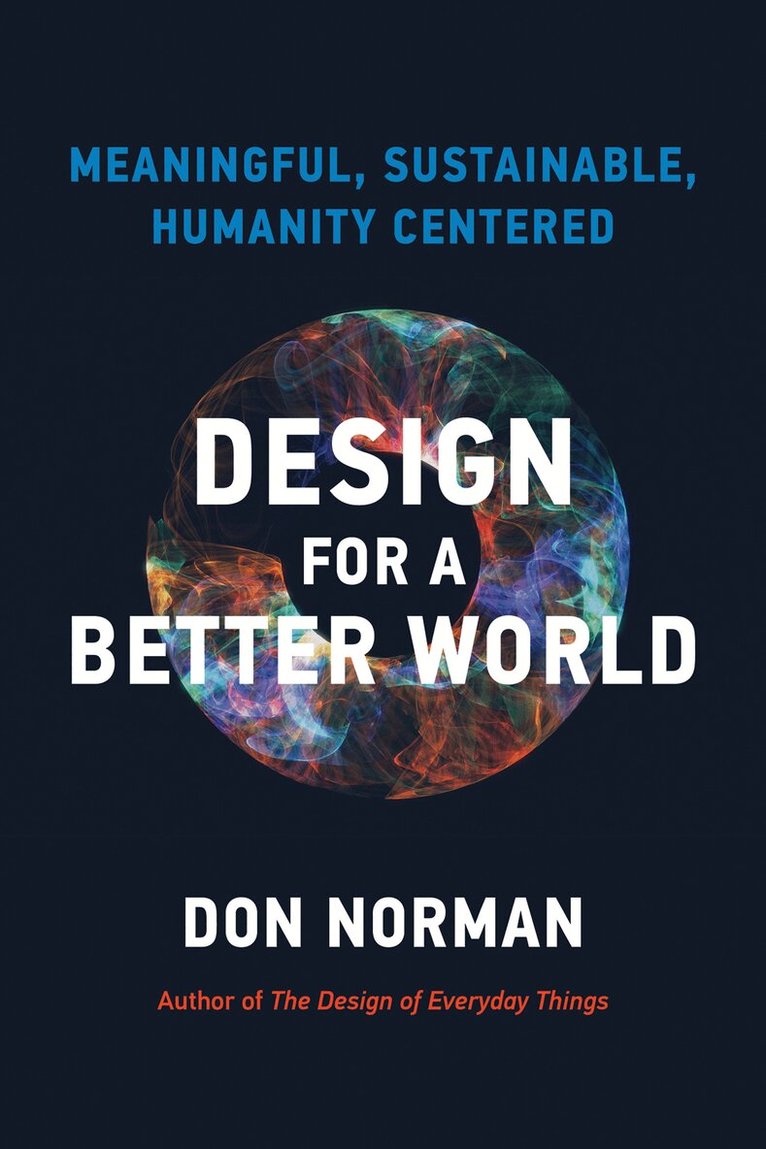
    Design for a Better World

    Meaningful, Sustainable, Humanity Centered

    AvDonald A. Norman

    Häftad, Engelska, 2024

    253 kr

    Skickas . Fri frakt över 249 kr.

    Fler format och utgåvor

    E-bok

    304 kr

    Beskrivning

    How human behavior brought our world to the brink, and how human behavior can save us.The world is a mess. Our dire predicament, from collapsing social structures to the climate crisis, has been millennia in the making and can be traced back to the erroneous belief that the earth's resources are infinite. The key to change, says Don Norman, is human behavior, covered in the book's three major themes: meaning, sustainability, and humanity-centeredness. Emphasize quality of life, not monetary rewards; restructure how we live to better protect the environment; and focus on all of humanity. Design for a Better World presents an eye-opening diagnosis of where we've gone wrong and a clear prescription for making things better.Norman proposes a new way of thinking, one that recognizes our place in a complex global system where even simple behaviors affect the entire world. He identifies the economic metrics that contribute to the harmful effects of commerce and manufacturing and proposes a recalibration of what we consider important in life. His experience as both a scientist and business executive gives him the perspective to show how to make these changes while maintaining a thriving economy. Let the change begin with this book before it's too late.

    Produktinformation

    • Utgivningsdatum:2024-04-02
    • Mått:152 x 229 x 29 mm
    • Vikt:462 g
    • Format:Häftad
    • Språk:Engelska
    • Antal sidor:376
    • Förlag:MIT Press Ltd
    • ISBN:9780262548304

    Utforska kategorier

    • Designhistoria inom Kultur

    Mer om författaren

    Don Norman is Distinguished Professor Emeritus of Cognitive Science and Psychology and founding director of the Design Lab at the University of California, San Diego. Business Week has named Norman one of the world's most influential designers. He was an Apple Vice President, has been an advisor and board member for numerous companies, and has three honorary degrees. His numerous books have been translated into over 20 languages, including The Design of Everyday Things and Living with Complexity, also from the MIT Press.

    Recensioner i media

    "A brave attempt to expand the scope of what one considers the possibility and responsibility of good design.”—Worth"Norman’s book is admirably ambitious."—Fast Company's Co.Design"Don Norman has worked in electrical engineering, cognitive psychology, computer science and design, in academia and industry. Now in his eighties, he draws on this experience to explain how designers, governments and industry must “broaden the notion of design from human centred to humanity centred”. In other words, they must emphasize quality of life, not monetary rewards, and reject harmful economic metrics. Only thus, he argues, will we survive the current environmental and economic crises."—Nature"Norman (founding dir., Design Lab, Univ. of California–San Diego; Living with Complexity) looks out on a world beset by climate change, inequality, and unconscionable waste. Nonetheless, he is optimistic. He believes that humans can change what they’ve created. Design is the key, for it can mobilize systems to address the complex interface that technologies, policies, and people have."—Library Journal"Norman (emer., Univ. of California, San Diego) offers a treatise on sustainable design, positing that too much of the world is designed rather than natural. According to Norman, people are surrounded by artifacts such as homes, clothes, tools, and books. This situation projects backward over millennia to hunting and farming existence. People born into this way of living have difficulty thinking of alternatives. Norman challenges readers to change their way of being, recognizing that people, nature, and the environment are a single complex system in which any change to a part might impact the whole. According to Norman's argument, designed things change the way people behave, act, and live: "we design the world, and it, in turn, designs us" . He calls for a mobilization of the many to change the world into one in which success is measured not in money but in the wellness and happiness of all people. He believes the design profession must be rethought and move toward a circular economy centered on recycling through designing for repair, regeneration, and reuse. Summing Up: Recommended. Upper-division undergraduates. Graduate students and professionals."—CHOICE"Don's Design for a Better World challenges the reader to critically examine the normative existing systems that inform and construct our everyday lives. Through pragmatic explorations, the book uncovers biases within calendar systems, scientific measurements and other constructions that constrain our existence for potential meaningful change. This book is an excellent introduction for those interested in human-centered design, design justice, systems design and the role of design in informing sustainable practices. Don's perspective is refreshing and optimistic, urging everyone to consider dismantling existing systems of power to bring about a 'better world.'"—The Association of Registered Graphic Designers

    Innehållsförteckning

    • TABLE OF CONTENTS...1 Almost Everything Artificial Has Been Designed 32 Our Artificial Way of Life is Unsustainable 113 Why History Matters 154 Precise--but Artificial--Measurements 275 If Technology Got Us into Today's Situation,Maybe Technology Can Can Get Us Out 396 This Book: Meaningful, Sustainable, and Humanity Centered 477 The Need for Meaning 578 Measurement in the Physical Sciences 639 Measuring What is Important to People 6710 The Gross Domestic Product 7911 What Measures Are Truly Important to People? 8712 Human Behavior and Economics 10313 We Live in the Age of Waste 11514 How Did the World Get into Today's Quandary 11915 Sustainability Has Multiple Components and Implications 12516 Design, Products, Sustainability, and the Circular Economy 13117 The Practical Difficulties of Implementing Circular Design 13918 Sustainable, Robust, and Resilient Systems 14719 People's Understanding of Systems 15520 Working with Complex Sociotechnical Systems 16721 It Is Not Too Late 17722 Moving from Humans to Humanity 18123 Democratizing Design and Development 18724 People Designing for Themselves 19525 DesignX: An Approach to Large, Complex Systems 20326 Where Incrementalism (Muddling Through) Fails 20927 Incremental Modular Design 21328 When Large, Multidisciplinary Projects Are Necessary 21729 Dealing with Scale 22530 Design: Necessary but Not Sufficient 23131 Why Change is Difficult 23932 People Will Mobilize for a Common Goal 24933 What Must Change? 25134 The Dominance of Technology 26535 The Future of Technology 27536 What Can Be Done? 28537 What Can We Do? 29138 The Major Points of This Book 301Acknowledgments 311Notes 315Bibliography 335Index 351