
- 10% rabatt på allt

Häftad, Engelska, 2014
269 kr
Skickas
269 kr
Skickas
347 kr
Skickas

188 kr
Skickas
257 kr
Skickas

230 kr
Skickas
222 kr
Skickas

440 kr
Skickas
What does the city's form actually mean to the people who live there? What can the city planner do to make the city's image more vivid and memorable to the city dweller? To answer these questions, Mr. Lynch, supported by studies of Los Angeles, Boston, and Jersey City, formulates a new criterion—imageability—and shows its potential value as a guide for the building and rebuilding of cities. The wide scope of this study leads to an original and vital method for the evaluation of city form. The architect, the planner, and certainly the city dweller will all want to read this book.
1 916 kr
Skickas

248 kr
Skickas
248 kr
Skickas
1 131 kr
Skickas
The goal of machine learning is to program computers to use example data or past experience to solve a given problem. Machine learning underlies such exciting new technologies as self-driving cars, speech recognition, and translation applications. This substantially revised fourth edition of a comprehensive, widely used machine learning textbook offers new coverage of recent advances in the field in both theory and practice, including developments in deep learning and neural networks.
The book covers a broad array of topics not usually included in introductory machine learning texts, including supervised learning, Bayesian decision theory, parametric methods, semiparametric methods, nonparametric methods, multivariate analysis, hidden Markov models, reinforcement learning, kernel machines, graphical models, Bayesian estimation, and statistical testing. The fourth edition offers a new chapter on deep learning that discusses training, regularizing, and structuring deep neural networks such as convolutional and generative adversarial networks; new material in the chapter on reinforcement learning that covers the use of deep networks, the policy gradient methods, and deep reinforcement learning; new material in the chapter on multilayer perceptrons on autoencoders and the word2vec network; and discussion of a popular method of dimensionality reduction, t-SNE. New appendixes offer background material on linear algebra and optimization. End-of-chapter exercises help readers to apply concepts learned. Introduction to Machine Learning can be used in courses for advanced undergraduate and graduate students and as a reference for professionals.

229 kr
Skickas
1 263 kr
Skickas
274 kr
Skickas
600 kr
Skickas

294 kr
Skickas

349 kr
Skickas

399 kr
Skickas inom 3-6 vardagar

219 kr
Skickas
188 kr
Skickas

331 kr
Skickas
363 kr
Skickas

592 kr
Skickas inom 5-8 vardagar
321 kr
Skickas inom 3-6 vardagar
1 262 kr
Skickas
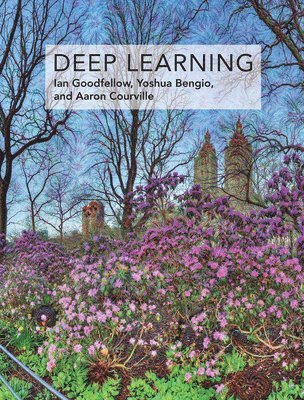
“Written by three experts in the field, Deep Learning is the only comprehensive book on the subject.”—Elon Musk, cochair of OpenAI; cofounder and CEO of Tesla and SpaceX
Deep learning is a form of machine learning that enables computers to learn from experience and understand the world in terms of a hierarchy of concepts. Because the computer gathers knowledge from experience, there is no need for a human computer operator to formally specify all the knowledge that the computer needs. The hierarchy of concepts allows the computer to learn complicated concepts by building them out of simpler ones; a graph of these hierarchies would be many layers deep. This book introduces a broad range of topics in deep learning.
The text offers mathematical and conceptual background, covering relevant concepts in linear algebra, probability theory and information theory, numerical computation, and machine learning. It describes deep learning techniques used by practitioners in industry, including deep feedforward networks, regularization, optimization algorithms, convolutional networks, sequence modeling, and practical methodology; and it surveys such applications as natural language processing, speech recognition, computer vision, online recommendation systems, bioinformatics, and videogames. Finally, the book offers research perspectives, covering such theoretical topics as linear factor models, autoencoders, representation learning, structured probabilistic models, Monte Carlo methods, the partition function, approximate inference, and deep generative models.
Deep Learning can be used by undergraduate or graduate students planning careers in either industry or research, and by software engineers who want to begin using deep learning in their products or platforms. A website offers supplementary material for both readers and instructors.
534 kr
Skickas
264 kr
Skickas
255 kr
Skickas
907 kr
Skickas inom 5-8 vardagar
1 239 kr