• Fri frakt över 249 kr
  • •
  • Snabba leveranser
  • •
  • Billiga böcker
Kundservice

Du är på sajten för privatpersoner.

Företag, bibliotek eller offentlig verksamhet?

Du handlar på classic.bokus.com, där alla dina funktioner finns intakta.
Till classic.bokus.com
Bokus logotyp. Gå till startsidan.
  • Erbjudanden
  • Nyheter
  • Student
  • Topplistor
  • Barn & ungdom
  • Bokus Play
  • E-böcker
  • Pocketböcker
  • Spel & pussel

10% rabatt på allt med kod: NYSTART10 →

Sidfot

Mina sidor

    Hjälp

    • Kundservice
    • Vanliga frågor och svar
    • Frakt och leverans
    • Retur vid ångerrätt
    • Reklamera vara
    • Betalning
    • Köpvillkor
    • Allmänna villkor
    • Information om webbplatsens tillgänglighet

    Om Bokus

    • Om oss
    • Pressrum
    • För studenter
    • För företag
    • För bibliotek och offentlig verksamhet
    • För leverantörer
    • Hållbarhet

    Populärt

    • Aktuella erbjudanden
    • Presentkort
    • Studentlitteratur
    • Nya böcker
    • Topplistor
    • Signerade böcker
    • Engelska böcker

    Inspiration

    • Boktips
    • BookTok
    • Populära bokserier
    • Barnbokskaraktärer
    • Populära författare
    Logotyp för Bokus
    Följ oss på Facebook (extern länk)Följ oss på Instagram (extern länk)Följ oss på YouTube (extern länk)Följ oss på TikTok (extern länk)
    bokus @ CookiesAnpassa cookiesIntegritetspolicyKöpvillkor
    Till Citymail hemsida (extern länk)Till Budbee hemsida (extern länk)Till Postnord hemsida (extern länk)Till Schenker hemsida (extern länk)Till Early Bird hemsida (extern länk)Till Walleys hemsida (extern länk)
    1. Historia och arkeologi
    2. Historia
    3. Europas historia

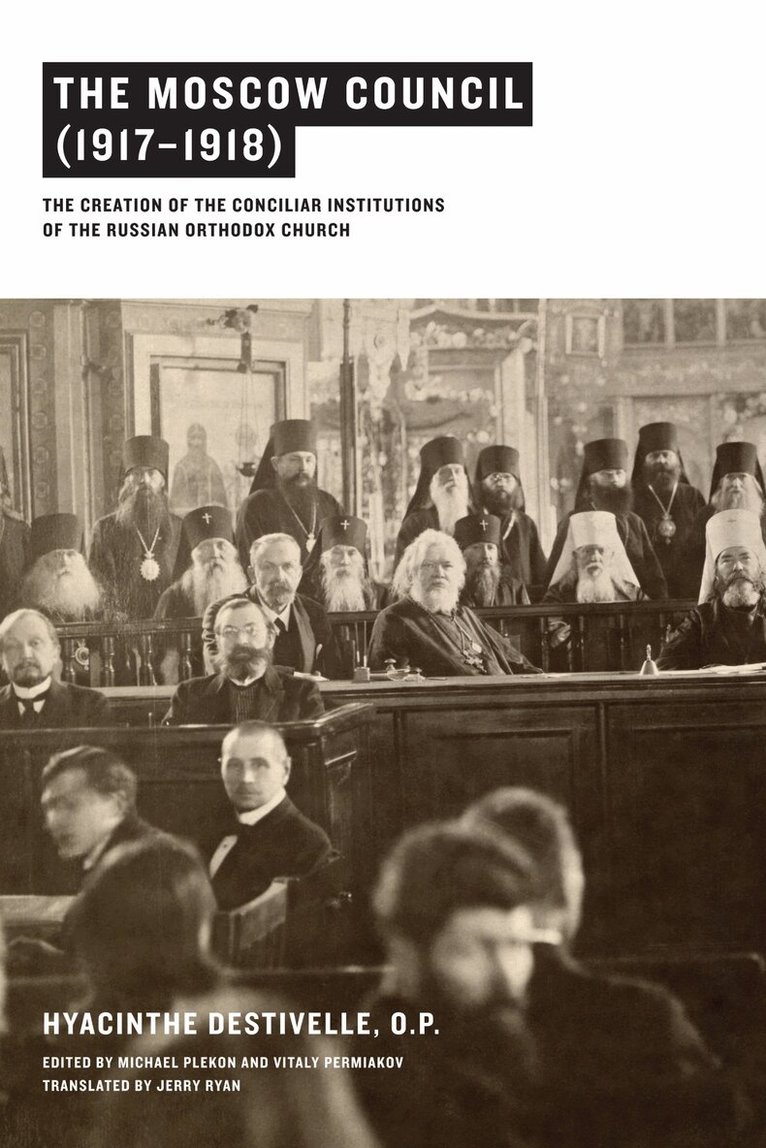
    Moscow Council (1917–1918)

    The Creation of the Conciliar Institutions of the Russian Orthodox Church

    AvHyacinthe Destivelle,Michael Plekon

    Inbunden, Engelska, 2015

    1 071 kr

    Beställningsvara. Skickas inom 5-8 vardagar. Fri frakt över 249 kr.

    Fler format och utgåvor

    Häftad

    408 kr

    Beskrivning

    By the early twentieth century, a genuine renaissance of religious thought and a desire for ecclesial reform were emerging in the Russian Orthodox Church. With the end of tsarist rule and widespread dissatisfaction with government control of all aspects of church life, conditions were ripe for the Moscow Council of 1917-1918 to come into being.The council was a major event in the history of the Orthodox Church. After years of struggle for reform against political and ecclesiastical resistance, the bishops, clergy, monastics, and laity who formed the Moscow Council were able to listen to one other and make sweeping decisions intended to renew the Russian Orthodox Church. Council members sought change in every imaginable area—from seminaries and monasteries, to parishes and schools, to the place of women in church life and governance. Like Vatican II, the Moscow Council emphasized the mission of the church in and to the world.Destivelle's study not only discusses the council and its resolutions but also provides the historical, political, social, and cultural context that preceded the council. In the only comprehensive and probing account of the council, he discusses its procedures and achievements, augmented by substantial appendices of translated conciliar documents.Tragically, due to the Revolution, the council's decisions could not be implemented to the extent its members hoped. Despite current trends in the Russian church away from the Moscow Council's vision, the council's accomplishments remain as models for renewal in the Eastern churches.

    Produktinformation

    • Utgivningsdatum:2015-05-30
    • Mått:152 x 229 x 25 mm
    • Vikt:823 g
    • Format:Inbunden
    • Språk:Engelska
    • Antal sidor:466
    • Förlag:University of Notre Dame Press
    • ISBN:9780268063399
    • Översättare:Jerry Ryan

    Utforska kategorier

    • Europas historia inom Historia och arkeologi
    • Religion: allmänt inom Filosofi och religion
    • Kristendom inom Filosofi och religion

    Mer om författaren

    Hyacinthe Destivelle, O.P., is an official at the Oriental section of the Pontifical Council for Promoting Christian Unity at the Vatican.Michael Plekon is professor in the Department of Sociology and Anthropology and in the Program in Religion and Culture at Baruch College of the City University of New York. Vitaly Permiakov teaches comparative and liturgical theology at Holy Trinity Orthodox Seminary, Jordanville, New York.Jerry Ryan is a translator and independent scholar.

    Recensioner i media

    "Dominican friar Hyacinthe Destivelle of the Pontifical Council for Christian Unity narrates the story of the Russian Church's reassertion of its conciliar identity and the restoration of the Patriarch of Moscow." —The Living Church"Destivelle's volume is a welcome contribution to the ever-burgeoning field of the history of Orthodoxy in Russia. This book will certainly become a staple for anyone desiring to become acquainted with one of the most exciting moments in Russian Orthodox history." —Theological Studies"[This] book is characterized primarily by the concise provision of accurate information. However, there is nothing tedious about this careful exposition of a potentially emotive subjective. [There] could be no better introduction to [the Moscow Council] than this cogently organized and exceptionally well indexed book. . ." —Slavonic and East European Review"This publication of this important work in English is an event of great significance. The book will serve as an indispensable handbook for historians, students of history and religion, and certainly also clerics and theologians wishing to acquaint themselves with the basics of a foundational even in the history of the modern Christian churches." —The Russian Review"[Destivelle's] book, which is based on the council documents and was originally published in French, is a brilliant and insightful analysis of the Moscow Council and its many fascinating ideas and challenges. It is not only a fair and balanced treatment of Russian Orthodoxy's determination to make Christ's enduring message of love and justice relevant to a people experiencing radical changes in society but also an incredibly rich presentation of original source documents." —The Catholic Historical Review"Contemporary global Orthodoxy is in the process of confronting unprecedented challenges. . . . The autocephalous Orthodox churches address these challenges in various ways, as pastors and theologians appeal to notions of consensus among the Fathers in the past as models. Occasionally, pastors and theologians will also consider creative models of the church for engaging the modern world. The University of Notre Dame Press's recent translation and publication of Hyacinthe Destivelle's comprehensive analysis of the Moscow Council of 1917–1918 grants English-language readers access to one of the most discussed and perhaps least understood historical examples of such models . . . an instant classic and a necessary desktop resource for all serious students and scholars of Russian Orthodoxy and ecclesiology." —The Wheel"Hyacinthe Destivelle's study is a much-needed and timely examination of the historic All-Russia Church Council of 1917–1918—a council that marked both the culmination and the beginning of a new epoch in modern Russian Orthodoxy. The English translation of the council's definitions and decrees, as well as the 'Statute of the Local Council of the Orthodox Church of All Russia,' along with Destivelle's exceptional commentary and annotations, will remain a foundational work for scholars and students of modern Christianity and Orthodoxy, as well as for scholars and students of Russian history, for decades to come." —Vera Shevzov, Smith College"As the centenary of the Russian Revolution approaches, Hyacinthe Destivelle's study offers a valuable resource for assessing a critical dimension of that momentous event: the Orthodox Church Council of 1917–1918. Deploying a wealth of published sources to recount the origins, activities, and results of this remarkable gathering, Destivelle provides a synthesis that is at once insightful and accessible to a broad readership. His work covers the entire period from the first calls for a council in 1905 through the assembly's conclusion in 1918, skillfully demonstrating how the conciliar ideal was translated into concrete ecclesiastical decrees. In doing so, Destivelle identifies the central players and the broad range of issues at stake in the Church's reform, as well as the resonance of the council's decisions for the rest of the twentieth century. His book represents a fine contribution to the growing scholarship on religion in Russia and provides an excellent point of entry for those seeking to understand the fate of the Orthodox Church in the twentieth century." —Paul W. Werth, University of Nevada, Las Vegas