• Fri frakt över 249 kr
  • •
  • Snabba leveranser
  • •
  • Billiga böcker
Kundservice

Du är på sajten för privatpersoner.

Företag, bibliotek eller offentlig verksamhet?

Du handlar på classic.bokus.com, där alla dina funktioner finns intakta.
Till classic.bokus.com
Bokus logotyp. Gå till startsidan.
  • Erbjudanden
  • Student
  • Topplistor
  • Barn & ungdom
  • Bokus Play
  • E-böcker
  • Ljudböcker
  • Pocketböcker
  • Spel och pussel

Pocketfynda! Hundratals böcker för 49 kr/st →

Sidfot

Mina sidor

    Hjälp

    • Kundservice
    • Vanliga frågor och svar
    • Frakt och leverans
    • Retur vid ångerrätt
    • Reklamera vara
    • Betalning
    • Köpvillkor
    • Allmänna villkor
    • Information om webbplatsens tillgänglighet

    Om Bokus

    • Om oss
    • Pressrum
    • För studenter
    • För företag
    • För bibliotek och offentlig verksamhet
    • För leverantörer
    • Hållbarhet

    Populärt

    • Aktuella erbjudanden
    • Presentkort
    • Studentlitteratur
    • Nya böcker
    • Topplistor
    • Signerade böcker
    • Engelska böcker

    Inspiration

    • Boktips
    • BookTok
    • Barnbokskaraktärer
    • Populära författare
    Logotyp för Bokus
    Följ oss på Facebook (extern länk)Följ oss på Instagram (extern länk)Följ oss på YouTube (extern länk)Följ oss på TikTok (extern länk)
    bokus @ CookiesAnpassa cookiesIntegritetspolicyKöpvillkor
    Till Citymail hemsida (extern länk)Till Budbee hemsida (extern länk)Till Postnord hemsida (extern länk)Till Schenker hemsida (extern länk)Till Early Bird hemsida (extern länk)Till Walleys hemsida (extern länk)
    1. Filosofi och religion
    2. Religion och tro
    3. Religion: allmänt

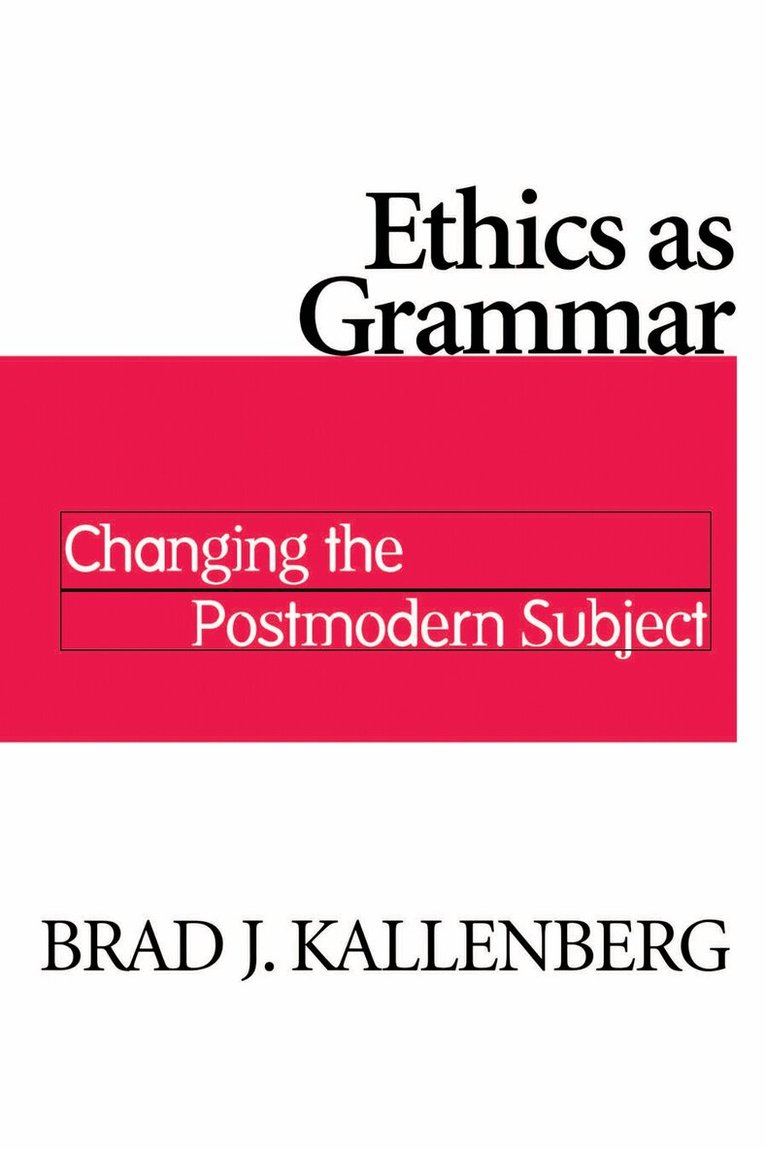
    Ethics As Grammar

    Changing the Postmodern Subject

    AvBrad J. Kallenberg

    E-bok
    Engelska, 2001

    419 kr

    Läs direkt i Bokus Reader – eller ladda ned till din enhet

    Fler format och utgåvor

    Inbunden

    858 kr

    Häftad

    363 kr

    E-bok

    419 kr

    Beskrivning

    Wittgenstein, one of the most influential, and yet widely misunderstood, philosophers of our age, confronted his readers with aporias—linguistic puzzles—as a means of countering modern philosophical confusions over the nature of language without replicating the same confusions in his own writings. In Ethics as Grammar, Brad Kallenberg uses the writings of theological ethicist Stanley Hauerwas as a foil for demonstrating how Wittgenstein's method can become concrete within the Christian tradition. Kallenberg shows that the aesthetic, political, and grammatical strands epitomizing Hauerwas's thought are the result of his learning to do Christian ethics by thinking through Wittgenstein.Kallenberg argues that Wittgenstein's pedagogical strategy cultivates certain skills of judgment in his readers by making them struggle to move past the aporias and acquire the fluency of language's deeper grammar. Theologians, says Kallenberg, are well suited to this task of "going on" because the gift of Christianity supplies them with the requisite resources for reading Wittgenstein. Kallenberg uses Hauerwas to make this case—showing that Wittgenstein's aporetic philosophy has engaged Hauerwas in a lifelong conversation that has cured him of many philosophical confusions. Yet, because Hauerwas comes to the conversation as a Christian believer, he is able to surmount Wittgenstein's aporias with the assistance of theological convictions that he possesses through grace.Ethics as Grammar reveals that Wittgenstein's intention to cultivate concrete skill in real people was akin to Aristotle's emphasis on the close relationship of practical reason and ethics. In this thought-provoking book, Kallenberg demonstrates that Wittgenstein does more than simply offer a vantage point for reassessing Aristotle, he paves the way for ethics to become a distinctively Christian discipline, as exemplified by Stanley Hauerwas.

    Produktinformation

    • Utgivningsdatum:2001-09-14
    • Språk:Engelska
    • Antal sidor:346
    • Filformat:EPUB
    • Kopieringsskydd:LCP
    • ISBN:9780268159696
    • Förlag:University of Notre Dame Press

    Utforska kategorier

    • Religion: allmänt inom Filosofi och religion
    • Kristendom inom Filosofi och religion

    Mer om författaren

    Brad J. Kallenberg is professor of religious studies at the University of Dayton, Ohio.

    Recensioner i media

    "Brad Kallenberg, in this extraordinary book, has done several things simultaneously. First, he has demonstrated his own mastery of the work of both Ludwig Wittgenstein and Stanley Hauerwas. Second, he has interestingly displayed, as he puts it, the family resemblance between the writings of Wittgenstein and Hauerwas. Third, and most importantly, he uses Wittgenstein's writings to show that Hauerwas is only sectarian or tribalist or fideist in ways that all of us are. This latter claim is at least one way of stating the overall purpose of the book." —Studies in Christian Ethics". . . this book ought to be of interest both to theologians and philosophers interested in the complex and interesting authorships of both Wittgenstein and Hauerwas . . . well worth the read. . . ." —Review of Metaphysics"This study of the work of Ludwig Wittgenstein and Stanley Hauerwas offers a much-needed contribution to contemporary theological ethics. The degree of difficulty that is involved in studying either of the subjects of this book is high enough, but to take on both is nothing less than stunning.... Thanks to Kallenberg's excellent study, philosophical and theological understanding of these issues has been newly enriched. I predict that in the years to come Ethics as Grammar will be a central text for theological ethicists writing after Hauerwas." —Journal of Religion"[I]t will probably have its greatest appeal to students and faculty in seminaries and divinity schools." —Choice"[A] demanding and rich discussion. It is splendid reading... Wittgenstein in particular. [I]mmensely illuminating–a very good book indeed." —Theology"In this perceptive and often mesmerizing book Kallenberg suggests innovative readings of two of the 20th century's most significant ethicists, Ludwig Wittgenstein and Stanley Hauerwas... He has a perceptive and unconventional interpretation of the challenges facing theological ethics today." —Theological Studies"In his carefully crafted and insightful Ethics as Grammar, Brad Kallenberg portrays a dependent relation between two important thinkers.... [I]t is a surprising one. He suggests that you cannot really understand Stanley Hauerwas until you have read Ludwig Wittgenstein. Who would think of associating these two minds? Kallenberg, however, makes the case brilliantly and in the process adds much to our comprehension of both thinkers." —Pro Ecclesia