• Fri frakt över 249 kr
  • •
  • Snabba leveranser
  • •
  • Billiga böcker
Kundservice

Du är på sajten för privatpersoner.

Företag, bibliotek eller offentlig verksamhet?

Du handlar på classic.bokus.com, där alla dina funktioner finns intakta.
Till classic.bokus.com
Bokus logotyp. Gå till startsidan.
  • Erbjudanden
  • Nyheter
  • Student
  • Topplistor
  • Barn & ungdom
  • Bokus Play
  • E-böcker
  • Pocketböcker
  • Spel & pussel

10% rabatt på allt med kod NYSTART10 →

Sidfot

Mina sidor

    Hjälp

    • Kundservice
    • Vanliga frågor och svar
    • Frakt och leverans
    • Retur vid ångerrätt
    • Reklamera vara
    • Betalning
    • Köpvillkor
    • Allmänna villkor
    • Information om webbplatsens tillgänglighet

    Om Bokus

    • Om oss
    • Pressrum
    • För studenter
    • För företag
    • För bibliotek och offentlig verksamhet
    • För leverantörer
    • Hållbarhet

    Populärt

    • Aktuella erbjudanden
    • Presentkort
    • Studentlitteratur
    • Nya böcker
    • Topplistor
    • Signerade böcker
    • Engelska böcker

    Inspiration

    • Boktips
    • BookTok
    • Populära bokserier
    • Barnbokskaraktärer
    • Populära författare
    Logotyp för Bokus
    Följ oss på Facebook (extern länk)Följ oss på Instagram (extern länk)Följ oss på YouTube (extern länk)Följ oss på TikTok (extern länk)
    bokus @ CookiesAnpassa cookiesIntegritetspolicyKöpvillkor
    Till Citymail hemsida (extern länk)Till Budbee hemsida (extern länk)Till Postnord hemsida (extern länk)Till Schenker hemsida (extern länk)Till Early Bird hemsida (extern länk)Till Walleys hemsida (extern länk)
    1. Språk och ordböcker
    2. Språkvetenskap och lingvistik

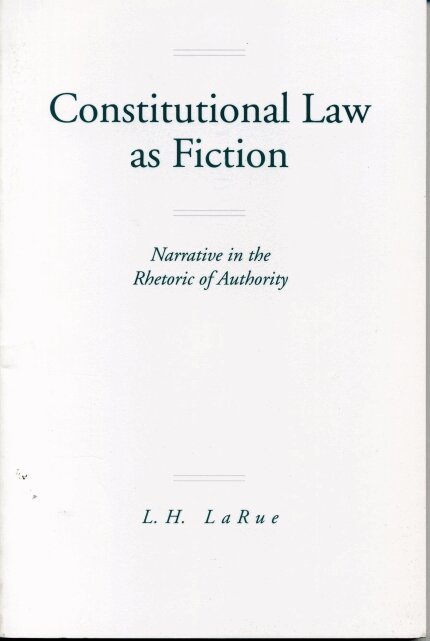
    Constitutional Law as Fiction

    Narrative in the Rhetoric of Authority

    AvLewis H. LaRue

    Häftad, Engelska, 1995

    535 kr

    Beställningsvara. Skickas inom 5-8 vardagar. Fri frakt över 249 kr.

    Beskrivning

    The fundamental thesis of Constitutional Law as Fiction is that in writing the opinion that explains a judgment, a judge not only analyzes and organizes precedent and makes and defends policy or value judgments, but he or she also tells a story, much as a historian does. Like a history, this story has the appearance of simple truth, but, in fact, of necessity, it is a "fiction" as well—not in the sense of a lie or fairy tale, but in the sense of a constructed meaning. Strangely enough, these fictions persuade those who read them and those who write them, and without this persuasion, the law would lose much of its authority. L. H. LaRue examines several critical Supreme Court cases, including Everson v. Board of Education and Marbury v. Madison, and specifically examines the rhetorical techniques of Chief Justice John Marshall.In analyzing the construction of meaning in the rhetoric of the law, LaRue ultimately contends that judges must not abandon the "fictions" in their judgments; they must strive to improve them.

    Produktinformation

    • Utgivningsdatum:1995-04-15
    • Mått:155 x 230 x 15 mm
    • Vikt:280 g
    • Format:Häftad
    • Språk:Engelska
    • Antal sidor:168
    • Förlag:Pennsylvania State University Press
    • ISBN:9780271014074

    Utforska kategorier

    • Språkvetenskap och lingvistik inom Språk och ordböcker
    • Juristyrken inom Juridik
    • Författningsrätt och förvaltningsrätt inom Juridik

    Mer om författaren

    L. H. LaRue is Class of 1958 Alumni Professor of Law, Washington and Lee University. He is the author of A Student's Guide to the Study of Law: An Introduction (1987) and Political Discourse: A Case Study of the Watergate Affair (1988) and co-editor (with Wythe Holt) of Rewriting the History of the Judiciary Act of 1787 by Wilfred J. Ritz (1990).

    Recensioner i media

    “LaRue is interested not in the simple claim that meaning is constructed, but in demonstrating the particular ways in which judicial writers create meaning in particular cases, and how in doing so they succeed, or fail, in creating the grounds of their own authority. . . . LaRue opens up a new set of questions and concerns, which should be of great value to lawyers, judges, and others interested in constitutional law, or law more generally.”—James Boyd White, Author of The Legal Imagination