• Fri frakt över 249 kr
  • •
  • Snabba leveranser
  • •
  • Billiga böcker
Kundservice

Du är på sajten för privatpersoner.

Företag, bibliotek eller offentlig verksamhet?

Du handlar på classic.bokus.com, där alla dina funktioner finns intakta.
Till classic.bokus.com
Bokus logotyp. Gå till startsidan.
  • Erbjudanden
  • Nyheter
  • Student
  • Topplistor
  • Barn & ungdom
  • Bokus Play
  • E-böcker
  • Pocketböcker
  • Spel & pussel

10% rabatt på allt med kod NYSTART10 →

Sidfot

Mina sidor

    Hjälp

    • Kundservice
    • Vanliga frågor och svar
    • Frakt och leverans
    • Retur vid ångerrätt
    • Reklamera vara
    • Betalning
    • Köpvillkor
    • Allmänna villkor
    • Information om webbplatsens tillgänglighet

    Om Bokus

    • Om oss
    • Pressrum
    • För studenter
    • För företag
    • För bibliotek och offentlig verksamhet
    • För leverantörer
    • Hållbarhet

    Populärt

    • Aktuella erbjudanden
    • Presentkort
    • Studentlitteratur
    • Nya böcker
    • Topplistor
    • Signerade böcker
    • Engelska böcker

    Inspiration

    • Boktips
    • BookTok
    • Populära bokserier
    • Barnbokskaraktärer
    • Populära författare
    Logotyp för Bokus
    Följ oss på Facebook (extern länk)Följ oss på Instagram (extern länk)Följ oss på YouTube (extern länk)Följ oss på TikTok (extern länk)
    bokus @ CookiesAnpassa cookiesIntegritetspolicyKöpvillkor
    Till Citymail hemsida (extern länk)Till Budbee hemsida (extern länk)Till Postnord hemsida (extern länk)Till Schenker hemsida (extern länk)Till Early Bird hemsida (extern länk)Till Walleys hemsida (extern länk)
    1. Samhälle och politik
    2. Sociologi och antropologi
    3. Sociologi

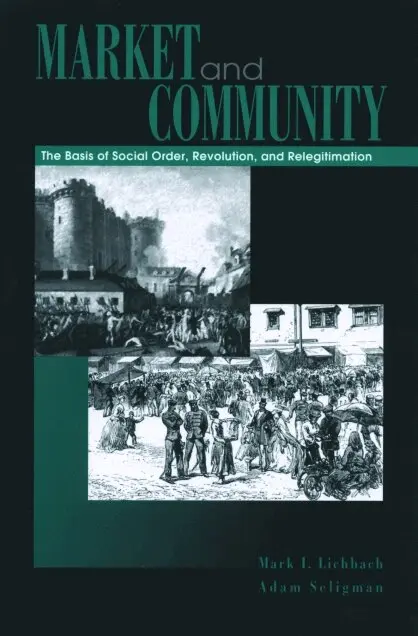
    Market and Community

    The Bases of Social Order, Revolution, and Relegitimation

    AvMark I. Lichbach,Adam B. Seligman

    Häftad, Engelska, 2000

    351 kr

    Beställningsvara. Skickas inom 5-8 vardagar. Fri frakt över 249 kr.

    Beskrivning

    Social order results from a complex interaction of individual actions, institutional structures, and cultural norms. But just how do they relate to one another, and is any one factor predominant? The answers that social science has provided reflect the competing paradigms of the rationalist, structuralist, and culturalist approaches.In this innovative book, two prominent social scientists coming from competing research traditions attempt to chart a course between them, drawing on their respective strengths to present a new model based on a classificatory scheme of market/community/contract/hierarchy. The discussion, which includes a closing dialogue between the authors, covers both methodological and empirical issues, with a review of classic theories of revolution and an analysis of the process of relegitimation following the French Revolution and the Dutch Revolt against the Hapsburgs.

    Produktinformation

    • Utgivningsdatum:2000-09-15
    • Mått:152 x 229 x 13 mm
    • Vikt:327 g
    • Format:Häftad
    • Språk:Engelska
    • Antal sidor:192
    • Förlag:Pennsylvania State University Press
    • ISBN:9780271020815

    Utforska kategorier

    • Sociologi inom Samhälle och politik

    Mer om författaren

    Mark I. Lichbach is Professor of Political Science at the University of California, Riverside. Adam B. Seligman is Associate Professor of Religion and Research Associate at the Institute for the Study of Economic Culture at Boston University.

    Recensioner i media

    “This is among the most exciting works of social theory I have read recently. It clearly and accurately describes the claims, achievements, and limitations of a variety of feuding traditions in social theory. It will probably be an important touchstone in future debates about the achievements and limits of rational choice and culturalist arguments in the social sciences. . . . The insightful command of the modern history of social theory deployed in this book is authoritative, and so is the discussion of leading exemplars of theorizing about revolution. The demonstration of the incapacity of rational choice or culturalist or materialist theory to produce fully satisfactory accounts manages to be both judicious and brilliant. . . . I believe this to be, therefore, a powerfully important critique of social theory (or should I say ‘theories’?) and a powerful call for moving beyond the mutual critiques that the various traditions have engaged in.”—John Markoff, University of Pittsburgh