• Fri frakt över 249 kr
  • •
  • Snabba leveranser
  • •
  • Billiga böcker
Kundservice

Du är på sajten för privatpersoner.

Företag, bibliotek eller offentlig verksamhet?

Du handlar på classic.bokus.com, där alla dina funktioner finns intakta.
Till classic.bokus.com
Bokus logotyp. Gå till startsidan.
  • Erbjudanden
  • Nyheter
  • Student
  • Topplistor
  • Barn & ungdom
  • Bokus Play
  • E-böcker
  • Pocketböcker
  • Spel & pussel

10% rabatt på allt med kod: NYSTART10 →

Sidfot

Mina sidor

    Hjälp

    • Kundservice
    • Vanliga frågor och svar
    • Frakt och leverans
    • Retur vid ångerrätt
    • Reklamera vara
    • Betalning
    • Köpvillkor
    • Allmänna villkor
    • Information om webbplatsens tillgänglighet

    Om Bokus

    • Om oss
    • Pressrum
    • För studenter
    • För företag
    • För bibliotek och offentlig verksamhet
    • För leverantörer
    • Hållbarhet

    Populärt

    • Aktuella erbjudanden
    • Presentkort
    • Studentlitteratur
    • Nya böcker
    • Topplistor
    • Signerade böcker
    • Engelska böcker

    Inspiration

    • Boktips
    • BookTok
    • Populära bokserier
    • Barnbokskaraktärer
    • Populära författare
    Logotyp för Bokus
    Följ oss på Facebook (extern länk)Följ oss på Instagram (extern länk)Följ oss på YouTube (extern länk)Följ oss på TikTok (extern länk)
    bokus @ CookiesAnpassa cookiesIntegritetspolicyKöpvillkor
    Till Citymail hemsida (extern länk)Till Budbee hemsida (extern länk)Till Postnord hemsida (extern länk)Till Schenker hemsida (extern länk)Till Early Bird hemsida (extern länk)Till Walleys hemsida (extern länk)
    1. Samhälle och politik
    2. Samhälle och kultur
    3. Kultur och medier
    4. Referensverk och tvärvetenskap

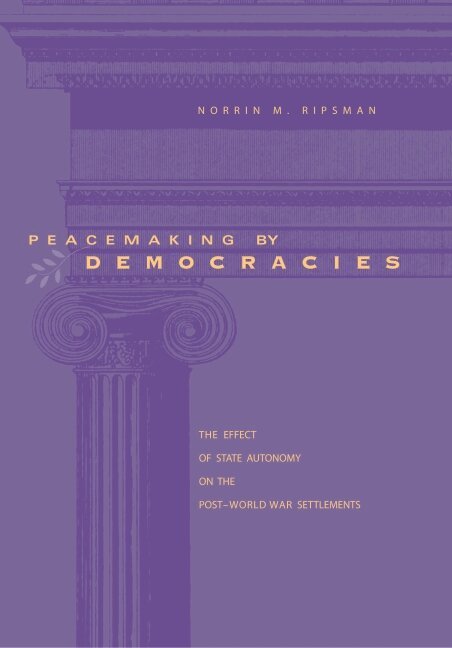
    Peacemaking by Democracies

    The Effect of State Autonomy on the Post–World War Settlements

    AvNorrin M. Ripsman

    Häftad, Engelska, 2002

    688 kr

    Beställningsvara. Skickas inom 5-8 vardagar. Fri frakt över 249 kr.

    Beskrivning

    When theorists explain how democracies conduct foreign policy, they tend to ignore or downplay differences and assume that democratic governments all behave similarly. Challenging this assumption, Norrin Ripsman breaks down the category of "democracy" to argue that differences in structural autonomy among democratic states have a lot to do with how foreign security policies are chosen and international negotiations are carried out. Concluding with an examination of the implications of these findings for security policy in contemporary democracies, Peacemaking by Democracies combines innovation in international relations theory with careful primary research in historical archives.

    Produktinformation

    • Utgivningsdatum:2002-12-15
    • Mått:152 x 229 x 21 mm
    • Vikt:426 g
    • Format:Häftad
    • Språk:Engelska
    • Antal sidor:280
    • Förlag:Pennsylvania State University Press
    • ISBN:9780271023984

    Utforska kategorier

    • Referensverk och tvärvetenskap inom Samhälle och politik
    • Internationella relationer inom Samhälle och politik

    Mer om författaren

    Norrin M. Ripsman is Assistant Professor of Political Science at Concordia University.

    Recensioner i media

    “Enormous attention has been paid to the differences between democracies and other regimes. Focusing on one feature of democratic states—their level of autonomy from public opinion in foreign policy—this book will help refine this line of research by shifting our attention to the specific features of these regimes. It is a model of careful case-study research, using original sources in several languages to test a clearly stated theoretical argument.”—Benjamin O. Fordham, SUNY-Albany

    Innehållsförteckning

    • ContentsAcknowledgments vi1.Introduction2.Domestic Opinion, Structural Autonomy, and Democratic Foreign Security Policy3.The Domestic Decision-Making Environments of Great Britain, France, and the United States after Two World Wars4.The Post–World War I Settlement, 19195.The Post–World War II Settlement, 1945–19546.Structural Autonomy and Democratic Foreign Security Policy: Conclusions and ImplicationsBibliographyIndex