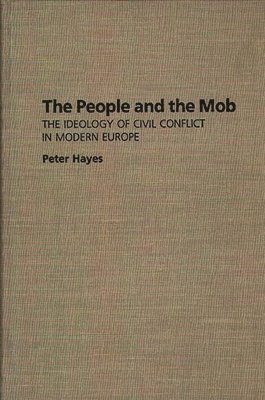
Inbunden, Engelska, 1992
People and the Mob
Av Peter Hayes
880 kr
Beställningsvara. Skickas inom 10-15 vardagar. Fri frakt över 249 kr.
Beskrivning
This book argues that although the mob and the people appear to be very separate concepts, they share a common ideological history. Hayes traces the developments undergone by the concepts of people and mob in modern European ideologies, and he examines Marx's depiction of the lumpenproletariat, Le Bon's analysis of the crowd, fascist depictions of the masses, and corporatist views of the political threat posed by the mob. He also discusses the implications of the distinction between the people and the mob for democracy providing a case study of the 1984-85 British miner's strike and reviewing the rhetoric of politicians in the new democracies of Eastern Europe.The People and the Mob examines the ideological depiction of the masses from the time of the French Revolution to the democratization of Eastern Europe. During this period, Hayes explains how political activists seeking popular appeal have increasingly identified mass social groups in positive rather than negative terms, as the people rather than the mob. However, Hayes argues that although the bulk of the population has come to be identified with the people, the concept of the mob has not disappeared from political discourse, but has rather been redifined to refer to a vicious minority. The ideological significance of this concept of the mob is made clear by Hayes's examination of Marx's depiction of the lumpenproleteriat, Le Bon's analysis of the crowd, fascist propaganda, and corporatist views of society and government. Throughout his analysis, Hayes finds the concept of the mob to be closely tied to that of the people in a way that indicates ambiguous, inconsistent, or opportunist attitudes toward mass social groups. Hayes investigates the implications of such attitudes for democracy by considering political conflicts in the 1984-85 British miners' strike, and in the new democracies of Eastern Europe.The People and the Mob explains how and why the concept of the mob has been incorporated into several forms of ideoloy that claim to speak for the people. This important finding is supported by Hayes's identification of a social analysis in which financiers and the mob are linked to each other, and separated from the people, using moral criteria of the work ethic. It is also supported by his explanation of the popular rhetorical appeal of political condemnations of the mob. Hayes shows that these rhetorical appeals and social distinctions are found in the ideology of both right and left. He demonstrates that even Marx has adopted such an ideology through his highly original interpretation of the class structure developed by Marx to explain events in France. Hayes's conclusions extend the fields of politicl theory and the history of ideas. The People and the Mob is useful to anyone interested in Marxism, crowd theory, fascism, corporatism, civil conflict in Europe, and the problems of modern democracy.
Produktinformation
- Utgivningsdatum: 1992-09-30
- Mått: 157 x 235 x 15 mm
- Vikt: 426 g
- Format: Inbunden
- Språk: Engelska
- Antal sidor: 184
- Förlag: Bloomsbury Publishing Plc
- ISBN: 9780275943363
Utforska kategorier
Betyg & recensioner
0 recensioner
Inga recensioner tillgängliga.