• Fri frakt över 249 kr
  • •
  • Snabba leveranser
  • •
  • Billiga böcker
Kundservice

Du är på sajten för privatpersoner.

Företag, bibliotek eller offentlig verksamhet?

Du handlar på classic.bokus.com, där alla dina funktioner finns intakta.
Till classic.bokus.com
Bokus logotyp. Gå till startsidan.
  • Erbjudanden
  • Student
  • Topplistor
  • Barn & ungdom
  • Bokus Play
  • E-böcker
  • Ljudböcker
  • Pocketböcker
  • Spel & pussel

Upp till 25% på utvalda nyheter →

Sidfot

Mina sidor

    Hjälp

    • Kundservice
    • Vanliga frågor och svar
    • Frakt och leverans
    • Retur vid ångerrätt
    • Reklamera vara
    • Betalning
    • Köpvillkor
    • Allmänna villkor
    • Information om webbplatsens tillgänglighet

    Om Bokus

    • Om oss
    • Pressrum
    • För studenter
    • För företag
    • För bibliotek och offentlig verksamhet
    • För leverantörer
    • Hållbarhet

    Populärt

    • Aktuella erbjudanden
    • Presentkort
    • Studentlitteratur
    • Nya böcker
    • Topplistor
    • Signerade böcker
    • Engelska böcker

    Inspiration

    • Boktips
    • BookTok
    • Populära bokserier
    • Barnbokskaraktärer
    • Populära författare
    Logotyp för Bokus
    Följ oss på Facebook (extern länk)Följ oss på Instagram (extern länk)Följ oss på YouTube (extern länk)Följ oss på TikTok (extern länk)
    bokus @ CookiesAnpassa cookiesIntegritetspolicyKöpvillkor
    Till Citymail hemsida (extern länk)Till Budbee hemsida (extern länk)Till Postnord hemsida (extern länk)Till Schenker hemsida (extern länk)Till Early Bird hemsida (extern länk)Till Walleys hemsida (extern länk)
    1. Samhälle och politik
    2. Samhälle och kultur
    3. Kultur och medier
    4. Referensverk och tvärvetenskap

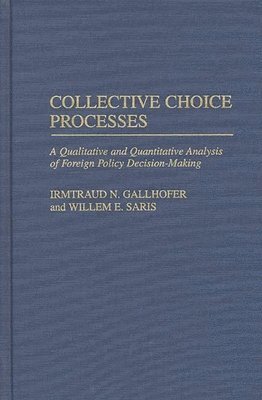
    Collective Choice Processes

    A Qualitative and Quantitative Analysis of Foreign Policy Decision-Making

    AvIrmtraud N. Gallhofer,Willem E. Saris

    Inbunden, Engelska, 1997

    1 048 kr

    Beställningsvara. Skickas inom 10-15 vardagar. Fri frakt över 249 kr.

    Beskrivning

    Gallhofer and Saris examine the collective choice processes in different decision-making units leading to World Wars I and II as well as the Cuban Missile Crisis, colonial wars, and to major foreign policy decisions of a European government after World War II. In the unit relating to the European government, they find strong evidence for consensual decision-making. But when disagreements occurred among the participants, alternative procedures were employed, such as postponements in order to search for additional information, shifts from argumentation to find a compromise, and change from consensus to majority decision-making. How quickly these shifts were made depended on the group norms.This book provides a theoretical framework to understand how different foreign-policy decision-making units or groups arrive at a collective choice. The qualitative and quantitative studies presented here are based on written records and deal with the choice process of four different decision-making units in situations that pertain to important foreign policy decisions. Germany's decision-making process under Hitler to initiate World War II exemplifies a group with a leader who is insensitive to advice, making the decisions himself and using the group only for acclamation. Kennedy's decision-making during the Cuban Missile Crisis is very different, as it shows a leader sensitive to advice where the group has the task of presenting different options and their consequences. The Austro-Hungarian cabinet's decision to initiate World War I exemplifies a homogeneous group with a dissenter, although it arrived at a collective decision quite quickly using persuasion, compromise, and some coercion. The bulk of the study deals with a heterogeneous unit in a great variety of decision situations, because most Western European governments are of this type. Where there is extreme conflict and time pressure, consensual decision-making is abandoned and a majority choice is hammered out.As the first systematic documented study of collective decision-making, as it pertains to different decision units, this book will be of considerable importance to scholars and researchers investigating the decision-making process in government and international affairs.

    Produktinformation

    • Utgivningsdatum:1997-11-20
    • Mått:157 x 235 x 18 mm
    • Vikt:499 g
    • Format:Inbunden
    • Språk:Engelska
    • Antal sidor:224
    • Förlag:Bloomsbury Publishing Plc
    • ISBN:9780275960292

    Utforska kategorier

    • Referensverk och tvärvetenskap inom Samhälle och politik
    • Internationella relationer inom Samhälle och politik

    Mer om författaren

    IRMTRAUD N. GALLHOFER is Senior Researcher at the Sociometric Research Foundation of Amstelveen.WILLEM E. SARIS is Professor of Statistics and Methods at the University of Amsterdam. In addition to numerous papers and articles, they coauthored Foreign Policy Decision-Making: A Qualitative and Quantitative Analysis of Political Argumentation (Praeger, 1996).

    Innehållsförteckning

    • Introduction A Qualitative Study of Collective Decision-Making Processes Theoretical Frameworks for Group Decision-Making in the Context of National Government Theoretical Framework Used in This Book Methodology Germany's Decision to Initiate World War II The World at the Brink of a Nuclear War: The U.S.' Decision to Avoid a Nuclear War, October 1962 The Austro-Hungarian Cabinet Decision to Initiate World War I The Dutch Cabinet Decision to Take Military Action in Indonesia, Autumn 1948: Consensual Decision-Making in a Heterogeneous Group The Dutch Cabinet Decision to Carry Out Military Action in Indonesia, December 1948: A Cabinet on the Brink of Tendering Its Resignation The Practice of Collective Choice A Quantitative Study of Collective Decision-Making by a Heterogeneous Group The Study of Decision-Making Processes The Decision-Making Process Results Preference Aggregation Rules References Subject Index Name Index Index