Willem E. Saris - Böcker
Visar alla böcker från författaren Willem E. Saris. Handla med fri frakt och snabb leverans.
5 produkter
5 produkter
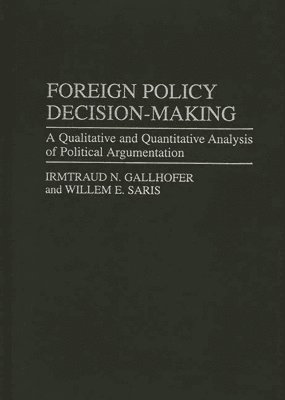
Foreign Policy Decision-Making
A Qualitative and Quantitative Analysis of Political Argumentation
Inbunden, Engelska, 1996
1 476 kr
Skickas inom 10-15 vardagar
This book investigates how politicians, in order to convince their audiences, argue about preferences for different courses of action. The qualitative and quantitative studies presented here are based on written records and deal with a variety of foreign policy issues, countries, and political regimes. Examining the argumentation employed by Hitler and Kennedy to ministers of the Austro-Hungarian empire, the authors conclude that only six basic forms of persuasion seem to be used and understood by politicians and their audiences, and that these same approaches are used almost irrespective of the political situation. This fascinating study of political argumentation will be of interest to scholars of political communication, rhetoric, political science, and international relations.
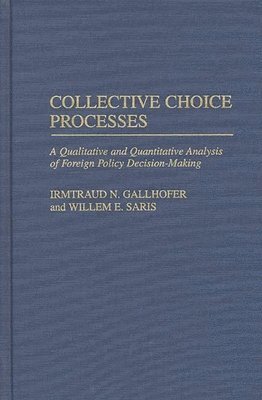
Collective Choice Processes
A Qualitative and Quantitative Analysis of Foreign Policy Decision-Making
Inbunden, Engelska, 1997
1 009 kr
Skickas inom 10-15 vardagar
Gallhofer and Saris examine the collective choice processes in different decision-making units leading to World Wars I and II as well as the Cuban Missile Crisis, colonial wars, and to major foreign policy decisions of a European government after World War II. In the unit relating to the European government, they find strong evidence for consensual decision-making. But when disagreements occurred among the participants, alternative procedures were employed, such as postponements in order to search for additional information, shifts from argumentation to find a compromise, and change from consensus to majority decision-making. How quickly these shifts were made depended on the group norms.This book provides a theoretical framework to understand how different foreign-policy decision-making units or groups arrive at a collective choice. The qualitative and quantitative studies presented here are based on written records and deal with the choice process of four different decision-making units in situations that pertain to important foreign policy decisions. Germany's decision-making process under Hitler to initiate World War II exemplifies a group with a leader who is insensitive to advice, making the decisions himself and using the group only for acclamation. Kennedy's decision-making during the Cuban Missile Crisis is very different, as it shows a leader sensitive to advice where the group has the task of presenting different options and their consequences. The Austro-Hungarian cabinet's decision to initiate World War I exemplifies a homogeneous group with a dissenter, although it arrived at a collective decision quite quickly using persuasion, compromise, and some coercion. The bulk of the study deals with a heterogeneous unit in a great variety of decision situations, because most Western European governments are of this type. Where there is extreme conflict and time pressure, consensual decision-making is abandoned and a majority choice is hammered out.As the first systematic documented study of collective decision-making, as it pertains to different decision units, this book will be of considerable importance to scholars and researchers investigating the decision-making process in government and international affairs.
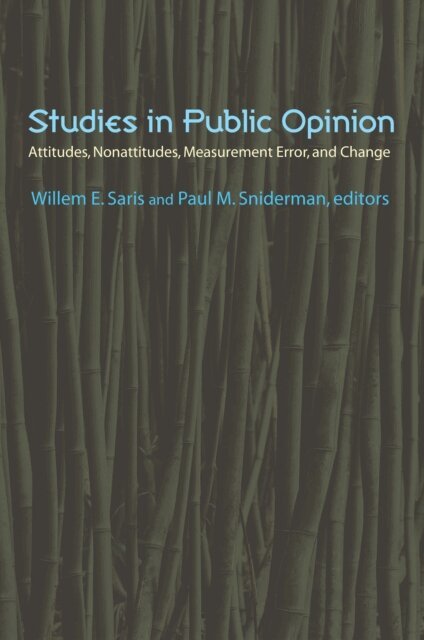
Studies in Public Opinion
Attitudes, Nonattitudes, Measurement Error, and Change
Häftad, Engelska, 2004
607 kr
Skickas inom 7-10 vardagar
In democratic societies, opinion polls play a vital role. But it has been demonstrated that many people do not have an opinion about major issues--the "nonattitudes" problem. Also, the framing of questions in different ways can generate very different estimates of public opinion--the "framing" effect. Both dilemmas raise questions about the competence of ordinary citizens to play the role a democratic society ostensibly expects of them. Although the impact of some factors is well established, particularly political information and sophistication, much is yet to be understood. Building on and reaching beyond themes in the work of Philip Converse, one of the pioneers in the study of public opinion, Studies in Public Opinion brings together a group of leading American and European social scientists to explore a number of new factors, with a particular emphasis on the structure of political choices. In twelve chapters that reflect different perspectives on how people form political opinions and how these opinions are manipulated, this book offers an unparalleled view of the state-of-the-art research on these important questions as it has developed on two continents.The contributors include Matthew K. Berent, Jaak Billiet, George Y. Bizer, Paul R. Brewer, John Bullock, Danielle Butschi, Michael Guge, Hanspeter Kriesi, Jon A. Krosnick, Milton Lodge, Michael F. Meffert, Peter Neijens, Willem E. Saris, Paul M. Sniderman, Marco R. Steenbergen, Marc Swyngedouw, Sean M. Theriault, William van der Veld, Penny S. Visser, Hans Waege, and John Zaller.
Del 80 - Quantitative Applications in the Social Sciences
Computer-Assisted Interviewing
Häftad, Engelska, 1991
767 kr
Skickas inom 3-6 vardagar
This book forms a useful introduction to computer assisted interviewing. . . . The book offers useful practical tips for those previously involved in more traditional questionnaire design, and gives examples of how questions can be adapted for use in computer assisted interviews. . . . Anyone who is already convinced that a computer-assisted interview meets their data gathering needs will find the book a worthwhile addition to the literature on questionnaire design. --International Journal of Nursing Studies "A practical and self-contained manual for doing CADAC, written by an author with a lot of experience in this field. It also contains a helpful list of software firms (with addresses) and a good bibliography for further in-depth work on the subject." --Bulletin de Methodologie Sociologique "This is a useful resource for those wishing to explore CADAC techniques." --British Journal of Mathematical and Statistical Psychology Since survey research is a time-consuming and involved process, researchers have found the computer a boon for facilitating the recording and coding of survey responses. As a result, the use of computer-assisted data collection (CADAC) is growing each year. Aimed at aiding researchers in the improvement of their data's quality, Computer-Assisted Interviewing will help the reader identify the possibilities and difficulties that arise in computer-assisted interviewing. Using concrete examples from surveys, the author annotates samples of actual research questionnaires so that the reader can compare the actual paper questionnaire against the extra statements needed for clear computer-assisted interviewing. In addition, the book includes coverage of the extra possibilities that computer-assisted interviewing has to offer to interviewer-administered interviewing, self-administered interviewing and panel surveys and an overview of the important features to consider if one wants to purchase a CADAC program.
953 kr
Skickas inom 7-10 vardagar
Praise for the First Edition"...this book is quite inspiring, giving many practical ideas for survey research, especially for designing better questionnaires."—International Statistical ReviewReflecting modern developments in the field of survey research, the Second Edition of Design, Evaluation, and Analysis of Questionnaires for Survey Research continues to provide cutting-edge analysis of the important decisions researchers make throughout the survey design process.The new edition covers the essential methodologies and statistical tools utilized to create reliable and accurate survey questionnaires, which unveils the relationship between individual question characteristics and overall question quality. Since the First Edition, the computer program Survey Quality Prediction (SQP) has been updated to include new predictions of the quality of survey questions on the basis of analyses of Multi-Trait Multi-Method experiments. The improved program contains over 60,000 questions, with translations in most European languages. Featuring an expanded explanation of the usage and limitations of SQP 2.0, the Second Edition also includes: New practice problems to provide readers with real-world experience in survey research and questionnaire designA comprehensive outline of the steps for creating and testing survey questionnairesContemporary examples that demonstrate the many pitfalls of questionnaire design and ways to avoid similar decisionsDesign, Evaluation, and Analysis of Questionnaires for Survey Research, Second Edition is an excellent textbook for upper-undergraduate and graduate-level courses in methodology and research questionnaire planning, as well as an ideal resource for social scientists or survey researchers needing to design, evaluate, and analyze questionnaires.