Beställningsvara. Skickas inom 10-15 vardagar. Fri frakt över 249 kr.
Beskrivning
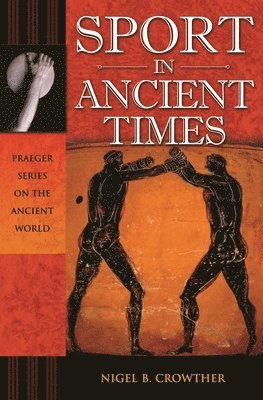
Crowther offers a fascinating look at the role of sport as practiced in several important civilizations in the ancient world. He not only probes the games themselves, but explores the ways in which athletics figured into cultural arenas that extended beyond physical prowess to military associations, rituals, status, and politics. Sport in Ancient Times has four distinct parts: the Prehistoric Age, historic Greece, ancient Italy, and the Byzantine Empire. Beginning with the earliest civilizations, Crowther examines the military and recreational aspects of sports in prehistoric Egypt, with brief references to other river-valley cultures in Sumeria, Mesopotamia, and Persia. He looks at the rituals of Cretan bull-leaping and boxing in the Bronze Age, the high status of sports in Mycenaean Greece, and the funeral games in the Trojan War as described by the epic poet Homer.In what he terms the historic period, Crowther examines the significance of the ancient Olympic Games, the events of Greek athletics, and the attitude of other civilizations (notably Rome) towards them. He attempts to discover to what extent the Romans believed in the famous ideal of Juvenal, a sound mind in a sound body, and discusses the significance of the famous Baths not only for sport, but also for culture and society. He likewise explores the Roman emphasis on spectator sports and the use of gladiatorial contests and chariot racing for political purposes (the concept of bread and games). The section on the Byzantine Empire focuses, notably, on chariot racing and the riots at sporting contests—riots reminiscent of crowd violence in modern sports such as soccer.Crowther closes with perspectives that bring to life some of the issues revealed in previous chapters. These include a comparison of the social status and significance of a famous Olympic athlete (Milo), a Roman gladiator (Hermes), and a Byzantine chariot racer (Porphyrius). He also addresses the changing role of women in sports in antiquity. Women were prominent in sport in Egypt, for example, but almost entirely absent from the ancient Olympic Games. The final chapter discusses team sports and ball games. Although these were comparatively rare in the ancient world, one may see in those that did exist the forerunners of modern football and hockey.
Recensioner i media
Crowther provides here the second volume in the Praeger Series on the Ancient World, which is aimed at the nonspecialist and general reader. Crowther's broad sweep includes the role of sports in ancient Egypt and the Middle East, early China and Japan, and even Mesoamerica. He focuses on Greek athletics (especially the Olympics) and Roman contests (especially spectator sports) and their use for political purposes, and he expands his discussion to sport in the Byzantine Empire, particularly charioteering. Other chapters emphasize social issues, and include a comparison of noted Greek, Roman, and Byzantine athletes and a discussion of the changing role of women in sport. Crowther's main themes include amateurism and professionalism, fair play, crowd behavior, politics, class, and sexuality. He includes a time line and a brief annotated list of further readings, but no notes. Crowther seems current with relevant sources, so one regrets his failure to name the authorities he discusses. Excellent graphics. Recommended. Lower-/upper-division undergraduates; general readers.