• Fri frakt över 249 kr
  • •
  • Snabba leveranser
  • •
  • Billiga böcker
Kundservice

Du är på sajten för privatpersoner.

Företag, bibliotek eller offentlig verksamhet?

Du handlar på classic.bokus.com, där alla dina funktioner finns intakta.
Till classic.bokus.com
Bokus logotyp. Gå till startsidan.
  • Erbjudanden
  • Nyheter
  • Student
  • Topplistor
  • Barn & ungdom
  • Bokus Play
  • E-böcker
  • Pocketböcker
  • Spel & pussel

10% rabatt på allt med kod NYSTART10 →

Sidfot

Mina sidor

    Hjälp

    • Kundservice
    • Vanliga frågor och svar
    • Frakt och leverans
    • Retur vid ångerrätt
    • Reklamera vara
    • Betalning
    • Köpvillkor
    • Allmänna villkor
    • Information om webbplatsens tillgänglighet

    Om Bokus

    • Om oss
    • Pressrum
    • För studenter
    • För företag
    • För bibliotek och offentlig verksamhet
    • För leverantörer
    • Hållbarhet

    Populärt

    • Aktuella erbjudanden
    • Presentkort
    • Studentlitteratur
    • Nya böcker
    • Topplistor
    • Signerade böcker
    • Engelska böcker

    Inspiration

    • Boktips
    • BookTok
    • Populära bokserier
    • Barnbokskaraktärer
    • Populära författare
    Logotyp för Bokus
    Följ oss på Facebook (extern länk)Följ oss på Instagram (extern länk)Följ oss på YouTube (extern länk)Följ oss på TikTok (extern länk)
    bokus @ CookiesAnpassa cookiesIntegritetspolicyKöpvillkor
    Till Citymail hemsida (extern länk)Till Budbee hemsida (extern länk)Till Postnord hemsida (extern länk)Till Schenker hemsida (extern länk)Till Early Bird hemsida (extern länk)Till Walleys hemsida (extern länk)
    1. Historia och arkeologi
    2. Historia
    3. Historia: särskilda händelser och ämnen
    4. Socialhistoria och kulturhistoria

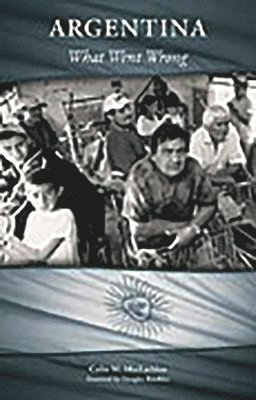
    Argentina

    What Went Wrong

    AvColin M. MacLachlan

    Inbunden, Engelska, 2006

    722 kr

    Beställningsvara. Skickas inom 10-15 vardagar. Fri frakt över 249 kr.

    Fler format och utgåvor

    E-bok

    777 kr

    Beskrivning

    Why has Argentina failed so spectacularly, both economically and politically? It is a puzzle because the country seemed to have all the requirements for greatness, including a well-established middle class of professionals. Its failure raises the specter that other middle-class societies could also fail. In Argentina, MacLachlan delivers history with a plot, a sense of direction and purpose, and fascinating conclusions that reveal a much more complex picture of Argentina than one might have had in mind prior to reading this book.Argentina traces the roots of the nation from the late colonial period to the present, and examines the impact of events that molded it: the failure of political accommodation in 1912, the role of the oligarchy, the development of a middle class, gender issues, the elaboration of a distinct culture, the era of Peron, the army, and the dirty war. The conclusion suggests the reasons for the nation's difficulties. The IMF, World Bank, and international financial markets play a role, but so does a high level of political corruption and mismanagement of the economy that emerged from political and economic failure. Juan and Eva Peron tried to override politics to create an economic and social balance between urban labor and agriculture interests, but failed. The dirty war arose from that failure. Nationalism forged a culture of victimization and resentment that continues to this day. Laying aside standard explanations, MacLachlan presents a portrait of Argentina that emphasizes the role of a destructive nationalism—and a form a corruption that turns citizens into clients.

    Produktinformation

    • Utgivningsdatum:2006-04-30
    • Mått:156 x 235 x 18 mm
    • Vikt:539 g
    • Format:Inbunden
    • Språk:Engelska
    • Antal sidor:240
    • Förlag:Bloomsbury Publishing Plc
    • ISBN:9780275990763

    Utforska kategorier

    • Socialhistoria och kulturhistoria inom Historia och arkeologi
    • Ekonomisk historia inom Ekonomi och Ledarskap

    Mer om författaren

    Colin M. MacLachlan is John Christie Barr Distinguished Professor of Latin American History at Tulane University. He is a member of the Executive Board of the Rocky Mountain Council of Latin American Studies, the Advisory Board of the Latin American Labor Institute, and a former member of the Board of Governors of the Pacific Coast Council of Latin American Studies. He is the author, co-author, or editor of a dozen books, including histories of Mexico, Brazil, and Latin America.

    Recensioner i media

    Life in Argentina presents challenges that not all Argentines are prepared to meet, as they prefer to emigrate rather than resolve the gnarls that distort national life--corrosive social stresses, endemic corruption, and what this author calls the culpable irresponsibility of its leaders. Constructing a coherent narrative from deceptive sources would seem impossible, but distinguished Latin American history professor MacLachlan succeeds brilliantly. Rather than attempt to reconcile the irreconcilable currents that threaten civilized life in Argentina, he presents them in all their splendid irrationality. His first four chapters discuss the events and ideologies that formed contemporary Argentina. Emphasis is on the struggle to define a national identity: countryside versus capital city, modernizers versus traditionalists, supporters versus resisters of authoritarian rulers from Rosas to Peron (Peron) to the Proceso. The book's second half takes readers through the labyrinth of successive presidencies, from Rivadavia to Menem. Pushing beyond objectivity, MacLachlan disentangles motives, actions, and outcomes that puzzle non-Argentines yet are accepted by natives as the way we do things here. This is a most welcome and useful addition to the author's earlier volumes on Mexico and Brazil. Highly recommended. All levels/libraries.

    Innehållsförteckning

    • Foreword by Douglas BrinkleyAcknowledgmentsIntroductionChronology1 Fringe of Empire2 The Compromise3 Urban Reality4 Confronting the Oligarchy5 The Age of Perón6 A Distant Shadow7 The Proceso's Dark Shadow, Menem, and NeoliberalismConclusion: Who or What Is to Blame?GlossaryNotesSelected Bibliography of Works in EnglishIndex