• Fri frakt över 249 kr
  • •
  • Snabba leveranser
  • •
  • Billiga böcker
Kundservice

Du är på sajten för privatpersoner.

Företag, bibliotek eller offentlig verksamhet?

Du handlar på classic.bokus.com, där alla dina funktioner finns intakta.
Till classic.bokus.com
Bokus logotyp. Gå till startsidan.
  • Erbjudanden
  • Nyheter
  • Student
  • Topplistor
  • Barn & ungdom
  • Bokus Play
  • E-böcker
  • Pocketböcker
  • Spel & pussel

Må bättre, för mindre! Upp till 50% rabatt på hälsoböcker

Sidfot

Mina sidor

    Hjälp

    • Kundservice
    • Vanliga frågor och svar
    • Frakt och leverans
    • Retur vid ångerrätt
    • Reklamera vara
    • Betalning
    • Köpvillkor
    • Allmänna villkor
    • Information om webbplatsens tillgänglighet

    Om Bokus

    • Om oss
    • Pressrum
    • För studenter
    • För företag
    • För bibliotek och offentlig verksamhet
    • För leverantörer
    • Hållbarhet

    Populärt

    • Aktuella erbjudanden
    • Presentkort
    • Studentlitteratur
    • Nya böcker
    • Topplistor
    • Signerade böcker
    • Engelska böcker

    Inspiration

    • Boktips
    • BookTok
    • Populära bokserier
    • Barnbokskaraktärer
    • Populära författare
    Logotyp för Bokus
    Följ oss på Facebook (extern länk)Följ oss på Instagram (extern länk)Följ oss på YouTube (extern länk)Följ oss på TikTok (extern länk)
    bokus @ CookiesAnpassa cookiesIntegritetspolicyKöpvillkor
    Till Citymail hemsida (extern länk)Till Budbee hemsida (extern länk)Till Postnord hemsida (extern länk)Till Schenker hemsida (extern länk)Till Early Bird hemsida (extern länk)Till Walleys hemsida (extern länk)
    1. Kultur
    2. Scenkonst och film
    3. Film

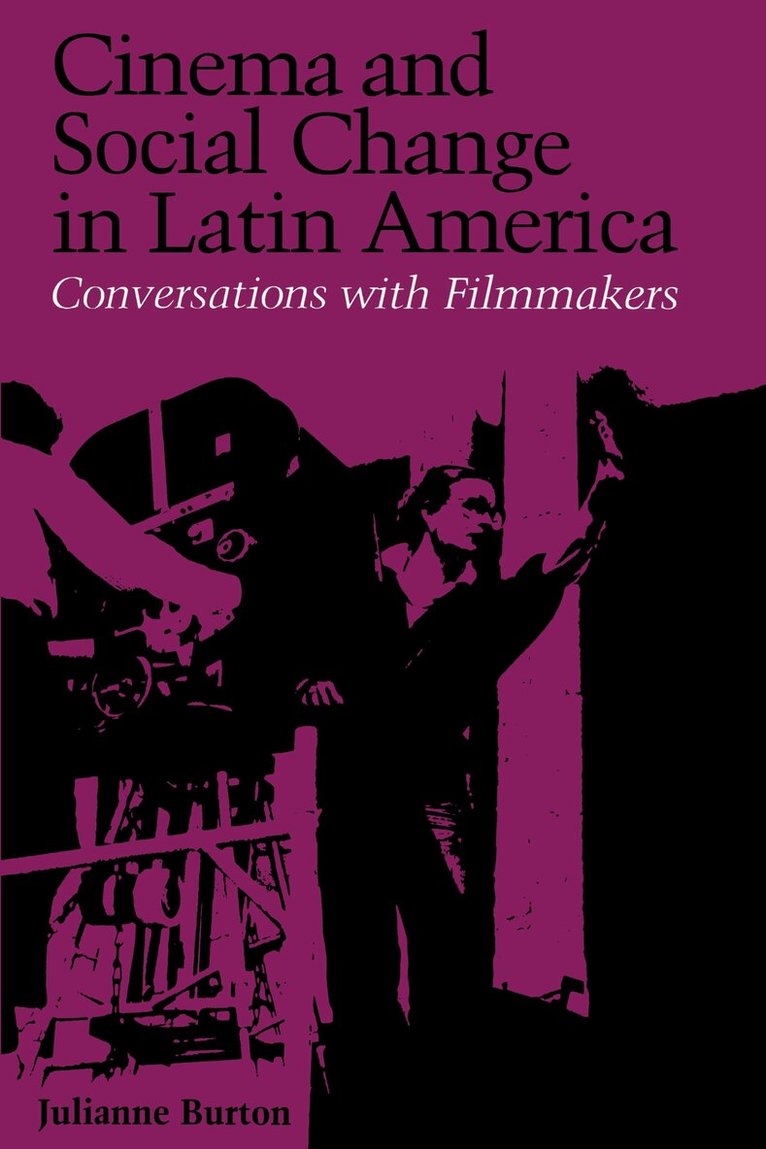
    Cinema and Social Change in Latin America

    Conversations with Filmmakers

    AvJulianne Burton

    Häftad, Engelska, 1986

    Del i serien LLILAS Special Publications

    346 kr

    Beställningsvara. Skickas inom 10-15 vardagar. Fri frakt över 249 kr.

    Beskrivning

    Since the late 1960s, films from Latin America have won widening audiences in North America and Europe. Until now, no single book has offered an introduction to the diverse personalities and practices that make up this important regional film movement. In Cinema and Social Change in Latin America, Julianne Burton presents twenty interviews with key figures of Latin American cinema, covering three decades and ranging from Argentina to Mexico. Interviews with pioneers Fernando Birri, Nelson Pereira dos Santos, and Glauber Rocha, renowned feature filmmakers TomÁs GutiÉrrez Alea and Carlos Diegues, prize-winning documentarists Patricio GuzmÁn and Helena Solberg-Ladd, among others, endeavor to balance personal achievement against the backdrop of historical, political, social, and economic circumstances that have influenced each director's career. Presented also are conversations that cast light on the related activities of acting, distribution, theory, criticism, and film-based community organizing. More than their counterparts in other regions of the world, Latin American artists and intellectuals acknowledge the degree to which culture is shaped by history and politics. Since the mid-1950s, a period of rising nationalism and regional consciousness, talented young artists and activists have sought to redefine the uses of the film medium in the Latin American context. Questioning the studio and star systems of the Hollywood industrial model, these innovators have developed new forms, content, and processes of production, distribution, and reception. The specific approaches and priorities of the New Latin American Cinema are far from monolithic. They vary from realism to expressionism, from observational documentary to elaborate fictional constructs, from "imperfect cinema" to a cinema that emulates the high production values of the developed sectors, from self-reflexive to "transparent" cinematic styles, from highly industrialized modes of production to purely artisanal ones. What does not vary is the commitment to film as a vehicle for social transformation and the expression of national and regional cultural autonomy. From early alternative cinema efforts in Argentina, Brazil, and Cuba to a contemporary perspective from within the Mexican commercial industry to the emerging cinema and video production from Central America, Cinema and Social Change in Latin America offers the most comprehensive look at Latin American film available today.

    Produktinformation

    • Utgivningsdatum:1986-11-01
    • Mått:152 x 229 x 19 mm
    • Vikt:454 g
    • Format:Häftad
    • Språk:Engelska
    • Serie:LLILAS Special Publications
    • Antal sidor:320
    • Förlag:University of Texas Press
    • Medarbetare:Julianne Burton-Carvajal
    • ISBN:9780292724549

    Utforska kategorier

    • Film inom Kultur

    Mer om författaren

    Julianne Burton-Carvajal is a professor emerita of literature at the University of California-Santa Cruz.

    Innehållsförteckning

    • Acknowledgments Introduction Part I. The Documentary Impulse: The Drama of Reality 1. Fernando Birri (Argentina), The Roots of Documentary Realism 2. Mario Handler (Uruguay), Starting from Scratch: Artisanship and Agitprop 3. Jorge Silva and Marta RodrÍguez (Colombia), Cine-Sociology and Social Change 4. Jorge SanjinÉs (Bolivia), Revolutionary Cinema: The Bolivian Experience 5. Patricio GuzmÁn (Chile), Politics and the Documentary in People’s Chile 6. Emilio RodrÍguez VÁzquez and Carlos Vicente Ibarra (Puerto Rico and Nicaragua), Filmmaking in Nicaragua: From Insurrection to INCINE 7. Helena Solberg-Ladd (Brazil and United States), The View from the United States Part II. Fictional Filmmaking: The Reality of Drama 8. Glauber Rocha (Brazil), Cinema Novo and the Dialectics of Popular Culture 9. TomÁs GutiÉrrez Alea (Cuba), Beyond the Reflection of Reality 10. Nelson Pereira dos Santos (Brazil), Toward a Popular Cinema 11. Humberto SolÁs (Cuba), Every Point of Arrival Is a Point of Departure 12. Antonio Eguino (Bolivia), Neorealism in Bolivia 13. Carlos Diegues (Brazil), The Mind of Cinema Novo 14. RaÚl Ruiz (Chile and France), Between Institutions 15. Marcela FernÁndez Violante (Mexico), Inside the Mexican Film Industry: A Woman’s Perspective Part III. Behind the Scenes 16. Nelson Villagra (Chile), The Actor at Home and in Exile 17. Walter Achugar (Uruguay and Latin America at Large), Using Movies to Make Movies 18. Enrique Colina (Cuba), The Film Critic on Prime Time 19. Julio GarcÍa Espinosa (Cuba), Theory and Practice of Film and Popular Culture in Cuba 20. Alfonso Gumucio DagrÓn (Bolivia and Latin America at Large), A Product of Circumstances: Reflections of a Media Activist For Further Reading Appendix: Films and Writings by Latin American Directors Index of Films General Index