• Fri frakt över 249 kr
  • •
  • Snabba leveranser
  • •
  • Billiga böcker
Kundservice

Du är på sajten för privatpersoner.

Företag, bibliotek eller offentlig verksamhet?

Du handlar på classic.bokus.com, där alla dina funktioner finns intakta.
Till classic.bokus.com
Bokus logotyp. Gå till startsidan.
  • Erbjudanden
  • Nyheter
  • Student
  • Topplistor
  • Barn & ungdom
  • Bokus Play
  • E-böcker
  • Pocketböcker
  • Spel & pussel

10% rabatt på allt med kod NYSTART10 →

Sidfot

Mina sidor

    Hjälp

    • Kundservice
    • Vanliga frågor och svar
    • Frakt och leverans
    • Retur vid ångerrätt
    • Reklamera vara
    • Betalning
    • Köpvillkor
    • Allmänna villkor
    • Information om webbplatsens tillgänglighet

    Om Bokus

    • Om oss
    • Pressrum
    • För studenter
    • För företag
    • För bibliotek och offentlig verksamhet
    • För leverantörer
    • Hållbarhet

    Populärt

    • Aktuella erbjudanden
    • Presentkort
    • Studentlitteratur
    • Nya böcker
    • Topplistor
    • Signerade böcker
    • Engelska böcker

    Inspiration

    • Boktips
    • BookTok
    • Populära bokserier
    • Barnbokskaraktärer
    • Populära författare
    Logotyp för Bokus
    Följ oss på Facebook (extern länk)Följ oss på Instagram (extern länk)Följ oss på YouTube (extern länk)Följ oss på TikTok (extern länk)
    bokus @ CookiesAnpassa cookiesIntegritetspolicyKöpvillkor
    Till Citymail hemsida (extern länk)Till Budbee hemsida (extern länk)Till Postnord hemsida (extern länk)Till Schenker hemsida (extern länk)Till Early Bird hemsida (extern länk)Till Walleys hemsida (extern länk)
    1. Kultur
    2. Konstböcker
    3. Konsthistoria

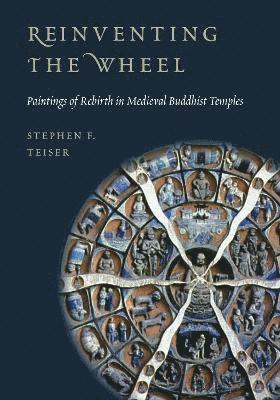
    Reinventing the Wheel

    Paintings of Rebirth in Medieval Buddhist Temples

    AvStephen F. Teiser

    Inbunden, Engelska, 2007

    Del i serien Reinventing the Wheel

    1 006 kr

    Tillfälligt slut

    Beskrivning

    Awarded the Prix Stanislas Julien by the Academie des Inscriptions et Belles-LettresThe Wheel of Rebirth is one of the most basic and popular images in Buddhist visual culture. For nearly two thousand years, artists have painted it onto the porches of Buddhist temples; preachers have used it to explain karmic retribution; and philosophers have invoked it to illuminate the contrast between ignorance and nirvana. In Reinventing the Wheel, noted scholar Stephen F. Teiser explores the history and varied interpretations of the Wheel of Rebirth, a circle divided into sections depicting the Buddhist cycle of transmigration.Combining visual evidence with textual sources, Reinventing the Wheel shows how the metaphor of the wheel has been interpreted in divergent local traditions, from India to Tibet, Central Asia, and China. Teiser deftly shows how written and painted renditions of the wheel have animated local architectural sites and religious rituals, informing concepts of time and reincarnation and acting as an organizing principle in the cosmology and daily life of practicing Buddhists.Engaging and accessible, this uniquely pan-Buddhist tour will appeal to anyone interested in Buddhist culture, as well as to scholars of religious studies, art history, architecture, philosophy, and textual studies.

    Produktinformation

    • Utgivningsdatum:2007-03-23
    • Mått:178 x 254 x undefined mm
    • Vikt:1 247 g
    • Format:Inbunden
    • Språk:Engelska
    • Serie:Reinventing the Wheel
    • Antal sidor:336
    • Förlag:University of Washington Press
    • ISBN:9780295986494

    Utforska kategorier

    • Konsthistoria inom Kultur
    • Arkitektur inom Kultur
    • Andra religioner och trosföreställningar inom Filosofi och religion

    Mer om författaren

    Stephen F. Teiser is D. T. Suzuki Professor in Buddhist Studies, Princeton University. He is the author of The Ghost Festival in Medieval China

    Recensioner i media

    Teiser . . . has a talent for explaining difficult concepts from the basics, and he includes references to popular or mass-media forms of contemporary Buddhism. His book is packed full of fascinating details and enlivened with translations of Buddhist narratives, legends, and miracle tales. This is a fine example of scholarship from the leading edge of the field of Buddhist studies. It will be appreciated and enjoyed by all those interested in the communication of ideas and the religious function of painted images.(History of Religions) [An] extraordinary book-length project . . . . Without question, Teiser has an extraordinary command of the material; he offers a rich, multilayered, multifaceted analysis that benefits from careful reading and rereading . . . . his methodological synthesis of visual and literary sources has significantly advanced the field of Buddhist studies, bridging the divide between Buddhist images and texts with a more productive collaborative and contextual analysis. This is a very important book that will long remain an enormously valuable resource to scholars and students.(Art Bulletin) [An] erudite and well-written study, one that deserves to be used as both a basic reference for the representation and history of wheels of rebirth as well as a methodological model for the study of Buddhist art.(CAA Reviews) Groundbreaking. . . . The gorgeous visuals, detailed maps, and line drawings materially herald an exciting new phase in Buddhology, pronouncing a long-awaited, mature marriage between art history and Buddhist studies. . . . Teiser has radically changed scholarly discourse and understanding. . . . A highly engaging, in-depth treatment of an important Buddhist symbol, this exquisitely produced book has much to offer to specialist readers and undergraduate students.(Journal of Chinese Religions) With keen aesthetic discernment, extensive historical scholarship, and sensitivity to Buddhist spirituality, this work seamlessly studies all significant aspects of the Buddhist wheel found in old Buddhist temples while bringing in relevant dimensions of Buddhist spirituality. Art, symbology, history, culture, and spirituality are interwoven in an engrossing, enlightening manner.(Midwest Book Review) A provocative and reliable account of an image that found its way from India to China in the medieval period and continues to play an important role in Buddhist practice and education in Tibet today.(Harvard Journal of Asiatic Studies) [This book] succeeds through an earnest engaging style and promises to garner in an exquisitely crafted production a wider audience for its subject.(Journal of Asian History)

    Innehållsförteckning

    • Preface and Acknowledgments1. Picturing Life and Death as a Wheel2. The Canonical Version of the Wheel of Rebirth3. Temples and Legends: Western India, 350-550 C.E.4. King Rudrayana's Painting of the Twelve Conditions5. La roue imaginaire en Chine6. Wheels for Meditation: Kumtura, Central Asia, Ninth Century7. Wheels in Cave Temples: Yulin, Gansu, Tenth Century8. Wheels in Esoteric Temples: Tabo, Western Tibet, Eleventh Century9. Wheels for Pilgrims: Baodingshan, Sichuan, Thirteenth Century10. ConclusionsCharacter GlossaryBibliographyIndex