• Fri frakt över 249 kr
  • •
  • Snabba leveranser
  • •
  • Billiga böcker
Kundservice

Du är på sajten för privatpersoner.

Företag, bibliotek eller offentlig verksamhet?

Du handlar på classic.bokus.com, där alla dina funktioner finns intakta.
Till classic.bokus.com
Bokus logotyp. Gå till startsidan.
  • Erbjudanden
  • Nyheter
  • Student
  • Topplistor
  • Barn & ungdom
  • Bokus Play
  • E-böcker
  • Pocketböcker
  • Spel & pussel

10% rabatt på allt med kod NYSTART10 →

Sidfot

Mina sidor

    Hjälp

    • Kundservice
    • Vanliga frågor och svar
    • Frakt och leverans
    • Retur vid ångerrätt
    • Reklamera vara
    • Betalning
    • Köpvillkor
    • Allmänna villkor
    • Information om webbplatsens tillgänglighet

    Om Bokus

    • Om oss
    • Pressrum
    • För studenter
    • För företag
    • För bibliotek och offentlig verksamhet
    • För leverantörer
    • Hållbarhet

    Populärt

    • Aktuella erbjudanden
    • Presentkort
    • Studentlitteratur
    • Nya böcker
    • Topplistor
    • Signerade böcker
    • Engelska böcker

    Inspiration

    • Boktips
    • BookTok
    • Populära bokserier
    • Barnbokskaraktärer
    • Populära författare
    Logotyp för Bokus
    Följ oss på Facebook (extern länk)Följ oss på Instagram (extern länk)Följ oss på YouTube (extern länk)Följ oss på TikTok (extern länk)
    bokus @ CookiesAnpassa cookiesIntegritetspolicyKöpvillkor
    Till Citymail hemsida (extern länk)Till Budbee hemsida (extern länk)Till Postnord hemsida (extern länk)Till Schenker hemsida (extern länk)Till Early Bird hemsida (extern länk)Till Walleys hemsida (extern länk)
    1. Historia och arkeologi
    2. Historia
    3. Europas historia

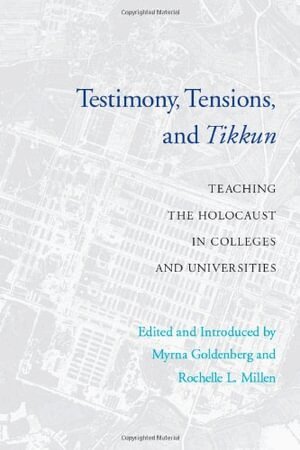
    Testimony, Tensions, and Tikkun

    Teaching the Holocaust in Colleges and Universities

    AvMyrna Goldenberg,Rochelle L. Millen

    Inbunden, Engelska, 2007

    Del i serien Testimony, Tensions, and Tikkun

    1 030 kr

    Beställningsvara. Skickas inom 5-8 vardagar. Fri frakt över 249 kr.

    Beskrivning

    The Holocaust was a cataclysmic upheaval in politics, culture, society, ethics, and theology. The very fact of its occurrence has been forcing scholars for more than sixty years to assess its impact on their disciplines. Educators whose work is represented in this volume ask their students to grapple with one of the grand horrors of the twentieth century and to accept the responsibility of building a more just, peaceful world (tikkun olam). They acknowledge that their task as teachers of the Holocaust is both imperative and impossible; they must “teach something that cannot be taught,” as one contributor puts it, and they recognize the formidable limits of language, thought, imagination, and comprehension that thwart and obscure the story they seek to tell. Yet they are united in their keen sense of pursuing an effort that is pivotal to our understanding of the past-and to whatever prospects we may have for a more decent and humane future.A “Holocaust course” refers to an instructional offering that may focus entirely on the Holocaust; may serve as a touchstone in a larger program devoted to genocide studies; or may constitute a unit within a wider curriculum, including art, literature, ethics, history, religious studies, jurisprudence, philosophy, theology, film studies, Jewish studies, German studies, composition, urban studies, or architecture. It may also constitute a main thread that runs through an interdisciplinary course.The first section of Testimony, Tensions, and Tikkun can be read as an injunction to teach and act in a manner consistent with a profound cautionary message: that there can be no tolerance for moral neutrality about the Holocaust, and that there is no subject in the humanities or social sciences where its shadow has not reached. The second section is devoted to the process and nature of students' learning. These chapters describe efforts to guide students through terrain that hides cognitive and emotional land mines. The authors examine their responsibility to foster students' personal connection with the events of the Holocaust, but in such a way that they not instill hopelessness about the future. The third and final section moves the subject of the Holocaust out of the classroom and into broader institutional settings-universities and community colleges and their surrounding communities, along with museums and memorial sites.For the educators represented here, teaching itself is testimony. The story of the Holocaust is one that the world will fail to master at its own peril.The editors of this volume, and many of its contributors, are members of the Pastora Goldner Holocaust Symposium. Led since its founding in 1996 by Leonard Grob and Henry F. Knight, the symposium's scholars--a group that is interfaith, international, interdisciplinary, and intergenerational--meet biennially in Oxfordshire, England.

    Produktinformation

    • Utgivningsdatum:2007-06-07
    • Mått:152 x 229 x undefined mm
    • Vikt:617 g
    • Format:Inbunden
    • Språk:Engelska
    • Serie:Testimony, Tensions, and Tikkun
    • Antal sidor:336
    • Förlag:University of Washington Press
    • ISBN:9780295986876

    Utforska kategorier

    • Europas historia inom Historia och arkeologi
    • Andra världskriget inom Historia och arkeologi
    • Undervisning i specifika ämnen inom Psykologi och pedagogik

    Mer om författaren

    Myrna Goldenberg is professor emerita, Montgomery College, Maryland, founding director of the Paul Peck Humanities Institute at Montgomery, and adjunct professor at the University of Maryland and Johns Hopkins University. Rochelle L. Millen is professor of religion at Wittenberg University, Springfield, Ohio. Other contributors include Beth Hawkins Benedix, Timothy A. Bennett, David R. Blumenthal, Stephen Feinstein, Donald Felipe, Leonard Grob, Marilyn J. Harran, Henry F. Knight, Paul A. Levine, Juergen Manemann, Rachel Rapperport Munn, Tam Parker, David Patterson, Didier Pollefeyt, Amy Shapiro, Stephen D. Smith, Laurinda Stryker, and Mary Todd.

    Recensioner i media

    "In a well-organized format, the editors of the book have compiled a highly readable set of essays offering practical suggestions for educators across the disciplines..Not only do these expert teachers encourage other instructors to include outcomes related to ethics and morals on a class syllabus, but they also encourage teachers and their students to use course material as a force for change and resistance."

    Innehållsförteckning

    • Foreword / Hubert G. LockeAcknowledgmentsIntroduction / Myrna Goldenberg and Rochelle L. MillenPart One: Course Content1. Use of the Arts in the Classroom: An Unexpected Alternative / Stephen Feinstein2. History, Memory, and City: Case Study-Berlin / Rachel Rapperport Munn3. Looking for Words: Teaching the Holocaust in Writing-Intensive Courses / Beth Hawkins4. Teaching Business Ethics and the Holocaust / Donald Felipe5. Teaching the Holocaust: The Ethics of "Witness" History / Tam Parker6. From the Archive to the Classroom: Reflections on Teaching the History of the Holocaust in Different Countries / Paul A. Levine7. Teaching as Testimony: Pedagogical Peculiarities of Teaching the Holocaust / David Patterson8. Histories: Betrayed and Unfulfilled / Timothy A. Bennett and Rochelle L. Millen9. Cross-Disciplinary Notes: Four Questions for Teaching the Shoah / David R. Blumenthal10. Developing Criteria for Religious and Ethical Teaching of the Holocaust / Didier PollefeytPart Two: The Process and Nature of Student Learning11. Students' Affective Responses to Studying the Holocaust: Pedagogical Issues and an Interview Process / Amy Shapiro12. Keeping the Faith: Exploring the Holocaust with Christian Students / Mary Todd13. Teaching Theology after Auschwitz: A Political-Theological Perspective / Juergen ManemannPart Three: Progress and Process: Higher Education, Museums, and Memorials 14. The Tensions of Teaching: Truth and Consequences / Laurinda Stryker15. An Unlikely Setting: Holocaust Education in Orange County / Marilyn J. Harran16. The Importance of Teaching the Holocaust in Community College: Democratizing the Study of the Holocaust / Myrna Goldenberg17. Teaching about the Holocaust in the Setting of Museums and Memorials / Stephen D. Smith18. Dialogue at the Threshold: The Pastora Goldner Symposium and the Work of Tikkun Olam / Leonard Grob and Henry F. KnightAbout the Editors and ContributorsIndex