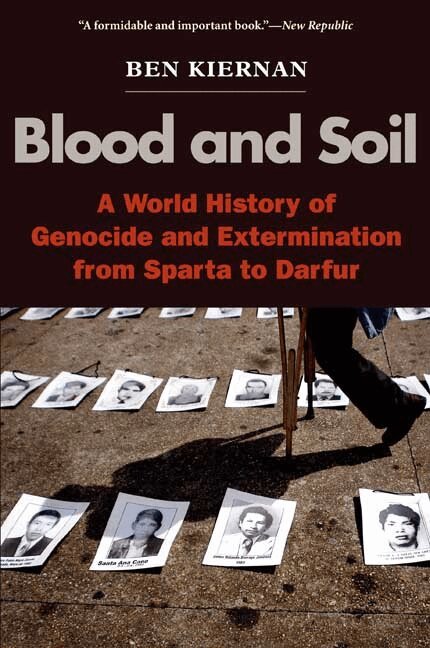
Blood and Soil
A World History of Genocide and Extermination from Sparta to Darfur
322 kr
Beställningsvara. Skickas inom 5-8 vardagar. Fri frakt över 249 kr.
Du är på sajten för privatpersoner.
322 kr
Beställningsvara. Skickas inom 5-8 vardagar. Fri frakt över 249 kr.
Ben Kiernan is the A. Whitney Griswold Professor of History, professor of international and area studies, and the founding director of the Genocide Studies Program at Yale University (www.yale.edu/gsp). His previous books include How Pol Pot Came to Power: Colonialism, Nationalism, and Communism in Cambodia, 1930–1975 and The Pol Pot Regime: Race, Power, and Genocide in Cambodia under the Khmer Rouge, 1975-1979, published by Yale University Press.
"Humans have been slaughtering each other for thousands of years, but only now is the field of genocide studies blooming. This grim account of history notes remarkable parallels in the patterns of mass slaughter, from Carthage to Darfur. With references to the genocides sanctioned by the Bible, it's ghastly reading. Yet you also can't help feeling a measure of progress over the centuries. Today, we're still far too passive about stopping genocide, but even those leaders who engage in it tend to be embarrassed, rather than boastful."—Nicholas D. Kristof, New-York Historical Society series "Books That Matter," New York Times Book Review "This grim account of history notes remarkable parallels in the patterns of mass slaughter, from Carthage to Darfur. With references to the genocides sanctioned by the Bible, it's ghastly reading. Yet you also can't help feeling a measure of progress over the centuries."—Nicholas D. Kristof, New-York Historical Society series "Books That Matter," New York Times Book Review "As a narrative history it is well-written, impressively researched, and affords many useful comparative insights. . . . One of the book's great strengths is its truly global sweep . . . One of the services the book performs is to highlight the ubiquity of mass killings in human history. . . . Along the way, there is much revelatory, intriguing and disturbing information to be gleaned. . . . Thorough though he is in cataloguing this history of horrors, Kiernan is careful to draw distinctions among various scales of killing and diverse forms of motivation."—Aviel Roshwald, Nationalities Papers"Kiernan identifies four necessary ingredients in the making of a genocidal situation . . . [Blood and Soil] also recognises the crucial processes that underpin their combination into an explosive mixture. Genocidal phenomena, Kiernan argues insightfully, are actually inherently contradictory occurrences where an anxious perception of a specific trend, or a series of developments, produces sustained counterpoint imaginings. Reality is going, or seems to be going one way, while the imagination proceeds in the opposite direction . . . Kiernan is right: all the atrocities he deals with in his narrative – and he deals with quite a few – display all these elements . . . [A] reliable compilation of genocidal phenomena, their chronology and genealogy . . . Kiernan endeavours effectively to impose a remarkable structuring coherence on an impressive amount of data. At the same time, he convincingly emphasises discursive links and resonances between different epochs and locations. You try and write a book like this."—Lozenzo Veracini, geschichte.transnational and H-Soz-u-Kult, H-Net Reviews"Genocide scholars and those with an interest in world history should be grateful for Kiernan's latest stimulating work."—Donald W. Beachler, Holocaust and Genocide StudiesWinner of the 2008 gold medal for the best book in History awarded by the Independent Publishers AssociationWinner of the 2009 Sybil Halpern Milton Book Prize for the best book in Holocaust Studies published in 2007-2008, given by the German Studies AssociationThe German edition, Erde und Blut: Völkermord und Vernichtung von der Antike bis heute, won first place in Germany’s Nonfiction Book of the Month Prize Die Sachbücher des Monats, sponsored by Süddeutsche Zeitung and NDR Kultur (June 2009)"In exploring the global 'prehistory' of the horrific forms of societal violence usually associated with the twentieth century, Kiernan identifies key factors that have been consistently associated with genocidal episodes. His book makes an original contribution to our understanding of the phenomenon."—Michael Adas, Rutgers University"Ben Kiernan’s Blood and Soil is a major work explaining myths and metaphors that have underwritten genocide for six hundred years—earlier within the bowels of the western tradition; now commonplace practice far beyond that tradition. In seeing genocide as linked to issues of land as well as race, nation, and expansion, Kiernan has opened up social, political, and economic analysis to the struggle for land and the control of property. Such an approach is unique as it is provocative. It is inspired by the author’s profound reading of Cambodia and Southeast Asia. Blood and Soil provides an angle of vision rarely found in those who start (and stop) with a European base of scholarship. The book opens up new questions and formulations on the nature of state inspired murder. It merits a close reading of the dark side of terror, often commented upon, but rarely probed."—Irving Louis Horowitz, Rutgers University "Blood and Soil is a stunning achievement. The idea for the project was clearly a prompting of the heart, but the argument itself is a thing of pure intellect. It surveys thousands of years, visits every corner of the world, and stares with scarcely a blink at the worst horrors the world has ever known. As an act of scholarship, it simply stands alone."—Kai Erikson, Yale University"Ben Kiernan’s book is a major contribution to genocide studies—a first attempt to tell the history of genocidal events, from Sparta to Darfur, Blood and Soil is a well-researched, detailed account of many instances of mass killings and the reasons for their occurrence. It will no doubt give rise to controversy, new research, and new insights."—Yehuda Bauer, Yad Vashem
Anton Weiss-Wendt, Robert Krieken, Alfred A. Cave, Ben Kiernan, Doris Bergen, David Moshman, Victoria Sanford, John Docker, Robert Hitchcock, D. Stone
Häftad, 2008
1 250 kr
Robert Hitchcock, John Docker, Victoria Sanford, David Moshman, Doris Bergen, Ben Kiernan, Alfred A. Cave, Robert Krieken, Anton Weiss-Wendt, D. Stone
1 684 kr
Eve Monique Zucker, Ben Kiernan
Inbunden, 2021
2 552 kr
Tristan S. Taylor, T. M. Lemos, Ben Kiernan
657 kr
Tristan S. Taylor, T. M. Lemos, Ben Kiernan
657 kr
Rebe Taylor, Benjamin Madley, Ben Kiernan, Ned Blackhawk
657 kr
Ned Blackhawk, Ben Kiernan, Benjamin Madley, Rebe Taylor
Inbunden, 2023
2 257 kr
Du är på sajten för privatpersoner.
322 kr
Beställningsvara. Skickas inom 5-8 vardagar. Fri frakt över 249 kr.
Ben Kiernan is the A. Whitney Griswold Professor of History, professor of international and area studies, and the founding director of the Genocide Studies Program at Yale University (www.yale.edu/gsp). His previous books include How Pol Pot Came to Power: Colonialism, Nationalism, and Communism in Cambodia, 1930–1975 and The Pol Pot Regime: Race, Power, and Genocide in Cambodia under the Khmer Rouge, 1975-1979, published by Yale University Press.
"Humans have been slaughtering each other for thousands of years, but only now is the field of genocide studies blooming. This grim account of history notes remarkable parallels in the patterns of mass slaughter, from Carthage to Darfur. With references to the genocides sanctioned by the Bible, it's ghastly reading. Yet you also can't help feeling a measure of progress over the centuries. Today, we're still far too passive about stopping genocide, but even those leaders who engage in it tend to be embarrassed, rather than boastful."—Nicholas D. Kristof, New-York Historical Society series "Books That Matter," New York Times Book Review "This grim account of history notes remarkable parallels in the patterns of mass slaughter, from Carthage to Darfur. With references to the genocides sanctioned by the Bible, it's ghastly reading. Yet you also can't help feeling a measure of progress over the centuries."—Nicholas D. Kristof, New-York Historical Society series "Books That Matter," New York Times Book Review "As a narrative history it is well-written, impressively researched, and affords many useful comparative insights. . . . One of the book's great strengths is its truly global sweep . . . One of the services the book performs is to highlight the ubiquity of mass killings in human history. . . . Along the way, there is much revelatory, intriguing and disturbing information to be gleaned. . . . Thorough though he is in cataloguing this history of horrors, Kiernan is careful to draw distinctions among various scales of killing and diverse forms of motivation."—Aviel Roshwald, Nationalities Papers"Kiernan identifies four necessary ingredients in the making of a genocidal situation . . . [Blood and Soil] also recognises the crucial processes that underpin their combination into an explosive mixture. Genocidal phenomena, Kiernan argues insightfully, are actually inherently contradictory occurrences where an anxious perception of a specific trend, or a series of developments, produces sustained counterpoint imaginings. Reality is going, or seems to be going one way, while the imagination proceeds in the opposite direction . . . Kiernan is right: all the atrocities he deals with in his narrative – and he deals with quite a few – display all these elements . . . [A] reliable compilation of genocidal phenomena, their chronology and genealogy . . . Kiernan endeavours effectively to impose a remarkable structuring coherence on an impressive amount of data. At the same time, he convincingly emphasises discursive links and resonances between different epochs and locations. You try and write a book like this."—Lozenzo Veracini, geschichte.transnational and H-Soz-u-Kult, H-Net Reviews"Genocide scholars and those with an interest in world history should be grateful for Kiernan's latest stimulating work."—Donald W. Beachler, Holocaust and Genocide StudiesWinner of the 2008 gold medal for the best book in History awarded by the Independent Publishers AssociationWinner of the 2009 Sybil Halpern Milton Book Prize for the best book in Holocaust Studies published in 2007-2008, given by the German Studies AssociationThe German edition, Erde und Blut: Völkermord und Vernichtung von der Antike bis heute, won first place in Germany’s Nonfiction Book of the Month Prize Die Sachbücher des Monats, sponsored by Süddeutsche Zeitung and NDR Kultur (June 2009)"In exploring the global 'prehistory' of the horrific forms of societal violence usually associated with the twentieth century, Kiernan identifies key factors that have been consistently associated with genocidal episodes. His book makes an original contribution to our understanding of the phenomenon."—Michael Adas, Rutgers University"Ben Kiernan’s Blood and Soil is a major work explaining myths and metaphors that have underwritten genocide for six hundred years—earlier within the bowels of the western tradition; now commonplace practice far beyond that tradition. In seeing genocide as linked to issues of land as well as race, nation, and expansion, Kiernan has opened up social, political, and economic analysis to the struggle for land and the control of property. Such an approach is unique as it is provocative. It is inspired by the author’s profound reading of Cambodia and Southeast Asia. Blood and Soil provides an angle of vision rarely found in those who start (and stop) with a European base of scholarship. The book opens up new questions and formulations on the nature of state inspired murder. It merits a close reading of the dark side of terror, often commented upon, but rarely probed."—Irving Louis Horowitz, Rutgers University "Blood and Soil is a stunning achievement. The idea for the project was clearly a prompting of the heart, but the argument itself is a thing of pure intellect. It surveys thousands of years, visits every corner of the world, and stares with scarcely a blink at the worst horrors the world has ever known. As an act of scholarship, it simply stands alone."—Kai Erikson, Yale University"Ben Kiernan’s book is a major contribution to genocide studies—a first attempt to tell the history of genocidal events, from Sparta to Darfur, Blood and Soil is a well-researched, detailed account of many instances of mass killings and the reasons for their occurrence. It will no doubt give rise to controversy, new research, and new insights."—Yehuda Bauer, Yad Vashem
Anton Weiss-Wendt, Robert Krieken, Alfred A. Cave, Ben Kiernan, Doris Bergen, David Moshman, Victoria Sanford, John Docker, Robert Hitchcock, D. Stone
Häftad, 2008
1 250 kr
Robert Hitchcock, John Docker, Victoria Sanford, David Moshman, Doris Bergen, Ben Kiernan, Alfred A. Cave, Robert Krieken, Anton Weiss-Wendt, D. Stone
1 684 kr
Eve Monique Zucker, Ben Kiernan
Inbunden, 2021
2 552 kr
Tristan S. Taylor, T. M. Lemos, Ben Kiernan
657 kr
Tristan S. Taylor, T. M. Lemos, Ben Kiernan
657 kr
Rebe Taylor, Benjamin Madley, Ben Kiernan, Ned Blackhawk
657 kr
Ned Blackhawk, Ben Kiernan, Benjamin Madley, Rebe Taylor
Inbunden, 2023
2 257 kr