• Fri frakt över 249 kr
  • •
  • Snabba leveranser
  • •
  • Billiga böcker
Kundservice

Du är på sajten för privatpersoner.

Företag, bibliotek eller offentlig verksamhet?

Du handlar på classic.bokus.com, där alla dina funktioner finns intakta.
Till classic.bokus.com
Bokus logotyp. Gå till startsidan.
  • Erbjudanden
  • Nyheter
  • Student
  • Topplistor
  • Barn & ungdom
  • Bokus Play
  • E-böcker
  • Pocketböcker
  • Spel & pussel

10% rabatt på allt med kod: NYSTART10 →

Sidfot

Mina sidor

    Hjälp

    • Kundservice
    • Vanliga frågor och svar
    • Frakt och leverans
    • Retur vid ångerrätt
    • Reklamera vara
    • Betalning
    • Köpvillkor
    • Allmänna villkor
    • Information om webbplatsens tillgänglighet

    Om Bokus

    • Om oss
    • Pressrum
    • För studenter
    • För företag
    • För bibliotek och offentlig verksamhet
    • För leverantörer
    • Hållbarhet

    Populärt

    • Aktuella erbjudanden
    • Presentkort
    • Studentlitteratur
    • Nya böcker
    • Topplistor
    • Signerade böcker
    • Engelska böcker

    Inspiration

    • Boktips
    • BookTok
    • Populära bokserier
    • Barnbokskaraktärer
    • Populära författare
    Logotyp för Bokus
    Följ oss på Facebook (extern länk)Följ oss på Instagram (extern länk)Följ oss på YouTube (extern länk)Följ oss på TikTok (extern länk)
    bokus @ CookiesAnpassa cookiesIntegritetspolicyKöpvillkor
    Till Citymail hemsida (extern länk)Till Budbee hemsida (extern länk)Till Postnord hemsida (extern länk)Till Schenker hemsida (extern länk)Till Early Bird hemsida (extern länk)Till Walleys hemsida (extern länk)
    1. Historia och arkeologi
    2. Historia
    3. Historia: särskilda händelser och ämnen
    4. Socialhistoria och kulturhistoria

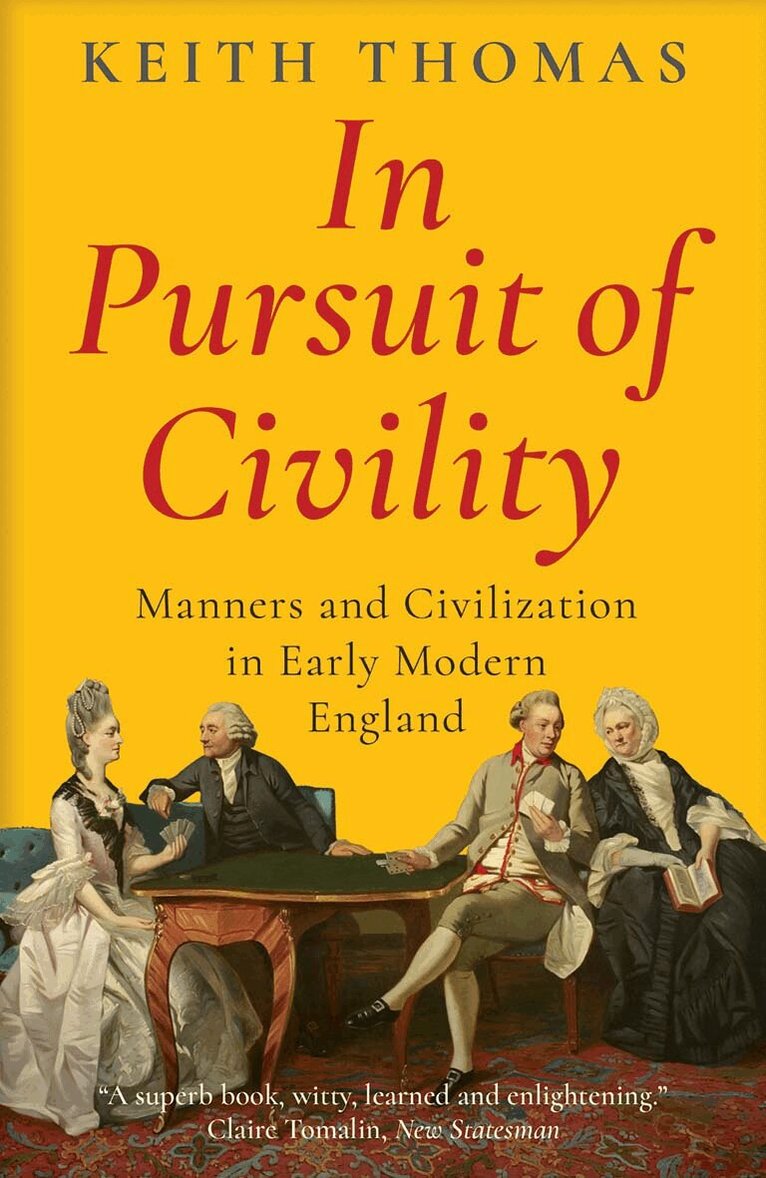
    In Pursuit of Civility

    Manners and Civilization in Early Modern England

    AvKeith Thomas

    Häftad, Engelska, 2020

    156 kr

    Beställningsvara. Skickas inom 5-8 vardagar. Fri frakt över 249 kr.

    Fler format och utgåvor

    Inbunden

    Tillf. slut

    Beskrivning

    A SUNDAY TIMES, EVENING STANDARD, SPECTATOR AND NEW STATESMAN BOOK OF THE YEAR“In this gloriously rich book, Keith Thomas, one of our greatest living historians, explores how the idea of civility, from lavatory habits to table manners, evolved in early modern England.”—Dominic Sandbrook, Sunday Times“One of the most entertaining books imaginable.”—Philip Hensher, Spectator"Our finest living historian gives a dismayingly entertaining survey of what was held to be civilised behaviour and what barbarous in England between 1500 and 1800.”—Claire Tomalin, New Statesman   Keith Thomas's seminal studies Religion and the Decline of Magic, Man and the Natural World, and The Ends of Life, explored the beliefs, values and social practices of the years between 1500 and 1800. In Pursuit of Civility continues this quest by examining what the English people thought it meant to be `civilized' and how that condition differed from being `barbarous' or `savage' .  Thomas shows how the upper ranks of society sought to distinguish themselves from their social inferiors by developing distinctive forms of moving, speaking and comporting themselves - and how the common people in turn developed their own forms of civility.  The belief of the English in their superior civility shaped their relations with the Welsh, the Scots and the Irish. By legitimizing international trade, colonialism, slavery, and racial discrimination, it was fundamental to their dealings with the native peoples of North America, India, and Australia.   Yet not everyone shared this belief in the superiority of Western civilization. In Pursuit of Civility throws light on the early origins of anti-colonialism and cultural relativism, and goes on to examine some of the ways in which the new forms of civility were resisted.    With all the author’s distinctive authority and brilliance - based as ever on wide reading, abounding in fresh insights, and illustrated by many striking quotations and anecdotes from contemporary sources - In Pursuit of Civility transforms our understanding of the past. In so doing, it raises important questions as to the role of manners in the modern world.

    Produktinformation

    • Utgivningsdatum:2020-04-14
    • Mått:197 x 129 x 41 mm
    • Vikt:542 g
    • Format:Häftad
    • Språk:Engelska
    • Antal sidor:490
    • Förlag:Yale University Press
    • ISBN:9780300251524

    Utforska kategorier

    • Socialhistoria och kulturhistoria inom Historia och arkeologi
    • Europas historia inom Historia och arkeologi

    Mer om författaren

    Sir Keith Thomas is an honorary fellow of All Souls College, Oxford, and a historian of early modern Britain. His classic works include Religion and the Decline of Magic and Man and the Natural World.

    Recensioner i media

    “No one masters so many primary and secondary sources. . . given character by the elegance and lightness of his literary touch. . . You will not read a work of wider interest on Thomas’s period.”—Blair Worden, Literary Review“This book is a fully realised successor to those classics by Thomas, Religion and the Decline of Magic and Man and the Natural World. . . The command of evidence is extraordinary, and the final result is of a huge poly-phony, as different voices disagree, conflict, reinforce each other and undermine another’s point of view. It is funny as well as heartbreaking, absurd as well as chilling. There is hardly a page without half a dozen extraordinary incidents, statements or facts — and the 100 pages of notes are a tour-de-force of learned command, intelligent investigation and compelling judgment. There can hardly be a more convincing statement of what civilisation means than Keith Thomas’s own work.”—Philip Hensher, Spectator“There is much scope for honest praise in this learned, humane and wide-ranging book, based on a lifetime’s reading in both early modern sources and recent scholarship on English social and cultural history.”—Ann Hughes, THES“Keith Thomas’s wonderful book, which is both erudite and energising, thoughtfully confirms that the way in which cultures deal with ethnic, religious and behavioural differences, as well as the often despised poor, is an index of its true civility. . . ought to be read and meditated upon by our increasingly boorish political classes.”—Brian Young, Daily Telegraph“Gloriously rich...an irresistible mosaic of 17th- and 18th-century life.” — Dominic Sandbrook, The Sunday Times“The result is as entertaining as it is erudite.” — William Moore, Evening Standard“The author of the classic Religion and the Decline of Magic, Thomas is a national treasure who should be cloned so that future generations can benefit from his intelligence and urbane sensibility. . . His research is impressive, but even more so is his ability to bring the past alive by letting people such as Defoe and Swift tell their stories. This is a very civilised book.”—Gerard DeGroot, The Times  “Thomas is one of Britain’s greatest living historians. . . In the final pages of his hugely rich and impressive book, [he] makes a strong case for the defence. What civility boiled down to, he says, was kindness, decency and cleanliness. And in some ways we have a lot to learn from our forebears.”—Dominic Sandbrook, Sunday Times“In Pursuit of Civility is a highly readable account of the ways in which the English have defined themselves and those around them, as well as of dissident voices who persistently criticised such fashioning. It also reminds us that we are part of a much older, global conversation about pluralism, difference and what it means to be members of the human species.”—Emily Jones, Financial Times“[A] fascinating but disquieting book about the history of English civility.”—Ysenda Maxtone Graham, Daily Mail“Reading [In Pursuit of Civility] is like listening to a continuous conversation between countless articulate voices from the past. . . A beautifully written and continuously stimulating tour-de-force.”—Fara Dabhoiwala, Guardian“Resting on an awesome foundation of scholarship, unobtrusively available in the endnotes, richly illustrated by contemporary quotations and produced in a handsome and remarkably affordable hardback, this is a book to ponder, to savour and to enjoy.”—Martin Wellings, Methodist Recorder“One of the most entertaining books imaginable.” —Philip Hensher, The Spectator (Books of the year 2018)"Our finest living historian gives a dismayingly entertaining survey of what was held to be civilised behaviour and what barbarous in England between 1500 and 1800.” —Claire Tomalin, New Statesman (Books of the Year)“Keith Thomas touches on the sentiment in his latest book on the history of early­modern England, in which he seeks, in his own words, ‘to demonstrate the importance of the ideals of civility and civilisation’ in England between the Reformation and the French Revolution.” — Serenhedd James, Church Times“Keith Thomas has produced a delightfully quirky book about how the English learnt to be nice.” —Gerard De Groot, The Times Ireland“A lively, engaging and perceptive book on the topic of civility in early modern England.” —Joan Redmond, Reviews in History“A thorough, lavishly illustrated account” —Karen Serres, The Burlington Magazine“A distinguished contribution to the "historical ethnography of early modern England" ” —Arnold Hunt, Times Literary Supplement“Brilliant study” —Bernard Richards, Oxford Magazine“A prodigious range of reference” — John Gallagher, LRB“In this magisterial study, Keith Thomas explores the history of socio-anthropological ideas about ‘manners’. They include not just conventional codes of politeness (such as behaviour at table) but the social customs which underpin all interpersonal relationships.”—Penelope J. Corfield, Cultural and Social History