• Fri frakt över 249 kr
  • •
  • Snabba leveranser
  • •
  • Billiga böcker
Kundservice

Du är på sajten för privatpersoner.

Företag, bibliotek eller offentlig verksamhet?

Du handlar på classic.bokus.com, där alla dina funktioner finns intakta.
Till classic.bokus.com
Bokus logotyp. Gå till startsidan.
  • Erbjudanden
  • Nyheter
  • Student
  • Topplistor
  • Barn & ungdom
  • Bokus Play
  • E-böcker
  • Pocketböcker
  • Spel & pussel

10% rabatt på allt med kod: NYSTART10 →

Sidfot

Mina sidor

    Hjälp

    • Kundservice
    • Vanliga frågor och svar
    • Frakt och leverans
    • Retur vid ångerrätt
    • Reklamera vara
    • Betalning
    • Köpvillkor
    • Allmänna villkor
    • Information om webbplatsens tillgänglighet

    Om Bokus

    • Om oss
    • Pressrum
    • För studenter
    • För företag
    • För bibliotek och offentlig verksamhet
    • För leverantörer
    • Hållbarhet

    Populärt

    • Aktuella erbjudanden
    • Presentkort
    • Studentlitteratur
    • Nya böcker
    • Topplistor
    • Signerade böcker
    • Engelska böcker

    Inspiration

    • Boktips
    • BookTok
    • Populära bokserier
    • Barnbokskaraktärer
    • Populära författare
    Logotyp för Bokus
    Följ oss på Facebook (extern länk)Följ oss på Instagram (extern länk)Följ oss på YouTube (extern länk)Följ oss på TikTok (extern länk)
    bokus @ CookiesAnpassa cookiesIntegritetspolicyKöpvillkor
    Till Citymail hemsida (extern länk)Till Budbee hemsida (extern länk)Till Postnord hemsida (extern länk)Till Schenker hemsida (extern länk)Till Early Bird hemsida (extern länk)Till Walleys hemsida (extern länk)
    1. Djur och Natur
    2. Naturböcker
    3. Växtböcker

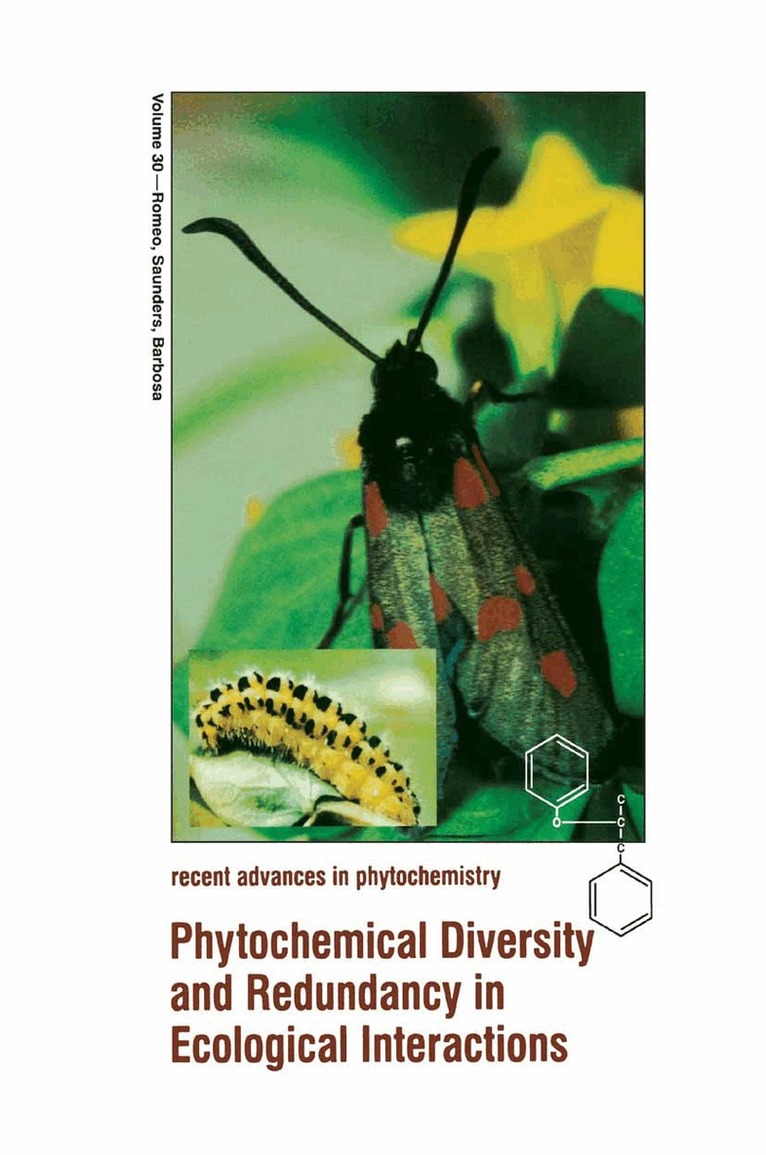
    Phytochemical Diversity and Redundancy in Ecological Interactions

    AvPhytochemical Society of North America,John T. Romeo

    Inbunden, Engelska, 1996

    Del i serien Recent Advances in Phytochemistry

    1 626 kr

    Beställningsvara. Skickas inom 10-15 vardagar. Fri frakt över 249 kr.

    Beskrivning

    Diversity within and among living organisms is both a biological impera­ tive and a biological conundrum. Phenotypic and genotypic diversity is the critical currency ofecological interactions and the evolution of life. Thus, it is not unexpected to find vast phytochemical diversity among plants. However, among the most compelling questions which arise among those interested in ecological phytochemistry is the extent, nature, and reasons for the diversity of chemieals in plants. The idea that natural products (secondary metabolites) are accidents of metabolism and have no biological function is an old one which has resurfaced recently under a new term "redundancy. " Redundancy in the broader sense can be viewed as duplication of effort. The co-occurrence of several classes of phytochemieals in a given plant may be redundancy. Is there unnecessary duplication of chemical defense systems and ifso, why? What selective forces have produced this result? On the other hand, why does the same compound often have multiple functions? At a symposium of the Phytochemical Society of North America held in August 1995, in Sault Ste. Marie, Ontario, Canada, the topic "Phytochernical Redundancy in Ecological Interactions" was discussed. The chapters in this volume are based on that symposium. They both stimulate thought and provide some working hypotheses for future research. It is being increasingly recognized that functional diversity and multiplicity of function of natural products is the norm rather than the exception.

    Produktinformation

    • Utgivningsdatum:1996-11-30
    • Mått:155 x 235 x 24 mm
    • Vikt:635 g
    • Format:Inbunden
    • Språk:Engelska
    • Serie:Recent Advances in Phytochemistry
    • Antal sidor:319
    • Upplaga:1996
    • Förlag:Springer Science+Business Media
    • ISBN:9780306455001

    Utforska kategorier

    • Växtböcker inom Djur och Natur
    • Biokemi inom Naturvetenskap och teknik
    • Botanik inom Naturvetenskap och teknik

    Innehållsförteckning

    • Phytochemistry and Diversity: Adaptation or Random Variation? M.R. Berenbaum, A.R. Zanger. Diversity, Redundancy and Multiplicity in Chemical Defense Systems of Aspen; R.L. Lindroth, S.Y. Hwang. Diversity and Dynamics of Crucifer Defenses against Adults and Larvae of Cabbage Butterflies; J.A.A. Renwick. Defensive Chemicals in Grass-Fungal Endophyte Associations; M.R. Siegel, L.P. Bush. Multiple Defenses and Signals in Plant Defense against Pathogens and Herbivores; R. Hammerschmidt, J.C. Schultz. Phytochemistry of the Meliceae: So Many Terpenoids, So Few Insecticides; M.B. Isman, et al. The Role of Mixtures and Variation in the Production of Terpenoids in Conifer-Insect-Pathogen Interactions; R.G. Cates. Relationships between the Defense Systems of Plants and Insects: The Cyanogenic System of the Moth Zygaena trifolii; A. Nahrstedt. Polyphenol Oxidase as a Component of the Inducible Defense Response in Tomato against Herbivores; C.P. Constabel, et al. The Role of Benzoic Acid Derivatives in Systemic Acquired Resistance; S. Uknes, et al. Natural Products, Complexity, and Evolution; B.B. Jarvis, J.D. Miller. An Explanation of Secondary Product Redundancy; R.D. Firn, C.G. Jones. Index.