Inbunden, Engelska, 1997
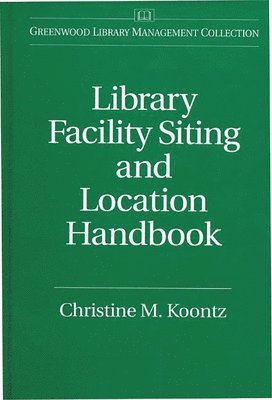
Library Facility Siting and Location Handbook
1127 kr
Beställningsvara. Skickas inom 10-15 vardagar. Fri frakt över 249 kr.
Beskrivning
Because libraries are costly to build, the location of new library facilities, as well as closures or mergers of existing ones, must be carefully analyzed. Numerous factors must be taken into account, including community demographics and information needs, the closeness of the proposed library site to prospective users, the presence and proximity of other library facilities, the elasticity of user demand, and the accessibility of the location. This professional reference provides a complete discussion of library facility siting and relocation issues, discusses marketing concepts of relevance to library managers in siting library facilities, and offers practical advice on how to locate library facilities to most effectively serve the local population. The volume provides a thorough review of the history of library siting and library location research, and it examines statistical models for site selection. Special attention is given to the use of Geographic Information Systems, and the handbook includes several case studies, including examples from increasingly common examples from majority-minority library markets.Libraries are a central feature of most communities. Because they are costly to build as well as to relocate, the location of library facilities must be carefully considered. Numerous factors determine the effective siting of library facilities. The demographic characteristics of the community help indicate how many people are likely to use the library and for what purposes; income levels help indicate the elasticity of demand for information; the presence and proximity of existing facilities further determines the likely market for the library; and the nature of transportation within the area dictates the accessibility of a proposed site. Moreover, siting decisions are not limited to the construction of new buildings, for librarians must also consider the expansion, merger, and closure of existing facilities. Library location theory is not well developed, and relevant literature has not heretofore been summarized conveniently.As a professional reference, this handbook is a guide to the complex process of library facility siting and location. While the bulk of the volume provides practical information, the work also presents an historical and theoretical context for siting decisions. Chapter 1 examines some of the issues that shape the location of library facilities, such as the growth of electronic access to information and the debate over the library as a place; Chapter 2 offers a review of the spatial development of the American public library and the history of library facility siting; Chapter 3 reviews research on library location; Chapter 4 discusses statistical modelling; Chapter 5 provides a sample library location model for diverse urban environments; and Chapter 6 examines the value of Geographic Information System software in library siting decisions. An appendix of case studies and an extensive bibliography conclude the volume.
Produktinformation
- Utgivningsdatum: 1997-05-28
- Mått: 156 x 235 x 18 mm
- Vikt: 510 g
- Format: Inbunden
- Språk: Engelska
- Serie: Libraries Unlimited Library Management Collection
- Antal sidor: 224
- Förlag: Bloomsbury Publishing Plc
- ISBN: 9780313286827
Utforska kategorier
Betyg & recensioner
0 recensioner
Inga recensioner tillgängliga.