• Fri frakt över 249 kr
  • •
  • Snabba leveranser
  • •
  • Billiga böcker
Kundservice

Du är på sajten för privatpersoner.

Företag, bibliotek eller offentlig verksamhet?

Du handlar på classic.bokus.com, där alla dina funktioner finns intakta.
Till classic.bokus.com
Bokus logotyp. Gå till startsidan.
  • Erbjudanden
  • Nyheter
  • Student
  • Topplistor
  • Barn & ungdom
  • Bokus Play
  • E-böcker
  • Pocketböcker
  • Spel & pussel

10% rabatt på allt med kod: NYSTART10 →

Sidfot

Mina sidor

    Hjälp

    • Kundservice
    • Vanliga frågor och svar
    • Frakt och leverans
    • Retur vid ångerrätt
    • Reklamera vara
    • Betalning
    • Köpvillkor
    • Allmänna villkor
    • Information om webbplatsens tillgänglighet

    Om Bokus

    • Om oss
    • Pressrum
    • För studenter
    • För företag
    • För bibliotek och offentlig verksamhet
    • För leverantörer
    • Hållbarhet

    Populärt

    • Aktuella erbjudanden
    • Presentkort
    • Studentlitteratur
    • Nya böcker
    • Topplistor
    • Signerade böcker
    • Engelska böcker

    Inspiration

    • Boktips
    • BookTok
    • Populära bokserier
    • Barnbokskaraktärer
    • Populära författare
    Logotyp för Bokus
    Följ oss på Facebook (extern länk)Följ oss på Instagram (extern länk)Följ oss på YouTube (extern länk)Följ oss på TikTok (extern länk)
    bokus @ CookiesAnpassa cookiesIntegritetspolicyKöpvillkor
    Till Citymail hemsida (extern länk)Till Budbee hemsida (extern länk)Till Postnord hemsida (extern länk)Till Schenker hemsida (extern länk)Till Early Bird hemsida (extern länk)Till Walleys hemsida (extern länk)
    1. Data och IT
    2. Programmeringsböcker

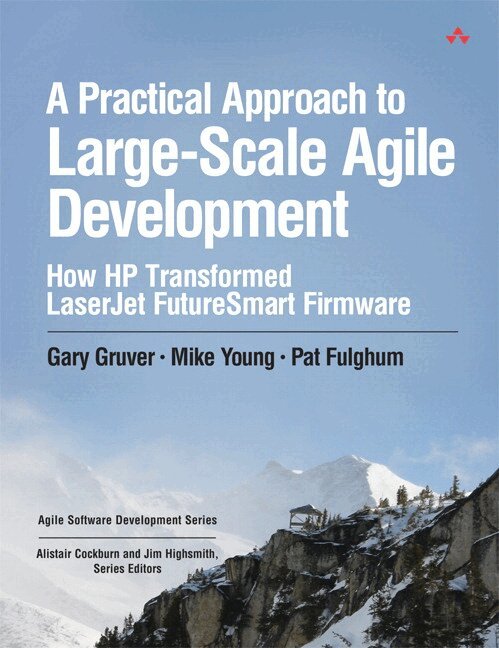
    Practical Approach to Large-Scale Agile Development, A

    How HP Transformed LaserJet FutureSmart Firmware

    AvGary Gruver,Mike Young

    Häftad, Engelska, 2012

    Del i serien Agile Software Development Series

    506 kr

    Beställningsvara. Skickas inom 3-6 vardagar. Fri frakt över 249 kr.

    Beskrivning

    Today, even the largest development organizations are turning to agile methodologies, seeking major productivity and quality improvements. However, large-scale agile development is difficult, and publicly available case studies have been scarce. Now, three agile pioneers at Hewlett-Packard present a candid, start-to-finish insider’s look at how they’ve succeeded with agile in one of the company’s most mission-critical software environments: firmware for HP LaserJet printers.

    This book tells the story of an extraordinary experiment and journey. Could agile principles be applied to re-architect an enormous legacy code base? Could agile enable both timely delivery and ongoing innovation? Could it really be applied to 400+ developers distributed across four states, three continents, and four business units? Could it go beyond delivering incremental gains, to meet the stretch goal of 10x developer productivity improvements?

    It could, and it did—but getting there was not easy.

    Writing for both managers and technologists, the authors candidly discuss both their successes and failures, presenting actionable lessons for other development organizations, as well as approaches that have proven themselves repeatedly in HP’s challenging environment. They not only illuminate the potential benefits of agile in large-scale development, they also systematically show how these benefits can actually be achieved.

    Coverage includes:
    • Tightly linking agile methods and enterprise architecture with business objectives
    • Focusing agile practices on your worst development pain points to get the most bang for your buck
    • Abandoning classic agile methods that don’t work at the largest scale
    • Employing agile methods to establish a new architecture
    • Using metrics as a “conversation starter” around agile process improvements
    • Leveraging continuous integration and quality systems to reduce costs, accelerate schedules, and automate the delivery pipeline
    • Taming the planning beast with “light-touch” agile planning and lightweight long-range forecasting
    • Implementing effective project management and ensuring accountability in large agile projects
    • Managing tradeoffs associated with key decisions about organizational structure
    • Overcoming U.S./India cultural differences that can complicate offshore development
    • Selecting tools to support quantum leaps in productivity in your organization
    • Using change management disciplines to support greater enterprise agility

    Produktinformation

    • Utgivningsdatum:2012-12-06
    • Mått:181 x 228 x 11 mm
    • Vikt:336 g
    • Format:Häftad
    • Språk:Engelska
    • Serie:Agile Software Development Series
    • Antal sidor:208
    • Upplaga:1
    • Förlag:Pearson Education
    • ISBN:9780321821720

    Utforska kategorier

    • Programmeringsböcker inom Data och IT

    Mer om författaren

    Gary Gruver is formerly the Director of Engineering for HP’s LaserJet Core Firmware Lab, and he worked at HP for 22 years. He is currently VP of Release, QA, and Operations at macys.com. Any major initiative needs a true business sponsor—someone who has truly caught the vision of agile, and who can make the business and financial decisions necessary to get huge breakthroughs to happen. Gary has also been able to bring a “manage to metrics” approach that rallies everyone to common measurable objectives without requiring lots of meeting and coordination overhead. Of course, his most critical role is buying lunch during particularly busy sprints for anyone working weekends to finish off key features. His favorite hobbies are cycling and skiing with family (he’s married with two daughters). Mike Young is the program manager directing day-to-day efforts across our many distributed teams at HP’s LaserJet Core Firmware Lab. Mike has been involved in development of HP LaserJet Printers for 18 years, and he previously designed satellite control systems for Hughes Aircraft Company. He also is one of the strongest advocates of agile approaches and helped get the organization started down this path before anyone really knew we were doing agile. His hobbies are family (he’s married, with two daughters and two sons) and playing racquetball. In agile, we’ve found that a program manager should spend most of his/her time watching the metrics and quietly coordinating behind-the-scenes to cater to the bottleneck. In our sprint checkpoints, we tend to minimize slideware and maximize problem solving and demos of new user stories. Pat Fulghum is architect of the HP LaserJet FutureSmart firmware and its development team’s agile toolset. Pat’s been at HP for 24 years. He found out during the past few years that his favorite escape is scuba diving in Maui with his family (he is married and has a son and a daughter). A large-scale agile initiative requires a central architect who can help maintain architectural integrity amid many pressures to do otherwise (which keeps the system enabled for the future) and who has the vision for making sure the architecture supports both firmware development and qualification. Pat still loves to get in and dig deep to solve vexing technical challenges. He also loves to find developer productivity improvements (build time, triage time) and has been the passion behind our “10x productivity improvement” vision.

    Innehållsförteckning

    • Foreword by Jim Highsmith, ThoughtWorks     xiiiPreface     xv Chapter 1  Agile Principles versus Practices     1 The Principles of the Agile Manifesto     2 Our Take on Agile/Lean Principles     3 A Quick Tutorial: Agile versus Waterfall     6 Summary     8 Chapter 2  Tuning Agile to Your Business Objectives     9 Background: HP FutureSmart Firmware Case Study     10 Cost and Cycle-Time Drivers Prior to HP FutureSmart Firmware     11 Value Proposition of Re-Architecting the HP FutureSmart Firmware and Processes     13 Establish Development Objectives from the Business Analysis     15 Summary     16 Chapter 3  Aligning Architecture with Business Objectives     17 Challenges with Existing Architecture     18 Architecting for the Business: Dynamic Variability and Forward Compatibility     19 Keeping an Architecture Current and Sustainable     22 Summary     25 Chapter 4  How to Establish a New Architecture Using Agile Concepts     27 Re-Architecting Iteratively     28 Making Progress     28 The Thin-Slice Model     30 Creating Cultural Shifts Through Architectural Demos     31 Summary     33 Chapter 5  The Real Secret to Success in Large-Scale Agile     35 Change for People’s Sake     36 Metrics Are a Conversation Starter     38 Iterative Model of Agile Management     39 Mini-Milestone Objectives     40 Cascading Objectives to Track Progress     41 Conversations     42 Learning     43 Agile Adjustments     44 Summary     44 Chapter 6  Continuous Integration and Quality Systems     45 Reducing Build Resources and Build Time: Continuous Integration     46 Achieving High Quality with CI: Automated Multilevel Testing     55 L0 Testing     57 L1 Testing     58 L2 Testing     58 L3 Testing     59 L4 Testing     60 Continuous Improvement of the Deployment Pipeline     60 Productivity Results of Our Automated Delivery Pipeline     61 Special Considerations for Enterprise Software Systems     63 Summary     65 Chapter 7  Taming the Planning Beast     67 Predict by Ballparking and Trend Watching     69 Ballpark Prediction: R&D Early Response to High-Level Initiatives     70 Trend Watching: Quick Response to All Feature Requestors (Where They’re Likely to Land)     70 Clear Prioritization     73 Just-in-Time User Story Definition     76 Invest in System Engineering     77 Put Marketing in Charge of a Unified 1-N List     80 Involve the Technology Architects     81 Use Project Managers as “Feature Leads”     81 Reuse Requirements and Test Tags for Scalability     82 Commit by Delivering, Not by Estimating     83 Convincing the Business: Agile Planning Is Okay     86 Summary     88 Chapter 8  Unique Challenges of Estimating Large Innovations     91 Waterfall Approach and Challenges     92 Agile Approach     92 Challenging Situations with the Agile Approach: Large Architectural Efforts     95 Change Management and Integrating with the Business     98 Summary     100 Chapter 9  Our Take on Project Management for Large-Scale Agile     101 Oversight and Priority: Program Managers     102 Accountability: Section Managers     103 Robustness and Scalability: Architects     104 Putting It All Together     104 Summary     105 Chapter 10  Organizational Approach: Managing to Disadvantages     107 Test Ownership Organization     108 Component versus Feature Organization     111 Traditionally Managed Project Teams versus Self-Managed Scrum Teams     114 Summary     116 Chapter 11  Effective Agile Development across U.S. and Indian Cultures     117 Lesson 1: Permission to Ask     118 Lesson 2: Ensure Time to Explore     119 Lesson 3: Have Small Wins First     119 Lesson 4: Exploit the Time Difference     120 Lesson 5: Take Time to Train–Always     121 Lesson 6: Remember a Team Is about People     121 Organizing for the Highest Leverage of Offshore Teams     122 Summary     125 Chapter 12  The Right Tools: Quantum Leaps in Productivity     127 Common Development Environment     128 Simulation and Emulation Environment for Automated Testing     129 Test Architecture for Scalability: Common Test Framework (CTF)     131 The Most Important Part of Test Automation: Virtual Machine Provisioning System (VMPS)     133 Real-Time Metrics and Tracking     136 Integrated Toolset     137 Cool Toys Worth Investing In     138 Summary     139 Chapter 13  Real-World Agile Results: HP FutureSmart Firmware     141 Resources Moved from Overhead to Innovation     142 R&D and Developer Productivity     144 Improvement in Current Product Support     146 Summary     147 Chapter 14  Change Management in Moving Toward Enterprise Agility     149 Impacts on Other R&D Groups and System Qualification     150 Impacts on Product Program Teams     151 Impacts on Non-R&D Product Generation Activities/Teams     154 Where to Draw Boundaries with Coordinating Organizational Agility     155 Change Management of the HP FutureSmart Firmware Transformation     156 Summary     158 Chapter 15  Differences in Our Perspective on Scaling Agile     159 A Difference in Perspective     160 Focusing on Agility Rather Than Team Operations     161 Changing the Deployment Pipeline     162 Embracing the Uncertainty of Agile     163 Enterprisewide Tracking and Incremental Improvements     164 Summary     164 Chapter 16  Taking the First Step     167 Figuring Out First Steps     168 What’s Next for FutureSmart?     169 Determining Your First Steps     171 Summary     172 Appendix A  Twelve Principles of Agile Software     173Bibliography     175Index     177