• Fri frakt över 249 kr
  • •
  • Snabba leveranser
  • •
  • Billiga böcker
Kundservice

Du är på sajten för privatpersoner.

Företag, bibliotek eller offentlig verksamhet?

Du handlar på classic.bokus.com, där alla dina funktioner finns intakta.
Till classic.bokus.com
Bokus logotyp. Gå till startsidan.
  • Erbjudanden
  • Nyheter
  • Student
  • Topplistor
  • Barn & ungdom
  • Bokus Play
  • E-böcker
  • Pocketböcker
  • Spel & pussel

10% rabatt på allt med kod: NYSTART10 →

Sidfot

Mina sidor

    Hjälp

    • Kundservice
    • Vanliga frågor och svar
    • Frakt och leverans
    • Retur vid ångerrätt
    • Reklamera vara
    • Betalning
    • Köpvillkor
    • Allmänna villkor
    • Information om webbplatsens tillgänglighet

    Om Bokus

    • Om oss
    • Pressrum
    • För studenter
    • För företag
    • För bibliotek och offentlig verksamhet
    • För leverantörer
    • Hållbarhet

    Populärt

    • Aktuella erbjudanden
    • Presentkort
    • Studentlitteratur
    • Nya böcker
    • Topplistor
    • Signerade böcker
    • Engelska böcker

    Inspiration

    • Boktips
    • BookTok
    • Populära bokserier
    • Barnbokskaraktärer
    • Populära författare
    Logotyp för Bokus
    Följ oss på Facebook (extern länk)Följ oss på Instagram (extern länk)Följ oss på YouTube (extern länk)Följ oss på TikTok (extern länk)
    bokus @ CookiesAnpassa cookiesIntegritetspolicyKöpvillkor
    Till Citymail hemsida (extern länk)Till Budbee hemsida (extern länk)Till Postnord hemsida (extern länk)Till Schenker hemsida (extern länk)Till Early Bird hemsida (extern länk)Till Walleys hemsida (extern länk)
    1. Naturvetenskap och teknik
    2. Teknik och industri
    3. Elektronik och kommunikationer

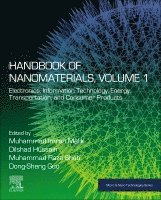
    Handbook of Nanomaterials, Volume 1

    Electronics, Information Technology, Energy, Transportation, and Consumer Products

    AvMuhammad Imran Malik,Dilshad Hussain

    Häftad, Engelska, 2024

    Del i serien Micro and Nano Technologies

    2 492 kr

    Beställningsvara. Skickas inom 10-15 vardagar. Fri frakt över 249 kr.

    Beskrivning

    Handbook of Nanomaterials, Volume One: Electronics, Information Technology, Energy, Transportation, and Consumer Products offers a comprehensive resource that introduces the role of nanotechnology and nanomaterials in a broad range of areas, covering fundamentals, methods, and applications. In this volume, the initial chapters introduce the core concepts of nanotechnology, synthesis methods, and characterization techniques. Following sections focus on key application areas across electronics, information technology, energy, transportation, and consumer products. In each chapter, detailed, but concise information is provided on a specific application, covering methods and latest advances. This book will be of interest to researchers and advanced students approaching nanotechnology from a range of disciplines, including materials science and engineering, chemistry, chemical engineering, electronics, energy, biomedicine, environmental science, food science, and agriculture, as well as scientists, engineers, and R&D professionals with an interest in the use of nanomaterials across a range of industries.

    • Introduces the reader to key applications of nanomaterials
    • Provides broad, systematic, concise coverage, supporting readers from a range of disciplines
    • Covers applications across electronics, information technology, energy, transportation, and consumer products

    Produktinformation

    • Utgivningsdatum:2024-01-17
    • Mått:191 x 235 x undefined mm
    • Vikt:1 650 g
    • Format:Häftad
    • Språk:Engelska
    • Serie:Micro and Nano Technologies
    • Antal sidor:798
    • Förlag:Elsevier Science
    • ISBN:9780323955119

    Utforska kategorier

    • Elektronik och kommunikationer inom Naturvetenskap och teknik
    • Maskinteknik och material inom Naturvetenskap och teknik

    Mer om författaren

    Dr. Muhammad Imran Malik is an Associate Professor at the HEJ Research Institute of Chemistry, International Centre for Chemical and Biological Sciences, University of Karachi, Pakistan. He received his doctorate in polymer chemistry at Karl-Franzens-Universitäte, Graz, Austria, in 2009, and subsequently worked as a post-doctoral research scientist, at the University of Stellenbosch, South Africa, and at POSTECH, in South Korea, with his research focusing on analytical polymer science. In 2012, he joined the International Center of Chemical and Biological Sciences at the University of Karachi as an Assistant Professor. Dr. Malik’s main research interests are the synthesis of novel polymeric architectures and the development of comprehensive analytical methods for polymers, as well as polymer-stabilized nanoparticles and their applications, such as sensors, drug delivery, molecularly imprinted polymers, and organic solar cells. Dr. Dilshad Hussain is an Assistant Professor at the LEJ Nanotechnology Centre, International Centre for Chemical and Biological Sciences, University of Karachi, Pakistan. In 2018, he completed his PhD in chemistry at Bahauddin Zakariya University, Multan, Pakistan, and in 2019, he worked as a post-doc at the University of Tours, in France. He works in the field of functional nanomaterials and their applications in textiles, sensing, membranes, and catalysis. His research work is focused on Metal-Organic Frameworks, Metal/Metal Oxide composites, Carbon Nanomaterials, Polymeric Materials, Quantum Dots, and Anisotropic Gold Nanoparticles. Dr. Dilshad’s group research projects include multifunctional textiles, nano-functionalized membranes for environmental applications, and smartphone-assisted portable sensors. Prof. Muhammad Raza Shah is a professor and Director of the International Center for Chemical and Biological Sciences (ICCBS), University of Karachi, Pakistan. He holds four US patents. Dr. Shah has received numerous awards, including the Khwarizmi International Award from the Ministry of Science, Research and Technology, Iran (2023). He has also been honored with the Civil Award Tamgha-i-Imtiaz (2015), Dr. Raziuddin Prize (2015), Prof. Atta-ur-Rahman Gold Medal by the Pakistan Academy of Sciences, Avicenna Science & Innovation Award (2015) by Brain Trust UK, and the Abdus Salam Award in Chemistry (2006). He was named TWAS Young Affiliate in 2010 by The World Academy of Sciences. Prof. Shah is a Fellow of the International Union of Pure and Applied Chemistry, the Chemical Society of Pakistan, the Islamic World Academy of Sciences, and the Royal College of Physicians (Edinburgh). Dr. Shah has conducted 29 Phase-I (BE and PK) studies, 04 Phase-II Randomized Clinical Trial as PI and lead the Phase-I RCT of Sinopharm COVID-19 vaccine and Phase-III RCT of COVID-19 booster vaccine as country PI. Dong-Sheng Guo is Full Professor at the College of Chemistry, Nankai University, China. He obtained his PhD degree from Nankai University under the guidance of Prof. Yu Liu in 2006, before joining Prof. Liu's group as a faculty member in the College of Chemistry. He was promoted to Associate Professor in 2008, and Professor in 2013. His current research interest is in supramolecular biomedical materials. The Guo group takes advantage of molecular recognition and self-assembly of calixarenes to engineer new smart biomaterials to achieve precision medicine. Prof. Guo was selected as the National Leader in Science and Technology Innovation (2019) and Youth Science and Technology Innovation Leader (2018) by the Ministry of Science and Technology of China, and for the Science Funds for Excellent Youth (2013) from the National Natural Science Foundation of China. He also won the Tianjin Natural Science Award (first ranked) in 2015, and is now a senior member of the Chinese Chemical Society. Prof. Guo has published more than 130 research papers in well-reputed international journals.

    Innehållsförteckning

    • List of contributorsForewordPrefaceCHAPTER 1 Introduction to nanotechnology CHAPTER 2 NanofluidsCHAPTER 3 Nanomaterials in nonvolatile resistive memory devicesCHAPTER 4 Nanomaterials in ultra-high definition displaysCHAPTER 5 Nanomaterials in robotics and artificial intelligenceCHAPTER 6 Nanomaterials in solar cellsCHAPTER 7 Nanomaterials in batteriesCHAPTER 8 Nanomaterials in energy generatorsCHAPTER 9 Nanophotonic biosensorsCHAPTER 10 Nanomaterials for supercapacitorsCHAPTER 11 Nanomaterials in solar collector technologyCHAPTER 12 Nanomaterials in flexible and wearable electronics/e-textilesCHAPTER 13 Nanomaterials and textile industryCHAPTER 14 Nanomaterials in functional textilesCHAPTER 15 Nanomaterials in membrane technologyCHAPTER 16 Nanomaterials in catalysisCHAPTER 17 Heterostructures of graphene and related twodimensional nanomaterials for photodetectionCHAPTER 18 Nanomaterials in optical sensingCHAPTER 19 Nanomaterials in electrochemical biosensorsCHAPTER 20 Nanomaterials in humidity sensorsCHAPTER 21 Nanomaterials in the transportation industryCHAPTER 22 Nanomaterials in fuel additives, lubricants, and engine oilsCHAPTER 23 Nanomaterials in petroleum industryCHAPTER 24 Nanomaterials in roadway asphalt materialsCHAPTER 25 Nanomaterials for coatingsCHAPTER 26 Nanomaterials in paintsCHAPTER 27 Functionalized nanoceramicsIndex