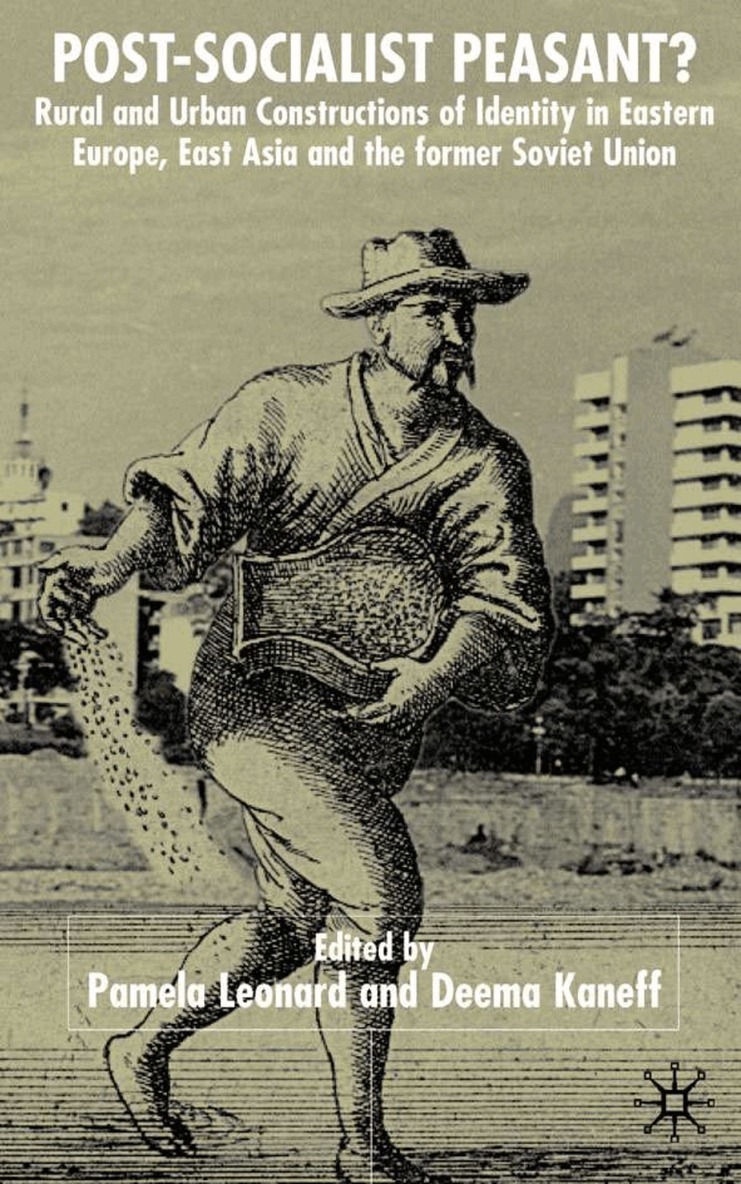
Post-Socialist Peasant?
Rural and Urban Constructions of Identity in Eastern Europe, East Africa and the Former Soviet Union
564 kr
Beställningsvara. Skickas inom 10-15 vardagar. Fri frakt över 249 kr.
Du är på sajten för privatpersoner.
564 kr
Beställningsvara. Skickas inom 10-15 vardagar. Fri frakt över 249 kr.
PAMELA LEONARD is Adjunct Lecturer at the University of North Carolina, Charlotte. During her fieldwork she lived with a Chinese family in rural Sichuan province China, while simultaneously working with an international NGO focused on livestock development. With her husband she has published articles on civil society and rural resistance. DEEMA KANEFF is a Senior Researcher at the Max Planck Institute for Social Anthropology in Germany. She has published numerous articles on a variety of topics, including, When 'Land' Becomes 'Territory': Land Privatization and Ethnicity in Rural Bulgaria.
'Post-Socialist Peasant? brings together important and recent research on Eastern Europe, Russia, Vietnam and China. The authors, using extensive first-hand knowledge, analyse how post-socialist transitions have affected the ways in which urban policy-makers and intellectuals, on the one hand, and rural residents, on the other, perceive the growing inequalities between rural and urban populations. These perceptions, the contributors convincingly argue, condition policy responses, which ostensibly are aimed at ameliorating those inequalities. Power relations differences between those who make policy and those who are the subject of those policies are especially well analysed. Post-Socialist Peasant? is full of rich detail and focuses on issues that are critical to our understanding of reformist policies throughout the post-socialist world.' - Rubie Watson, William and Muriel Seabury Howells, Peabogy Museum of Archaeology and Ethnology, Harvard University 'The inability of many policy makers and analysts to make better sense of the post-socialist condition can be traced in part to their lack of interest in the countryside. This collection convincingly demonstrates the rural influence on the trajectory of 'transition', and provides the information we need to correct earlier interpretations and policies.' - Gerald Creed, Hunter College and the Graduate School City University, New York
Du är på sajten för privatpersoner.
564 kr
Beställningsvara. Skickas inom 10-15 vardagar. Fri frakt över 249 kr.
PAMELA LEONARD is Adjunct Lecturer at the University of North Carolina, Charlotte. During her fieldwork she lived with a Chinese family in rural Sichuan province China, while simultaneously working with an international NGO focused on livestock development. With her husband she has published articles on civil society and rural resistance. DEEMA KANEFF is a Senior Researcher at the Max Planck Institute for Social Anthropology in Germany. She has published numerous articles on a variety of topics, including, When 'Land' Becomes 'Territory': Land Privatization and Ethnicity in Rural Bulgaria.
'Post-Socialist Peasant? brings together important and recent research on Eastern Europe, Russia, Vietnam and China. The authors, using extensive first-hand knowledge, analyse how post-socialist transitions have affected the ways in which urban policy-makers and intellectuals, on the one hand, and rural residents, on the other, perceive the growing inequalities between rural and urban populations. These perceptions, the contributors convincingly argue, condition policy responses, which ostensibly are aimed at ameliorating those inequalities. Power relations differences between those who make policy and those who are the subject of those policies are especially well analysed. Post-Socialist Peasant? is full of rich detail and focuses on issues that are critical to our understanding of reformist policies throughout the post-socialist world.' - Rubie Watson, William and Muriel Seabury Howells, Peabogy Museum of Archaeology and Ethnology, Harvard University 'The inability of many policy makers and analysts to make better sense of the post-socialist condition can be traced in part to their lack of interest in the countryside. This collection convincingly demonstrates the rural influence on the trajectory of 'transition', and provides the information we need to correct earlier interpretations and policies.' - Gerald Creed, Hunter College and the Graduate School City University, New York