• Fri frakt över 249 kr
  • •
  • Snabba leveranser
  • •
  • Billiga böcker
Kundservice

Du är på sajten för privatpersoner.

Företag, bibliotek eller offentlig verksamhet?

Du handlar på classic.bokus.com, där alla dina funktioner finns intakta.
Till classic.bokus.com
Bokus logotyp. Gå till startsidan.
  • Erbjudanden
  • Nyheter
  • Student
  • Topplistor
  • Barn & ungdom
  • Bokus Play
  • E-böcker
  • Pocketböcker
  • Spel & pussel

10% rabatt på allt med kod: NYSTART10 →

Sidfot

Mina sidor

    Hjälp

    • Kundservice
    • Vanliga frågor och svar
    • Frakt och leverans
    • Retur vid ångerrätt
    • Reklamera vara
    • Betalning
    • Köpvillkor
    • Allmänna villkor
    • Information om webbplatsens tillgänglighet

    Om Bokus

    • Om oss
    • Pressrum
    • För studenter
    • För företag
    • För bibliotek och offentlig verksamhet
    • För leverantörer
    • Hållbarhet

    Populärt

    • Aktuella erbjudanden
    • Presentkort
    • Studentlitteratur
    • Nya böcker
    • Topplistor
    • Signerade böcker
    • Engelska böcker

    Inspiration

    • Boktips
    • BookTok
    • Populära bokserier
    • Barnbokskaraktärer
    • Populära författare
    Logotyp för Bokus
    Följ oss på Facebook (extern länk)Följ oss på Instagram (extern länk)Följ oss på YouTube (extern länk)Följ oss på TikTok (extern länk)
    bokus @ CookiesAnpassa cookiesIntegritetspolicyKöpvillkor
    Till Citymail hemsida (extern länk)Till Budbee hemsida (extern länk)Till Postnord hemsida (extern länk)Till Schenker hemsida (extern länk)Till Early Bird hemsida (extern länk)Till Walleys hemsida (extern länk)
    1. Samhälle och politik
    2. Politik och statsskick
    3. Politisk aktivism

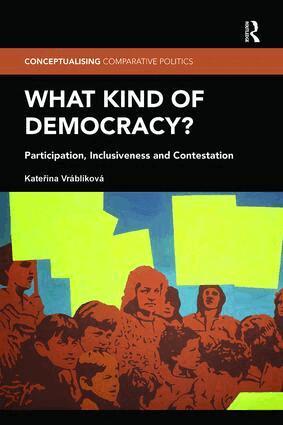
    What Kind of Democracy?

    Participation, Inclusiveness and Contestation

    AvKateřina Vráblíková

    Häftad, Engelska, 2018

    Del i serien Conceptualising Comparative Politics

    723 kr

    Beställningsvara. Skickas inom 10-15 vardagar. Fri frakt över 249 kr.

    Fler format och utgåvor

    Inbunden

    2 421 kr

    E-bok

    858 kr

    Beskrivning

    The broad expansion of non-electoral political participation is considered one of the major changes in the nature of democratic citizenship in the 21st century. Most scholars – but also governments, transnational and subnational political institutions, and various foundations – have adopted the notion that contemporary democratic societies need a more politically active citizenry. Yet, contemporary democracies widely differ in the extent to which their citizens get involved in politics beyond voting. Why is political activism other than voting flourishing in the United States, but is less common in Britain and almost non-existent in post-communist countries like Bulgaria? The book shows that the answer does not lie in citizen’s predispositions, social capital or institutions of consensual democracy. Instead, the key to understanding cross-country differences in political activism beyond voting rests in democratic structures that combine inclusiveness and contestation. What Kind of Democracy? is the first book to provide a theoretically driven empirical analysis of how different types of democratic arrangements affect individual participation in non-electoral politics.

    Produktinformation

    • Utgivningsdatum:2018-07-27
    • Mått:152 x 229 x 20 mm
    • Vikt:344 g
    • Format:Häftad
    • Språk:Engelska
    • Serie:Conceptualising Comparative Politics
    • Antal sidor:230
    • Förlag:Taylor & Francis Ltd
    • ISBN:9780367000233

    Utforska kategorier

    • Politisk aktivism inom Samhälle och politik
    • Statsskick: demokrati inom Samhälle och politik

    Mer om författaren

    Kateřina Vráblíková is Lecturer and the Chair of Political Science and International Comparative Social Research at the University of Mannheim, Germany. Her research and teaching focuses on political participation, political attitudes and values, social movements, and research methods.

    Recensioner i media

    'This book does an excellent job in enhancing our understanding of non-electoral political participation, a very important political phenomenon. The author builds on earlier works such as micro level explanations of political participation, institutions, or political culture but enriches our understanding of cross-country differences by adding that a crucial national characteristic, a political system that exhibits inclusiveness combined with contestation, will have a profound effect on participation. The book does a terrific job combining a strong theoretical approach with empirical findings across multiple countries.' - Zsolt Nyiri, Montclair State University, USA'A highly needed and very original contribution to our understanding of cross-national variations in political participation. The sophisticated empirical analyses of the interplay between individual, institutional, and cultural factors are just as convincing as Vráblíková’s thoughtful discussions of the implications for normative democratic theories.' - Jan W. van Deth, University of Mannheim, Germany 'What Kind of Democracy shows how institutional and social contexts shape the level of protest activity across contemporary democracies. Vrablikova also offers an astute discussion of how democracies can create contexts to expand citizen participation beyond elections, and the implications that follow from a more engaged citizenry.' - Russell Dalton, University of California, Irvine"Vrablikova crafted a challenging account of nonelectoral participation. Pitting the traditional inclusive consensus perspective on democracy against her inclusive contestation perspective she develops a new approach to democracy. Building on evidence from the ISSP and the ESS she show that nonelectoral participation is stimultated by factors included from the contestation model but not by factors from the consensus model. All this is written in a clear style. Highly recommended." - Bert Klandermans, VU-University of Amsterdam, the Netherlands

    Innehållsförteckning

    • Introduction: The Landscape PuzzleChapter 2: Inclusive ContestationChapter 3: Micro Level of Political ParticipationChapter 4: How Do State Structures Matter? Chapter 5: How Does Mobilization Matter? Chapter 6: How Does Political Culture Matter? Chapter 7: Solving the Landscape PuzzleConclusion: What Kind of Democracy?