• Fri frakt över 249 kr
  • •
  • Snabba leveranser
  • •
  • Billiga böcker
Kundservice

Du är på sajten för privatpersoner.

Företag, bibliotek eller offentlig verksamhet?

Du handlar på classic.bokus.com, där alla dina funktioner finns intakta.
Till classic.bokus.com
Bokus logotyp. Gå till startsidan.
  • Erbjudanden
  • Nyheter
  • Student
  • Topplistor
  • Barn & ungdom
  • Bokus Play
  • E-böcker
  • Pocketböcker
  • Spel & pussel

10% rabatt på allt med kod NYSTART10 →

Sidfot

Mina sidor

    Hjälp

    • Kundservice
    • Vanliga frågor och svar
    • Frakt och leverans
    • Retur vid ångerrätt
    • Reklamera vara
    • Betalning
    • Köpvillkor
    • Allmänna villkor
    • Information om webbplatsens tillgänglighet

    Om Bokus

    • Om oss
    • Pressrum
    • För studenter
    • För företag
    • För bibliotek och offentlig verksamhet
    • För leverantörer
    • Hållbarhet

    Populärt

    • Aktuella erbjudanden
    • Presentkort
    • Studentlitteratur
    • Nya böcker
    • Topplistor
    • Signerade böcker
    • Engelska böcker

    Inspiration

    • Boktips
    • BookTok
    • Populära bokserier
    • Barnbokskaraktärer
    • Populära författare
    Logotyp för Bokus
    Följ oss på Facebook (extern länk)Följ oss på Instagram (extern länk)Följ oss på YouTube (extern länk)Följ oss på TikTok (extern länk)
    bokus @ CookiesAnpassa cookiesIntegritetspolicyKöpvillkor
    Till Citymail hemsida (extern länk)Till Budbee hemsida (extern länk)Till Postnord hemsida (extern länk)Till Schenker hemsida (extern länk)Till Early Bird hemsida (extern länk)Till Walleys hemsida (extern länk)
    1. Psykologi och pedagogik
    2. Pedagogik
    3. Pedagogisk psykologi

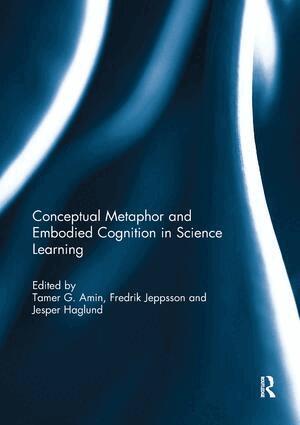
    Conceptual metaphor and embodied cognition in science learning

    AvTamer Amin,Fredrik Jeppsson

    Häftad, Engelska, 2018

    709 kr

    Beställningsvara. Skickas inom 10-15 vardagar. Fri frakt över 249 kr.

    Beskrivning

    Scientific concepts are abstract human constructions, invented to make sense of complex natural phenomena. Scientists use specialised languages, diagrams, and mathematical representations of various kinds to convey these abstract constructions. This book uses the perspectives of embodied cognition and conceptual metaphor to explore how learners make sense of these concepts. That is, it is assumed that human cognition – including scientific cognition – is grounded in the body and in the material and social contexts in which it is embedded. Understanding abstract concepts is therefore grounded, via metaphor, in knowledge derived from sensory and motor experiences arising from interaction with the physical world. The volume consists of nine chapters that examine a number of intertwined themes: how systematic metaphorical mappings are implicit in scientific language, diagrams, mathematical representations, and the gestures used by scientists; how scientific modelling relies fundamentally on metaphor and can be seen as a form of narrative cognition; how implicit metaphors can be the sources of learner misconceptions; how conceptual change and the acquisition of scientific expertise involve learning to coordinate the use of multiple implicit metaphors; and how effective instruction can build on recognising the embodied nature of scientific cognition and the role of metaphor in scientific thought and learning. The volume also includes three extended commentaries from leading researchers in the fields of cognitive linguistics, the learning sciences, and science education, in which they reflect on theoretical, methodological and pedagogical issues raised in the book. This book was originally published as a special issue of the International Journal of Science Education.

    Produktinformation

    • Utgivningsdatum:2018-10-18
    • Mått:174 x 246 x undefined mm
    • Vikt:453 g
    • Format:Häftad
    • Språk:Engelska
    • Antal sidor:268
    • Förlag:Taylor & Francis Ltd
    • ISBN:9780367075842

    Utforska kategorier

    • Pedagogisk psykologi inom Psykologi och pedagogik
    • Undervisning i specifika ämnen inom Psykologi och pedagogik
    • Naturvetenskap:allmänt inom Naturvetenskap och teknik

    Mer om författaren

    Tamer Amin is Associate Professor and Director of the Science and Mathematics Education Center in the Department of Education at the American University of Beirut, Lebanon. His research focuses on the development of scientific understanding and reasoning, with a particular emphasis on how language relates to this process. He is currently co-editing (with Olivia Levrini) a forthcoming Routledge publication entitled Converging Perspectives on Conceptual Change: Mapping an Emerging Paradigm in the Learning Sciences. Fredrik Jeppsson is Assistant Professor in the Department of Social and Welfare Studies at Linköping University, Sweden. His research focuses on the teaching and learning of thermal science at different age levels. He has an interest in embodied cognition and, in particular, how metaphorical language can support students’ learning. He currently studies how primary students’ meaning-making of science content can be promoted by mediation through different semiotic modes (e.g. verbal language, body language, images, or models). Jesper Haglund is a Postdoctoral Researcher and Docent in Physics with Specialization in Physics Education at the Department of Physics and Astronomy, Uppsala University, Sweden. His research focuses on the teaching and learning of thermal science at different age levels. He has a particular interest in embodied cognition and how analogies and metaphors can support students’ learning. Recently, his study has focused on how infrared cameras can be used in open-ended laboratory activities.

    Innehållsförteckning

    • Introduction: Conceptual Metaphor and Embodied Cognition in Science Learning 1. The Importance of Language in Students’ Reasoning About Heat in Thermodynamic Processes 2. Varying Use of Conceptual Metaphors across Levels of Expertise in Thermodynamics 3. On Conceptual Metaphor and the Flora and Fauna of Mind: Commentary on Brookes and Etkina; and Jeppsson, Haglund and Amin 4. Applying Conceptual Blending to Model Coordinated Use of Multiple Ontological Metaphors 5. Enacting Conceptual Metaphor through Blending: Learning activities embodying the substance metaphor for energy 6. Some Challenges in the Empirical Investigation of Conceptual Mappings and Embodied Cognition in Science Education: Commentary on Dreyfus, Gupta and Redish; and Close and Scherr 7. An Analysis of Metaphors Used by Students to Describe Energy in an Interdisciplinary General Science Course 8. Understanding Starts in the Mesocosm: Conceptual metaphor as a framework for external representations in science teaching 9. From Stories to Scientific Models and Back: Narrative framing in modern macroscopic physics 10. On the Significance of Conceptual Metaphors in Teaching and Learning Science: Commentary on Lancor; Niebert and Gropengiesser; and Fuchs 11. Conceptual Metaphor and the Study of Conceptual Change: Research synthesis and future directions

    Betyg & recensioner

    4/5