• Fri frakt över 249 kr
  • •
  • Snabba leveranser
  • •
  • Billiga böcker
Kundservice

Du är på sajten för privatpersoner.

Företag, bibliotek eller offentlig verksamhet?

Du handlar på classic.bokus.com, där alla dina funktioner finns intakta.
Till classic.bokus.com
Bokus logotyp. Gå till startsidan.
  • Erbjudanden
  • Nyheter
  • Student
  • Topplistor
  • Barn & ungdom
  • Bokus Play
  • E-böcker
  • Pocketböcker
  • Spel & pussel

10% rabatt på allt med kod NYSTART10 →

Sidfot

Mina sidor

    Hjälp

    • Kundservice
    • Vanliga frågor och svar
    • Frakt och leverans
    • Retur vid ångerrätt
    • Reklamera vara
    • Betalning
    • Köpvillkor
    • Allmänna villkor
    • Information om webbplatsens tillgänglighet

    Om Bokus

    • Om oss
    • Pressrum
    • För studenter
    • För företag
    • För bibliotek och offentlig verksamhet
    • För leverantörer
    • Hållbarhet

    Populärt

    • Aktuella erbjudanden
    • Presentkort
    • Studentlitteratur
    • Nya böcker
    • Topplistor
    • Signerade böcker
    • Engelska böcker

    Inspiration

    • Boktips
    • BookTok
    • Populära bokserier
    • Barnbokskaraktärer
    • Populära författare
    Logotyp för Bokus
    Följ oss på Facebook (extern länk)Följ oss på Instagram (extern länk)Följ oss på YouTube (extern länk)Följ oss på TikTok (extern länk)
    bokus @ CookiesAnpassa cookiesIntegritetspolicyKöpvillkor
    Till Citymail hemsida (extern länk)Till Budbee hemsida (extern länk)Till Postnord hemsida (extern länk)Till Schenker hemsida (extern länk)Till Early Bird hemsida (extern länk)Till Walleys hemsida (extern länk)
    1. Språk och ordböcker
    2. Språkundervisning och språkinlärning

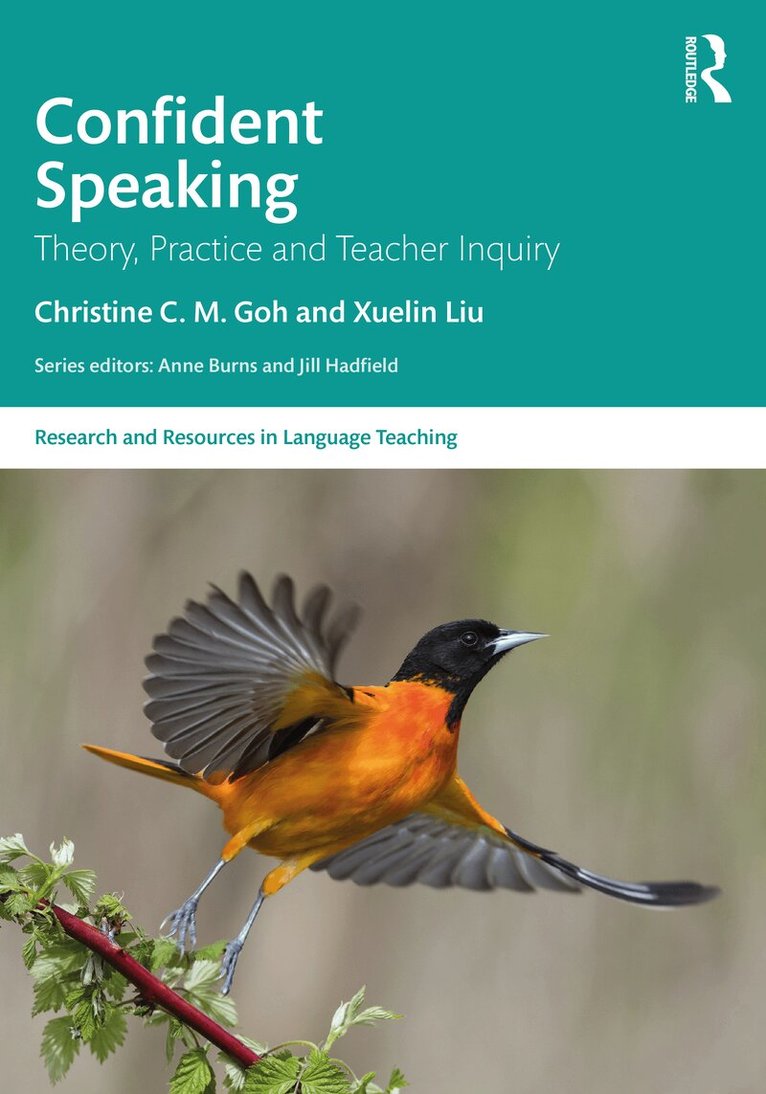
    Confident Speaking

    Theory, Practice and Teacher Inquiry

    AvChristine C. M. Goh,Xuelin Liu

    Häftad, Engelska, 2023

    Del i serien Research and Resources in Language Teaching

    607 kr

    Beställningsvara. Skickas inom 10-15 vardagar. Fri frakt över 249 kr.

    Fler format och utgåvor

    Inbunden

    2 354 kr

    Beskrivning

    Confident Speaking provides language teachers and teacher educators with evidence-informed ideas to help second language (L2) learners speak fluently and confidently in different social and academic contexts.Christine C. M. Goh and Xuelin Liu, thought leaders in the field of language education, draw on scholarly literature and their own experience to show language teachers how to apply insights from research and theory in everyday classroom teaching. They offer 80 hands-on activities to help learners develop speaking skills through fluency practice and language-focused activities, and tap into their metacognitive thinking to adopt strategies for facilitating oral communication. Also included is guidance for teachers in designing lessons and larger units of work with the activities and carrying out professional inquiry activities into their own practice of teaching L2 speaking.This book is a valuable resource for language teachers and teacher educators, as well as researchers interested in the teaching and development of second language speaking.

    Produktinformation

    • Utgivningsdatum:2023-12-22
    • Mått:152 x 229 x 17 mm
    • Vikt:380 g
    • Format:Häftad
    • Språk:Engelska
    • Serie:Research and Resources in Language Teaching
    • Antal sidor:232
    • Förlag:Taylor & Francis Ltd
    • ISBN:9780367211011

    Utforska kategorier

    • Språkundervisning och språkinlärning inom Språk och ordböcker
    • Språkvetenskap och lingvistik inom Språk och ordböcker
    • Lärarutbildning inom Psykologi och pedagogik

    Mer om författaren

    Christine C. M. Goh is President’s Chair Professor of Linguistics and Language Education at the National Institute of Education, Nanyang Technological University Singapore. She has more than 30 years of experience in language teaching, teacher education and language learning research. Her most recent book is the second edition of Teaching and Learning Second Language Listening: Metacognition in Action by Routledge (with Larry Vandergrift).Xuelin Liu has taught EFL/ESL for more than four decades, at Yangzhou University, China; the National Institute of Education, Nanyang Technological University, Singapore; and Thompson Rivers University, Canada. In addition to teaching, she has been a consultant developing oral communication curricula for language institutions in several countries. Her latest project is an English education programme offering courses in language proficiency and test preparation for international students in Canada and China.

    Innehållsförteckning

    • Permissions & AcknowledgementsSeries Editor Preface1 From Research to ImplicationsIntroductionA. Processes in Speech Production1. Conceptualisation, Formulation and Articulation2. Monitoring and EvaluationB. Linguistic Knowledge for Speaking1. Knowledge of Discourse2. Knowledge of Grammar and PronunciationC. Learning to Speak and Speaking to Learn1. Speaking Skills2. Discussion Skills3. Metacognitive KnowledgeD. Instructional Enablers that Support Speaking Performance and Development1. Pre-Task Planning2. Task Repetition3. Strategy Use and InstructionE. Practical Implications for Teaching L2 Speaking1. Develop Learners’ Knowledge about Speaking2. Plan Learning Activities for Practice and Holistic DevelopmentF. Application, Implementation and Research2 From Implications to ApplicationOverviewA. Developing Speaking Fluency and SkillsB. Learning to DiscussC. Learning about Spoken Discourse and LanguageD. Developing Metacognitive Knowledge and Strategy UseA. Developing Speaking Fluency and Skills I. OFF-THE-CUFF ACTIVITIESActivity A1: Sequence and CompleteActivity A2: Ask and AnswerActivity A3: Share and ReconstructActivity A4: Imagine and ShareActivity A5: Respond and ShareII. PLANNED ACTIVITIESActivity A6: Read and CompareActivity A7: Listen and CompareActivity A8: Sequence and CompleteActivity A9: Construct and ExplainActivity A10: Construct and CompareActivity A11: Select and NarrateActivity A12: Respond and ShareActivity A13: Recall and RecountActivity A14 Prepare and TalkActivity A15: Construct and RetellActivity A16: Explain and AdviseActivity A17: Describe and ShareActivity A18: Draw, Share and ThinkActivity A19: Describe and ChooseActivity A20: Infer and ConstructActivity A21: Design and ShareActivity A22: Select and ExplainActivity A23: Create and DemonstrateActivity A24: Reflect and ShareActivity A25: Share and PredictActivity A26: Summarise and OrganiseActivity A27: Collate and ReportActivity A28: Infer and TellActivity A29: Consider and ResolveActivity A30: Explain and DefendActivity A31: Understand and RetellActivity A32: Describe, Ask and PresentActivity A33: Describe, Draw and CompareB. Learning to DiscussI. UNDERSTANDING THE DEMANDS OF DISCUSSIONActivity B1: Learn about Discussion 1Activity B2: Learn about Discussions 2Activity B3: Learn to Manage Problems During DiscussionsActivity B4: Learn to Lead a DiscussionII. PRACTISING DISCUSSION SKILLSActivity B5: Discuss and AdviseActivity B6: Discuss and JustifyActivity B7: Discuss and ConstructActivity B8: Discuss and EvaluateActivity B9: Discuss and PlanActivity B10: Develop Others’ ViewpointsActivity B11: Offer Alternative ViewpointsActivity B12: Explore Ideas TogetherActivity B13: Discuss and ElaborateActivity B14: Discuss and ProposeActivity B15: Discuss, Demonstrate and ObserveActivity B16: Discuss and SelectC. Learning about Spoken Discourse and LanguageI. DISCOURSE STRUCTURE ACTIVITIESActivity C1: Structure of a Casual ConversationActivity C2: Structure of a NarrativeActivity C3: Structure of an Explanation TextActivity C4: Structure of a Formal Conversation: Survey InterviewActivity C5: Structure of a RecountActivity C6: Structure of a Procedure TextActivity C7: Structure of an Information ReportActivity C8: Structure of an Expository TextActivity C9: Making Speeches in Class DebatesII. LANGUAGE KNOWLEDGE ACTIVITIESActivity C10: Language for Talking about the FutureActivity C11: Language for Conveying Preferences and ComparingActivity C12: Transition Markers When Describing a ProcessActivity C13: Language for Expressing RegretsActivity C14: Language for Interrupting with QuestionsActivity C15: Features of Spoken LanguageActivity C16: Features of Spoken and Written LanguageActivity C17: Features of Different Spoken TextsD. Developing Metacognitive Knowledge and Strategy UseI. PERSON AND TASK KNOWLEDGEActivity D1: An Overview of Metacognitive KnowledgeActivity D2: Person Knowledge (Knowing about Myself)Activity D3: Task Knowledge (Knowing about Speaking Tasks)Activity D4: Task Knowledge (Cognitive Processes in Speaking 1)Activity D5: Task Knowledge (Cognitive Processes in Speaking 2)Activity D6: Task Knowledge (Monitoring and Evaluation)Activity D7: Task Knowledge (Evaluating Speaking Performance)Activity D8: Person and Task Knowledge (Self-Evaluation and Planning)II. STRATEGY KNOWLEDGE AND STRATEGY USEActivity D9: Strategy Knowledge (Knowing Which Strategies to Use)Activity D10: Learning about Communication Strategies Activity D11: Strategies for Presenting and Asking Presenters QuestionsActivity D12: A Proficient L2 Speaker’s StrategiesActivity D13: Sharing Experiences of Strategy UseActivity D14: Sharing Plans for Strategy UseActivity D15: Demonstrating and Observing Strategy Use3 From Application to Implementation IntroductionA. Planning Lessons for L2 Speaking1. Fluency Activities2. Language-Focused Activities3. Metacognitive ActivitiesB. The Teaching Speaking CycleC. Lesson Planning with the Teaching Speaking Cycle1. Sample TSC Plan 12. Sample TSC Plan 23. Sample TSC Plan 34. Planning Your Own Teaching Speaking Cycle4 From Implementation to ResearchIntroductionA. Teachers Inquiring into Your Own PracticeB. Inquiry Tasks1. Doing Inquiry in a Group2. Doing Inquiry on Your Own3. Questions to AskC. Inquiry Projects1. Topics of Inquiry Focus2. Considerations When Planning an Inquiry Project3. Inquiry Tools and ProceduresConclusion and Final ThoughtsAppendix A: Three Types of Metacognitive Knowledge about L2 Speaking from Learners’ Perspectives Appendix B: Communication Strategies for L2 Speaking Appendix C: Themes and Topics for Speaking Activities Appendix D: Language Items to Support Speaking ActivitiesReferencesIndex