• Fri frakt över 249 kr
  • •
  • Snabba leveranser
  • •
  • Billiga böcker
Kundservice

Du är på sajten för privatpersoner.

Företag, bibliotek eller offentlig verksamhet?

Du handlar på classic.bokus.com, där alla dina funktioner finns intakta.
Till classic.bokus.com
Bokus logotyp. Gå till startsidan.
  • Erbjudanden
  • Nyheter
  • Student
  • Topplistor
  • Barn & ungdom
  • Bokus Play
  • E-böcker
  • Pocketböcker
  • Spel & pussel

10% rabatt på allt med kod NYSTART10 →

Sidfot

Mina sidor

    Hjälp

    • Kundservice
    • Vanliga frågor och svar
    • Frakt och leverans
    • Retur vid ångerrätt
    • Reklamera vara
    • Betalning
    • Köpvillkor
    • Allmänna villkor
    • Information om webbplatsens tillgänglighet

    Om Bokus

    • Om oss
    • Pressrum
    • För studenter
    • För företag
    • För bibliotek och offentlig verksamhet
    • För leverantörer
    • Hållbarhet

    Populärt

    • Aktuella erbjudanden
    • Presentkort
    • Studentlitteratur
    • Nya böcker
    • Topplistor
    • Signerade böcker
    • Engelska böcker

    Inspiration

    • Boktips
    • BookTok
    • Populära bokserier
    • Barnbokskaraktärer
    • Populära författare
    Logotyp för Bokus
    Följ oss på Facebook (extern länk)Följ oss på Instagram (extern länk)Följ oss på YouTube (extern länk)Följ oss på TikTok (extern länk)
    bokus @ CookiesAnpassa cookiesIntegritetspolicyKöpvillkor
    Till Citymail hemsida (extern länk)Till Budbee hemsida (extern länk)Till Postnord hemsida (extern länk)Till Schenker hemsida (extern länk)Till Early Bird hemsida (extern länk)Till Walleys hemsida (extern länk)
    1. Psykologi och pedagogik
    2. Pedagogik
    3. Skolan och förskolan

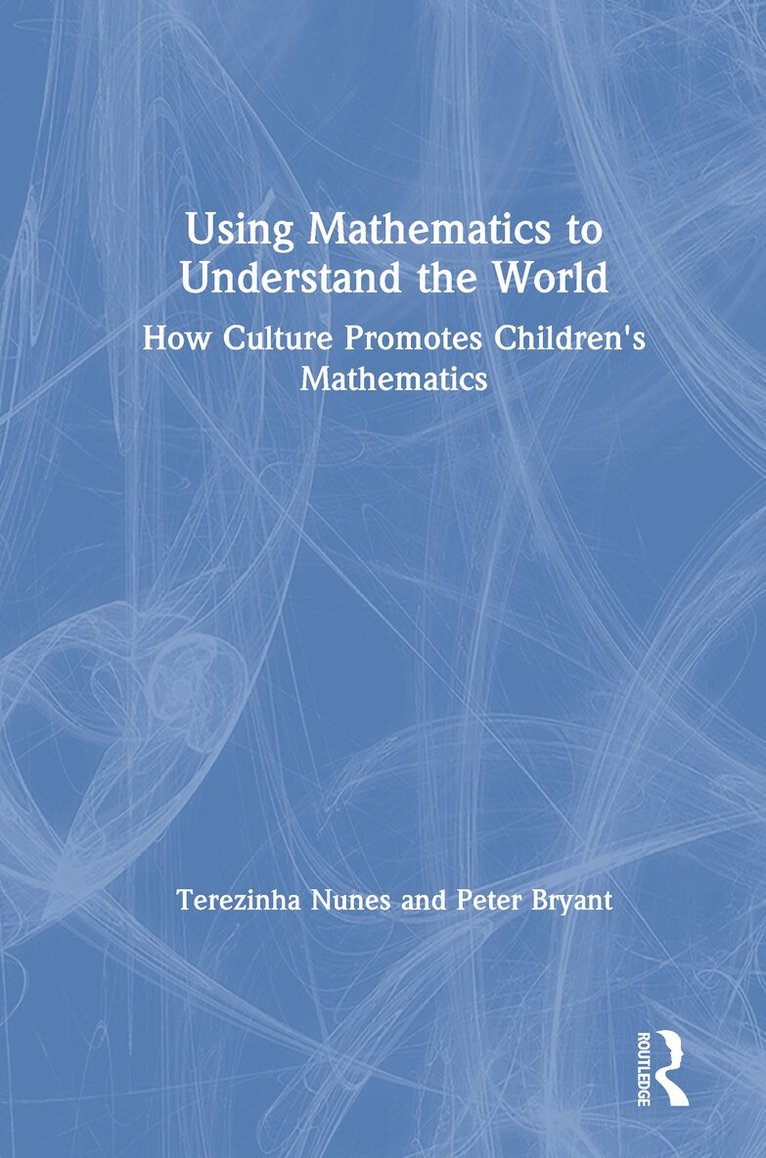
    Using Mathematics to Understand the World

    How Culture Promotes Children's Mathematics

    AvTerezinha Nunes,Peter Bryant

    Inbunden, Engelska, 2021

    2 002 kr

    Beställningsvara. Skickas inom 10-15 vardagar. Fri frakt över 249 kr.

    Fler format och utgåvor

    Häftad

    594 kr

    Beskrivning

    Using Mathematics to Understand the World: How Culture Promotes Children's Mathematics offers fundamental insight into how mathematics permeates our lives as a way of representing and thinking about the world. Internationally renowned experts Terezinha Nunes and Peter Bryant examine research into children’s mathematical development to show why it is important to distinguish between quantities, relations and numbers. Using Mathematics to Understand the World presents a theory about the development of children’s quantitative reasoning and reveals why and how teaching about quantitative reasoning can be used to improve children’s mathematical attainment in school. It describes how learning about the analytical meaning of numbers is established as part of mathematics at school but quantitative reasoning is emphasized less even though it is increasingly acclaimed as essential for thinking mathematically and for using mathematics to understand the world.This essential text is for all students of mathematics education, developmental psychology and cognitive psychology. By including activities for parents and professionals to try themselves, it may help you to recognize your own quantitative reasoning.

    Produktinformation

    • Utgivningsdatum:2021-08-06
    • Mått:156 x 234 x 17 mm
    • Vikt:660 g
    • Format:Inbunden
    • Språk:Engelska
    • Antal sidor:172
    • Förlag:Taylor & Francis Ltd
    • ISBN:9780367211684

    Utforska kategorier

    • Skolan och förskolan inom Psykologi och pedagogik
    • Barnpsykologi och utvecklingspsykologi inom Psykologi och pedagogik

    Mer om författaren

    Terezinha Nunes is a Brazilian Psychologist with a doctorate from City University of New York and a Doctor Honoris Causa from Szeged University. She is Emeritus Professor of Education, Oxford University. She received the 2017 Freudenthal Award for innovative and influential research in mathematics education from the International Committee on Mathematics Instruction.Peter Bryant’s research has been on children’s cognitive development and its impact on how they learn to read and write and to do mathematics. He is a FRS and he was the Watts Professor of Psychology at Oxford University for several years.

    Recensioner i media

    "This book is a most valuable contribution to scholarship in Mathematics Education and Education in general. Thanks to a remarkable organization, the book leads to discussions of arithmetic thinking, of language and of cultural issues. The resource to the most recent advances in the sciences of cognition and the amazing list of about 500 items distributed in the six chapters are an indicator of the high scholarship level of this book. I highlighted some key discussions in the book. The authors aim at discussing arithmetic skill as the ability to think about the behavior of numbers in relation to arithmetic operations. They focus on how children regard quantitative thinking. Since early childhood, children develop capability of observing their environment and comparing what they observe. This reveals quantitative perceptions. The authors carefully explain how the referential and analytical meanings of words progressively changes for children and how the nature of word meanings give them the ability to use language as a tool for thought. When children understand the analytical meaning of words, given by the relations between words in the language, this knowledge enriches their understanding of the referential meaning, because the analytical meaning leads to thinking about many relations. Children have the same motivation and use the same cognitive resources to learn the meaning of number words as to learn other words in the language. But when it comes to number words, they have an extra resource. They learn that, if they count the items, they can connect number words with quantities in the external world. Although the authors do not provide a systematic review of the vast literature on children’s counting, their conclusion is that children learn to implement the counting principles over a few years. In our view, the ability to be systematic in implementing procedures is part of their development of mathematical thinking. They also discuss rational numbers based on division rather than addition, hence the analytical meaning of rational numbers is also different from the analytical meaning of natural numbers: any natural number has a unique successor but rational numbers do not. They also discuss word problems as a way to apply mathematics in different contexts. The authors synthesize the importance of word problems as the promotion of students quantitative reasoning, the recognition of relations between quantities in the situation rather than by arithmetical operations and the explanation of students reasoning as part of solving the problem. Bringing the context to play a fundamental role in problem solving leads to very interesting discussions of how culture is intrinsic to mathematical thinking. I learned a lot from reading this book." Ubiratan D’Ambrosio is Emeritus Professor of State University of Campinas (UNICAMP), Brazil, and recipient of the Kenneth O. May Prize in History of Mathematics (2001) and of the Felix Klein Medal (2005) for pioneering work in mathematics education."In this impressively clear, coherent and thought-provoking book, two of the most eminent scholars of the past half a century of research on mathematics education, provide a unique synthesis of and reflection upon their work on children’s mathematical thinking and learning. The insightful central idea of their "opus magnum" is the need to put the referential meaning of numbers and arithmetic operations and, thus, the development of quantitative reasoning much more into the center of our educational efforts. This ambitious reconceptualization of mathematics education, which brings both culture and mathematical modelling to the foreground, will inspire every researcher and practitioner active in this field."Lieven Verschaffel is Full Professor in Educational Sciences at the University of Leuven, Belgium. Member of the Flemish Royal Academia for Sciences and Arts of Belgium and Member of the Academia Europeae.

    Innehållsförteckning

    • 1. Mathematical models and thinking 2. Counting, adding and natural numbers 3. Sharing, dividing and rational numbers 4. Word problems, implicit agreements, quantitative reasoning and arithmetic 5. Promoting quantitative reasoning in elementary school 6. When what we know is not what we see