Inbunden, Engelska, 2026
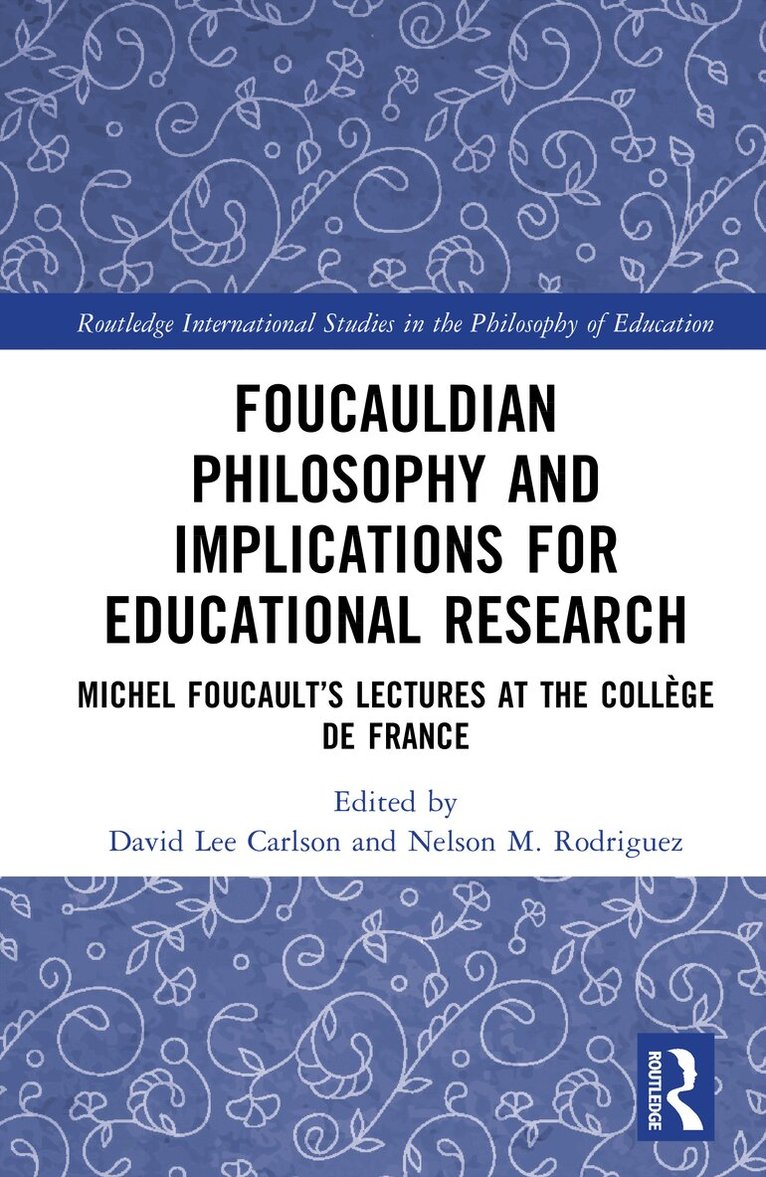
Foucauldian Philosophy and Implications for Educational Research
Michel Foucault’s Lectures at the Collège de France
Av David Lee Carlson, Nelson M. Rodriguez
Del i serien Routledge International Studies in the Philosophy of Education
2467 kr
Kommande
Beskrivning
Produktinformation
- Utgivningsdatum: 2026-11-30
- Mått: 152 x 229 x undefined mm
- Vikt: 453 g
- Format: Inbunden
- Språk: Engelska
- Serie: Routledge International Studies in the Philosophy of Education
- Antal sidor: 266
- Förlag: Taylor & Francis Ltd
- ISBN: 9780367356071
Utforska kategorier
Mer om författaren
David Lee Carlson is Professor of Qualitative Inquiry and Curriculum Studies at Arizona State University and has published over ten books and 45 articles. He is a member of the Professors of Curriculum Honorary Society.Nelson M. Rodriguez is Associate Professor of Women’s, Gender, and Sexuality Studies at The College of New Jersey, where he serves as Coordinator of the Sexuality and Queer Studies Program. His scholarship spans the fields of queer and gender studies, Foucault studies, critical pedagogy and cultural studies, and education.
Recensioner i media
This book brings Michel Foucault’s lectures at the Collège de France into conversation with educational inquiry, expanding Foucauldian scholarship beyond his published works. Curated chronologically, each chapter is anchored in a different lecture series, offering historically situated analyses while opening up pressing questions for education. The entire volume moves chapter by chapter through disciplinary power, biopower, governmentality, truth-telling, and the ethical care of the self, asking the overarching question on what this can do for education in the present. This collection invites readers to engage the lectures alongside its chapters, thinking with Foucault to problematize the taken-for-granted practices that structure schools, curricula, and education research. For readers encountering these lectures for the first time and for seasoned Foucauldian scholars, this book is a timely and intellectually compelling contribution that highlights the enduring political significance of educational inquiry today.-Sun Young Lee, Associate Professor, School of Education, Wichita State UniversityDavid Lee Carlson & Nelson Rodriguez have done us all a great favor by pulling this collection of essays on Foucault's work together. They astutely observe in their introduction that Foucault does not need another work introducing his ideas to authors. Today Foucault is ubiquitous, even hegemonic, in a way he would never have endorsed. His work is often cited to justify the necessity of historicizing the subjectivity of others, but his work and this insistence is rarely historicized. What we need is a way to see both the necessity of Foucault and the necessity of seeing beyond him. Carlson, Rodriguez, and the authors contributing to this book have provided us with the syllabus for such an engagement. I found myself imagining a seminar where we read Foucault's original works alongside the essays about those works in this book. What a delight that would be. This text will be of great value to instructors who want to teach advanced undergrads and graduate students about Foucault in a generative way.-Jerry Rosiek, Professor and Department Head of Education Studies, University of OregonThe work of Michel Foucault has had an extraordinary influence on fields across the humanities and social sciences, including education and, specifically, on curriculum theory. In the mid-1970s I was introduced to Foucault’s work by my brilliant then doctoral student at the University of Rochester - Peter M. Taubman - whose doctoral dissertation explicates his early work and its significance for gendered curriculum studies. Since then and over the decades I have studied Foucault’s work extensively, concentrating on his later work and as referenced in curriculum theory, such as in the important scholarship of James P. Burns. So it is with a long-standing appreciation for Foucault’s oeuvre that I proclaim the volume David Carlson and Nelson Rodriguez have assembled - this very volume - among the most important books published since Foucault appeared on the North American scene sixty years ago. My congratulations to Professors Carlson and Rodriguez - and to the distinguished contributors - for this invaluable volume.-William F. Pinar, Tetsuo Aoki Professor in Curriculum Studies, The University of British Columbia, Vancouver, CanadaWhat a wonderful idea for a book. Not only do we get a careful exposition of each of Foucault’s College de France lectures, the chapters also use Foucault’s toolbox to interrogate that which we call education. This is a rich resource for students seeking access to Foucauldian ideas and for those wanting to think differently about education. The individual chapters are elegantly written and full of important insights. This collection clearly demonstrates the relevance of Foucault for education research. -Stephen J. Ball, Emeritus Professor of Sociology of Education, University College LondonThe publishing of Foucault’s lectures at the College de France has been a significant contribution for understanding a style of reasoning that problematizes knowledge as a materiality of the present and the political of modernities. This volume’s archival inquiry into the different Foucault lectures furthers that contribution through exploring its style of reason to rethink critical studies in education and the potentialities of resistance. The transdisciplinary essays cross multiple terrains such as queer theory, security studies, biopolitics, and hermeneutics as well as new ways of thinking of affect theory and the production of difference in the topoi of professionalization, citizenship, delinquency, and the neoliberalism, among others.-Thomas Popkewitz, Professor, University of Wisconsin-MadisonAt a moment of increasingly virulent anti-intellectualism, and amid the systematic dismantling of the U.S. research sector, Foucault’s notion of actualité calls us to engage with our current conditions in ways that help us understand how they are making us, without losing the hope that we can always become-otherwise. This collection of essays takes up actualité by putting Foucault’s lectures at the Collège de France to work, explicitly connecting theory to political action and reminding us of our responsibility to intervene in the forces reshaping knowledge production in contemporary society. The volume offers situated readings of power, truth, knowledge production, and inquiry as tools for contemporary educational research—tools desperately needed for comprehending our precarious present and refusing it, while creating new possibilities.- Katie Strom, Professor of Educational Leadership, Cal State East BayCan we ever get enough Foucault? Never! This book reminds us of the importance of critically re-engaging with intellectual figures even when we think we know it all. The contributors to this book engage Foucault's Lectures at the College de France in profoundly fresh ways that compel us to return to the discourses of power, knowledge, subjectivity, history, and ethics to understand more deeply how education is an ethical endeavor, not a technology. It provides a space of solace in turbulent times. - Petra Munro Hendry, Professor Emeritus, Louisiana State UniversityEducation today is increasingly a contested terrain, where what it means to be educated and what knowledge can and should be taught is continually challenged. Understanding these conditions requires theoretical analyses that illuminate how education is governed and how particular forms of knowledge become authorized. Drawing on Foucault’s lecture series, this timely edited volume speaks directly to this intellectual need. Its contributors bring Foucault’s thinking vividly into the present, offering educational researchers a rich set of conceptual tools for thinking differently, asking critical questions, and illuminating the complex relations among knowledge, power, and education. This compelling volume demonstrates both the enduring vitality of Foucault’s thought and the intellectual possibilities that emerge when contemporary scholars engage with it anew.- Jeong-Hee Kim, Professor of Curriculum Studies and Teacher Education, College of Education, Texas Tech UniversityThis collection of provocative essays stages a dialogue with Foucault's Lectures at the Collège de France, decisively showing the continued value of these rich and unsettling ideas for educational research. Framed by a witty and brilliantly expansive Introduction that canvasses shifting moods and engagements with Foucault’s work, these essays enliven possibilities for Foucauldian scholarship in education, prodding familiar concepts and opening up powerful new questions for the present. - Julie McLeod, Director of Research Capability and Professor Curriculum Equity and Social Change, Faculty of Education, The University of MelbourneThis edited volume contributes to an understanding of Foucault’s scholarly thinking by providing close readings of Foucault’s Lectures at the Collège de France in relation to current educational issues. Chapters provide an intellectual background to specific lectures, topics, and the methods of inquiry. Authors offer engaging and erudite readings of the lectures, which present Foucault’s ideas as tools for re/considering educational research and practice. The book cultivates additional routes for critical thinking across Foucault and education.- Nancy Lesko, Maxine Greene Professor Emerita for Distinguished Contributions to EducationExecutive Editor, Teachers College Record
Betyg & recensioner
0 recensioner
Inga recensioner tillgängliga.