• Fri frakt över 249 kr
  • •
  • Snabba leveranser
  • •
  • Billiga böcker
Kundservice

Du är på sajten för privatpersoner.

Företag, bibliotek eller offentlig verksamhet?

Du handlar på classic.bokus.com, där alla dina funktioner finns intakta.
Till classic.bokus.com
Bokus logotyp. Gå till startsidan.
  • Erbjudanden
  • Nyheter
  • Student
  • Topplistor
  • Barn & ungdom
  • Bokus Play
  • E-böcker
  • Pocketböcker
  • Spel & pussel

Må bättre, för mindre! Upp till 50% rabatt på hälsoböcker

Sidfot

Mina sidor

    Hjälp

    • Kundservice
    • Vanliga frågor och svar
    • Frakt och leverans
    • Retur vid ångerrätt
    • Reklamera vara
    • Betalning
    • Köpvillkor
    • Allmänna villkor
    • Information om webbplatsens tillgänglighet

    Om Bokus

    • Om oss
    • Pressrum
    • För studenter
    • För företag
    • För bibliotek och offentlig verksamhet
    • För leverantörer
    • Hållbarhet

    Populärt

    • Aktuella erbjudanden
    • Presentkort
    • Studentlitteratur
    • Nya böcker
    • Topplistor
    • Signerade böcker
    • Engelska böcker

    Inspiration

    • Boktips
    • BookTok
    • Populära bokserier
    • Barnbokskaraktärer
    • Populära författare
    Logotyp för Bokus
    Följ oss på Facebook (extern länk)Följ oss på Instagram (extern länk)Följ oss på YouTube (extern länk)Följ oss på TikTok (extern länk)
    bokus @ CookiesAnpassa cookiesIntegritetspolicyKöpvillkor
    Till Citymail hemsida (extern länk)Till Budbee hemsida (extern länk)Till Postnord hemsida (extern länk)Till Schenker hemsida (extern länk)Till Early Bird hemsida (extern länk)Till Walleys hemsida (extern länk)
    1. Filosofi och religion
    2. Filosofi

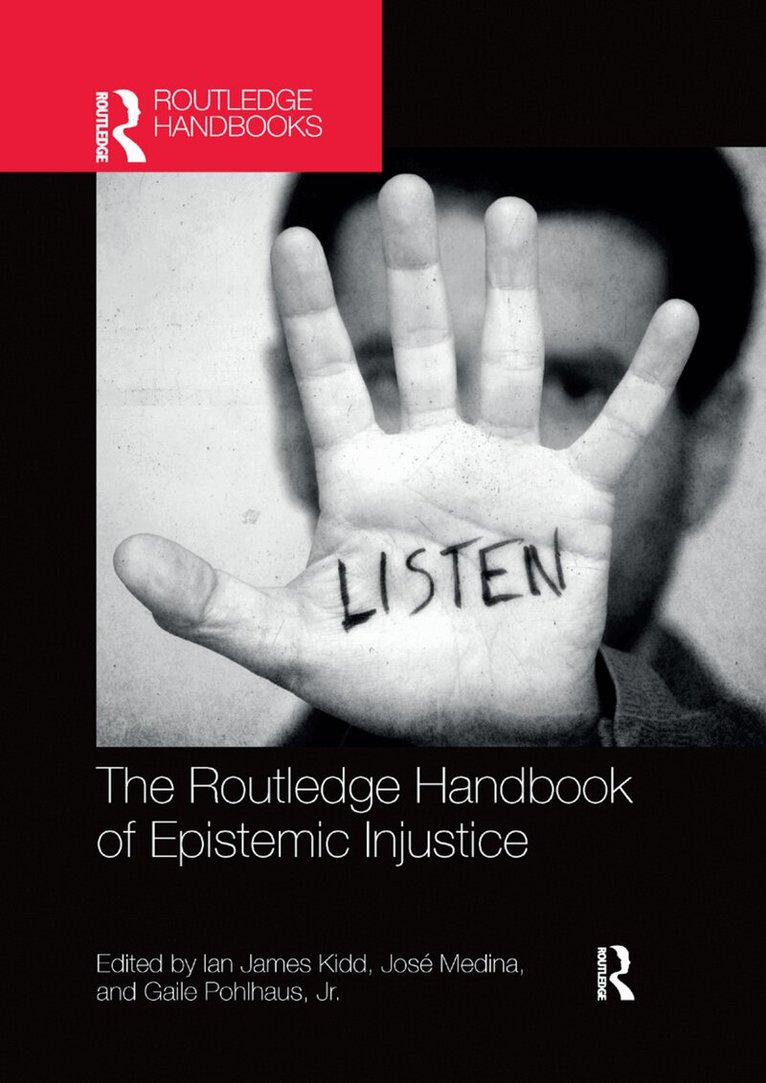
    Routledge Handbook of Epistemic Injustice

    AvIan James Kidd,José Medina

    Häftad, Engelska, 2019

    Del i serien Routledge Handbooks in Philosophy

    779 kr

    Beställningsvara. Skickas inom 10-15 vardagar. Fri frakt över 249 kr.

    Beskrivning

    In the era of information and communication, issues of misinformation and miscommunication are more pressing than ever. Epistemic injustice - one of the most important and ground-breaking subjects to have emerged in philosophy in recent years - refers to those forms of unfair treatment that relate to issues of knowledge, understanding, and participation in communicative practices.The Routledge Handbook of Epistemic Injustice is an outstanding reference source to the key topics, problems and debates in this exciting subject. The first collection of its kind, it comprises over thirty chapters by a team of international contributors, divided into five parts: Core ConceptsLiberatory Epistemologies and Axes of OppressionSchools of Thought and Subfields within EpistemologySocio-political, Ethical, and Psychological Dimensions of KnowingCase Studies of Epistemic Injustice. As well as fundamental topics such as testimonial and hermeneutic injustice and epistemic trust, the Handbook includes chapters on important issues such as social and virtue epistemology, objectivity and objectification, implicit bias, and gender and race. Also included are chapters on areas in applied ethics and philosophy, such as law, education, and healthcare.The Routledge Handbook of Epistemic Injustice is essential reading for students and researchers in ethics, epistemology, political philosophy, feminist theory, and philosophy of race. It will also be very useful for those in related fields, such as cultural studies, sociology, education and law.

    Produktinformation

    • Utgivningsdatum:2019-09-11
    • Mått:173 x 241 x 25 mm
    • Vikt:704 g
    • Format:Häftad
    • Språk:Engelska
    • Serie:Routledge Handbooks in Philosophy
    • Antal sidor:456
    • Förlag:Taylor & Francis Ltd
    • ISBN:9780367370633

    Utforska kategorier

    • Filosofi inom Filosofi och religion
    • Filosofiska discipliner inom Filosofi och religion

    Mer om författaren

    Ian James Kidd is Assistant Professor of Philosophy at the University of Nottingham, UK. With Jonathan Beale he is editor of Wittgenstein and Scientism (Routledge, 2017).José Medina is Professor of Philosophy at Vanderbilt University, USA. He is the author of four books, including The Epistemology of Resistance: Gender and Racial Oppression, Epistemic Injustice, and Resistant Imaginations (2013).Gaile Pohlhaus, Jr. is Associate Professor of Philosophy and affiliate of Women’s, Gender, and Sexuality Studies at Miami University, USA.

    Recensioner i media

    '…someone may not know where to begin since the discussion on epistemic injustice has grown so fast since Miranda Fricker's book burst onto the scene. But now, with the publication of the excellent, well-written, and beautifully compiled Routledge Handbook of Epistemic Injustice, there is a book that discusses the principal themes of epistemic injustice, highlights numerous connections to other academic literatures and contemporary debates, and opens the door to potential areas of further study that will make projects—such as identifying and resisting immigration injustices in US policy—much easier.' - Allison B. Wolf, Hypatia'… [A] comprehensive anthology on the current theories of epistemic injustice with important implications for future research. The diverse methods and topics of this text make it an excellent introduction for graduate seminars, as well as a common resource for researchers in the field. It includes contributions from most authors active in the field, with enough diversity in contributors to represent the substantive and methodological differences among them. … The Routledge Handbook of Epistemic Injustice provides a great deal of content and opportunities in a single volume.' - Amiel Bernal, Social Epistemology Review and Reply Collective'This could not be a more timely and consequential book. The editors assemble an impressive cross-section of contributors actively engaged in debates about the nature of epistemic violence, injustice, and responsibility. Best of all, they turn their gaze back on philosophy itself, and they turn it outward, asking what strategies of resistance, disruption, prevention and repair make sense, given their diagnoses of the problem. This is philosophy that 'lets the world in'.' - Alison Wylie, University of Washington – Seattle, USA, and Durham University, UK'The chapters collected here are authored by an all-star cast. They ably explore the many implications of epistemic injustice across philosophical sub-fields and through timely case studies. This Handbook takes the next step in broadening and deepening our understanding of this distinctive form of harm.' - Michael Brownstein, John Jay College of Criminal Justice (CUNY), USA'This is a timely and well-constructed volume on the state of discussions around epistemic injustice. The interdisciplinary nature of the chapters and the comprehensiveness of the coverage makes it a ‘must-read’ for anyone interested in investigations into epistemic injustice today. I, for one, sincerely thank the editors for their service in bringing together diverse authors and an expansive range of topics for this grand and successful book.' - Kristie Dotson, Michigan State University, USA

    Innehållsförteckning

    • Introduction Ian James Kidd, José Medina, and Gaile Pohlhaus, Jr. Part 1: Core Concepts1. Varieties of Epistemic Injustice Gaile Pohlhaus, Jr. 2. Varieties of Testimonial Injustice Jeremy Wanderer3. Varieties of Hermeneutical Injustice José Medina4. Evolving Concepts of Epistemic Injustice Miranda Fricker5. Epistemic Injustice as Distributive Injustice David Coady6. Trust, Distrust, and Epistemic Injustice Katherine Hawley7. Forms of Knowing and Epistemic Resources Alexis Shotwell8. Epistemic Responsibility Lorraine Code9. Ideology Charles MillsPart 2: Liberatory Epistemologies and Axes of Oppression10. Intersectionality and Epistemic Injustice Patricia Hill Collins11. Feminist Epistemology: The Subject of Knowledge Nancy Tuana12. Epistemic Injustice and the Philosophy of Race Luvell Anderson13. Decolonial Praxis and Epistemic Injustice Andrea J. Pitts14. Queer Epistemology and Epistemic Injustice Kim Q. Hall15. Allies Behaving Badly: Gaslighting as Epistemic Injustice Rachel McKinnon16. Knowing Disability Differently Shelley TremainPart 3: Schools of Thought and Subfields within Epistemology17. Power/Knowledge/Resistance: Foucault and Epistemic Injustice Amy Allen18. Epistemic Injustice and Phenomenology Lisa Guenther19. On the Harms of Epistemic Injustice: Pragmatism and Transactional Epistemology Shannon Sullivan20. Social Epistemology and Epistemic Injustice Sanford Goldberg21. Testimonial Injustice, Epistemic Vice, and Virtue Epistemology Heather BattalyPart 4: Socio-political, Ethical, and Psychological Dimensions of Knowing22. Implicit Bias and Stereotype Threat Jennifer Saul23. What’s Wrong with Epistemic Injustice? Harm, Vice, Objectification, Misrecognition Matthew Congdon24. Epistemic and Political Agency Lorenzo Simpson25. Epistemic and Political Freedom Susan Babbitt26. Epistemic Communities and Institutions Nancy McHugh27. Objectivity, Epistemic Objectification, and Oppression Sally HaslangerPart 5: Case Studies of Epistemic Injustice28. Epistemic Justice and the Law Michael Sullivan29. The Case of Digital Environments Gloria Origgi and Serena Ciranna30. Epistemic Injustice in Science Heidi Grasswick31. Education and Epistemic Injustice Ben Kotzee32. Epistemic Injustice in Medicine and Healthcare Havi Carel and Ian James Kidd33. Epistemic Injustice and Mental Illness Anastasia Scrutton34. Indigenous Peoples, Anthropology, and the Legacy of Epistemic Injustice Rebecca Tsosie 35. Epistemic Injustice and Archaeological Heritage Andreas Pantazatos36. Epistemic Injustice and Religion Ian James Kidd37. Philosophy and Philosophical Practice: Eurocentrism as an Epistemology of Ignorance Linda Martín AlcoffIndex