• Fri frakt över 249 kr
  • •
  • Snabba leveranser
  • •
  • Billiga böcker
Kundservice

Du är på sajten för privatpersoner.

Företag, bibliotek eller offentlig verksamhet?

Du handlar på classic.bokus.com, där alla dina funktioner finns intakta.
Till classic.bokus.com
Bokus logotyp. Gå till startsidan.
  • Erbjudanden
  • Student
  • Topplistor
  • Barn & ungdom
  • Bokus Play
  • E-böcker
  • Ljudböcker
  • Pocketböcker
  • Spel och pussel

Pocketfynda! Hundratals böcker för 49 kr/st →

Sidfot

Mina sidor

    Hjälp

    • Kundservice
    • Vanliga frågor och svar
    • Frakt och leverans
    • Retur vid ångerrätt
    • Reklamera vara
    • Betalning
    • Köpvillkor
    • Allmänna villkor
    • Information om webbplatsens tillgänglighet

    Om Bokus

    • Om oss
    • Pressrum
    • För studenter
    • För företag
    • För bibliotek och offentlig verksamhet
    • För leverantörer
    • Hållbarhet

    Populärt

    • Aktuella erbjudanden
    • Presentkort
    • Studentlitteratur
    • Nya böcker
    • Topplistor
    • Signerade böcker
    • Engelska böcker

    Inspiration

    • Boktips
    • BookTok
    • Barnbokskaraktärer
    • Populära författare
    Logotyp för Bokus
    Följ oss på Facebook (extern länk)Följ oss på Instagram (extern länk)Följ oss på YouTube (extern länk)Följ oss på TikTok (extern länk)
    bokus @ CookiesAnpassa cookiesIntegritetspolicyKöpvillkor
    Till Citymail hemsida (extern länk)Till Budbee hemsida (extern länk)Till Postnord hemsida (extern länk)Till Schenker hemsida (extern länk)Till Early Bird hemsida (extern länk)Till Walleys hemsida (extern länk)
    1. Ekonomi och Ledarskap
    2. Företagsekonomi
    3. Försäljning och marknadsföring

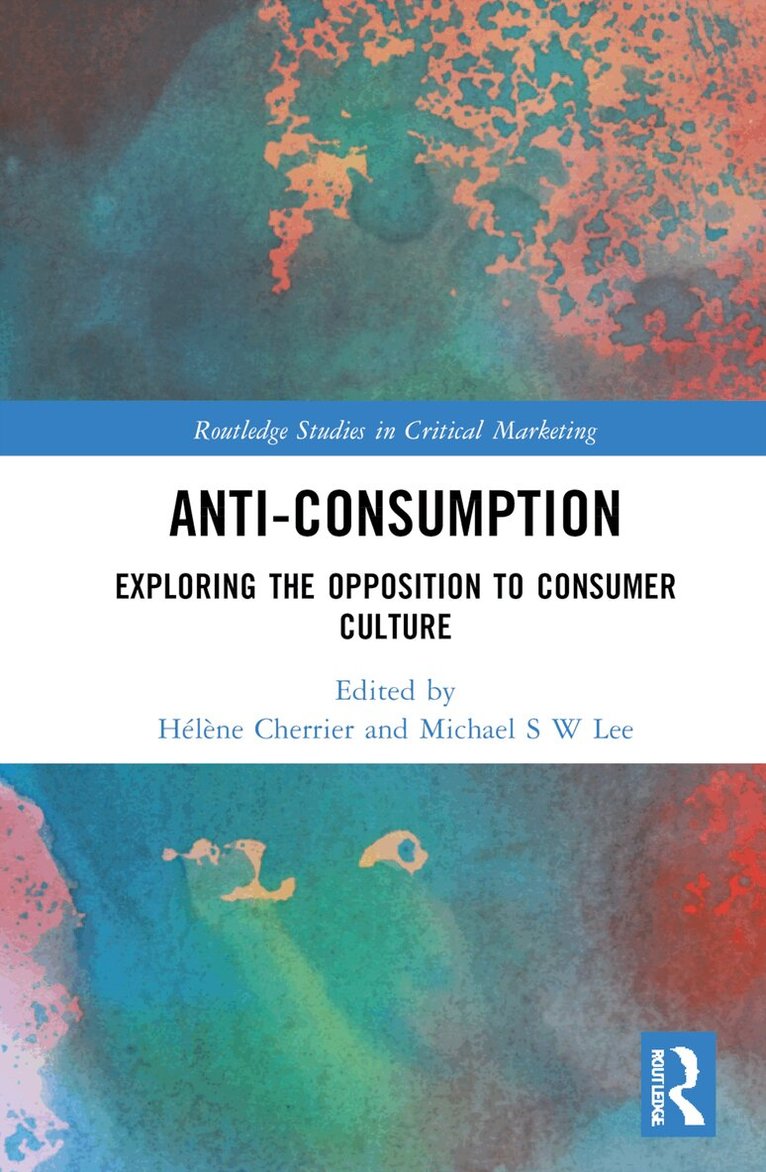
    Anti-Consumption

    Exploring the Opposition to Consumer Culture

    AvHélène Cherrier,Michael S W Lee

    Inbunden, Engelska, 2022

    Del i serien Routledge Studies in Critical Marketing

    2 482 kr

    Beställningsvara. Skickas inom 10-15 vardagar. Fri frakt över 249 kr.

    Beskrivning

    In this edited volume, the leading scholars in the field engage with consumers, marketers, corporations and policymakers as well as space dynamics and network formation to provide an in-depth examination of anti-consumption: a voluntary behavioural inclination to minimise rather than grow, to decelerate and simplify and to reduce the unnecessary exploitation of resources fuelled by consumer culture. This book does not place anti-consumption on the high moral ground but rather demonstrates its complexity to spur innovative and critical thinking on how people, organisations, businesses and governments can treat consumption more as a necessity for survival than as a tool for self-expression, pleasure and economic growth.The first part of this book looks at anti-consumption from a diversity of perspectives. It analyses voluntary simplicity, a self-motivated engagement in consumption reduction, and boycotting, a politically-motivated reaction against unacceptable corporate practices, as distinct manifestations of anti-consumption that nonetheless remain rooted in the logic of the market. Paving the way to critical perspectives on the interface between anti-consumption, people and the environment, the second part of the book projects anti-consumption to issues of waste production and provides possible answers to global challenges of resources depletion, social inequalities and global warming. In this section, anti-consumption is critically assessed as an actor of change, both in terms of social change and paradigm change. To move the field forward, the third part of this book presents several theoretical frameworks that help set a roadmap for future research.Anti-Consumption will be of direct interest to scholars and researchers within the fields of marketing, consumer research, business studies, environmental studies and sustainability. It will also be of value to those researching the economics and/or sociology of markets.

    Produktinformation

    • Utgivningsdatum:2022-09-01
    • Mått:156 x 234 x 20 mm
    • Vikt:471 g
    • Format:Inbunden
    • Språk:Engelska
    • Serie:Routledge Studies in Critical Marketing
    • Antal sidor:242
    • Förlag:Taylor & Francis Ltd
    • ISBN:9780367420758

    Utforska kategorier

    • Försäljning och marknadsföring inom Ekonomi och Ledarskap
    • Entreprenörskap inom Ekonomi och Ledarskap

    Mer om författaren

    Hélène Cherrier is an award-winning Professor in Marketing at Skema Business School, Sophia Antipolis, France. Hélène has worked at internationally renowned institutions such as RMIT, Melbourne, Australia; Griffith University, Brisbane, Australia; the American University of Dubai, United Arab Emirates; LUISS University, Rome, Italy; Sydney University, Sydney, Australia, and Westminster University, London, UK. Hélène has been interested in the forces of market constituents responsible for shaping and nurturing unsustainable consumption, often in the context of waste, since completing her PhD at the University of Arkansas focusing on voluntary simplicity and consumer identity. Hélène has edited a book on downshifting and published her work in prestigious journals such as the Journal of Consumer Research; Journal of Business Research, Journal of Public Policy & Marketing, Consumption, Markets and Culture, Journal of Marketing Management, and Journal of Consumer Affairs. Hélène has also been an active participant in dumpster diving, home-free living, clothes swapping, and zero waste experiments, and she struggles to maintain a low impact consumption as a mother of five children.Michael S.W. Lee is an award-winning Associate Professor of Marketing at The University of Auckland with research interests in anti-consumption and consumer resistance, and specific expertise in the area of brand avoidance, innovation resistance, dissatisfaction and complaining behaviours. An offshoot of his doctoral research delved into consumer perceptions of brands associated with genetic modification. Overall he is interested in why people reject certain markets or offerings and how industries can understand consumers better in order to adapt, improve, become more sustainable or, in some cases, overcome resistance. His latest research applies anti-consumption to areas of public policy and consumer well-being, where he is particularly interested in consumer perceptions, attitudes and behaviour towards waste and waste utilisation. He has been awarded over $150,000 in funding for various research projects and has published and/or guest edited special issues in The Journal of Business Research; Consumption, Markets and Culture; European Journal of Marketing; Advances in Consumer Research; Journal of Consumer Marketing; Journal of Consumer Behaviour; Journal of Macromarketing; Journal of Global Marketing; Australasian Marketing Journal; Journal of Public Policy and Marketing; Journal of Consumer Affairs; and Psychology & Marketing.Recognising a need for international collaboration, Mike founded The International Centre of Anti-Consumption Research (ICAR) in 2005. Under his Directorship, ICAR continues to organise international symposiums and special issues in quality journals, providing an avenue of research for hundreds of scholars. Mike’s contribution to the area has resulted in the Association of Consumer Research recognising anti-consumption as an official field of inquiry.

    Innehållsförteckning

    • Introduction Hélène Cherrier and Michael S.W. LeePart 1. What Is Anti-Consumption?Chapter 1: Consumer Boycott Participation: Evidence for the Trigger/Promoter/Inhibitor ModelStefan HoffmannChapter 2: The evolution of Voluntary Simplicity: From Soulful Search for Meaning to Extreme Lifestyle ExperimentsStephen Zavestoski and Marilyn DeLaureChapter 3: How Green Demarketing Brands Can Successfully Support Anti-ConsumptionCatherine Armstrong Soule and Tejvir SekhonChapter 4: "I am NOT a Consumer" or "I Don't WANT to be a Consumer" or "I CAN'T be a Consumer": A Fresh Look at the New Strategies Consumers Use to Avoid the MarketplaceSusan DobschaChapter 5: Anti-Consumers, Pro-Consumers, and Two Social Paradigms of ConsumptionJim Muncy and Rajesh IyerPart 2. Why Is Anti-Consumption Important?Chapter 6: Anti-Consumption and Our Current Crisis of CareAndreas ChatzidakisChapter 7: Different Sides of the Same Coin? Political Ideology Inflects How Symbolism Relates to Mask Avoidance or Adoption in the Age of COVID-19Charles S. Areni and Hélène CherrierChapter 8: Anti-Consumption In Emerging MarketsPragea Geldoffy Putra and Michael S.W. LeeChapter 9: The Trio of Religiosity, Materialism, and Anti-Consumption in Explaining Life SatisfactionBetul Balikcioglu and Faith Mehmet KiyakPart 3. The Future of Anti-Consumption ResearchChapter 10: The "Fake It Till We Make It" Path to a Shared, sustainable societyKaren V. FernandezChapter 11: Promoting Consumption Reduction: A Behaviour Change ChallengeKen PeattieChapter 12: Socially Oriented Anti-ConsumptionNieves García-de-Frutos and José Manuel Ortega-Egea