• Fri frakt över 249 kr
  • •
  • Snabba leveranser
  • •
  • Billiga böcker
Kundservice

Du är på sajten för privatpersoner.

Företag, bibliotek eller offentlig verksamhet?

Du handlar på classic.bokus.com, där alla dina funktioner finns intakta.
Till classic.bokus.com
Bokus logotyp. Gå till startsidan.
  • Erbjudanden
  • Nyheter
  • Student
  • Topplistor
  • Barn & ungdom
  • Bokus Play
  • E-böcker
  • Pocketböcker
  • Spel & pussel

10% rabatt på allt med kod: NYSTART10 →

Sidfot

Mina sidor

    Hjälp

    • Kundservice
    • Vanliga frågor och svar
    • Frakt och leverans
    • Retur vid ångerrätt
    • Reklamera vara
    • Betalning
    • Köpvillkor
    • Allmänna villkor
    • Information om webbplatsens tillgänglighet

    Om Bokus

    • Om oss
    • Pressrum
    • För studenter
    • För företag
    • För bibliotek och offentlig verksamhet
    • För leverantörer
    • Hållbarhet

    Populärt

    • Aktuella erbjudanden
    • Presentkort
    • Studentlitteratur
    • Nya böcker
    • Topplistor
    • Signerade böcker
    • Engelska böcker

    Inspiration

    • Boktips
    • BookTok
    • Populära bokserier
    • Barnbokskaraktärer
    • Populära författare
    Logotyp för Bokus
    Följ oss på Facebook (extern länk)Följ oss på Instagram (extern länk)Följ oss på YouTube (extern länk)Följ oss på TikTok (extern länk)
    bokus @ CookiesAnpassa cookiesIntegritetspolicyKöpvillkor
    Till Citymail hemsida (extern länk)Till Budbee hemsida (extern länk)Till Postnord hemsida (extern länk)Till Schenker hemsida (extern länk)Till Early Bird hemsida (extern länk)Till Walleys hemsida (extern länk)
    1. Kultur
    2. Arkitektur

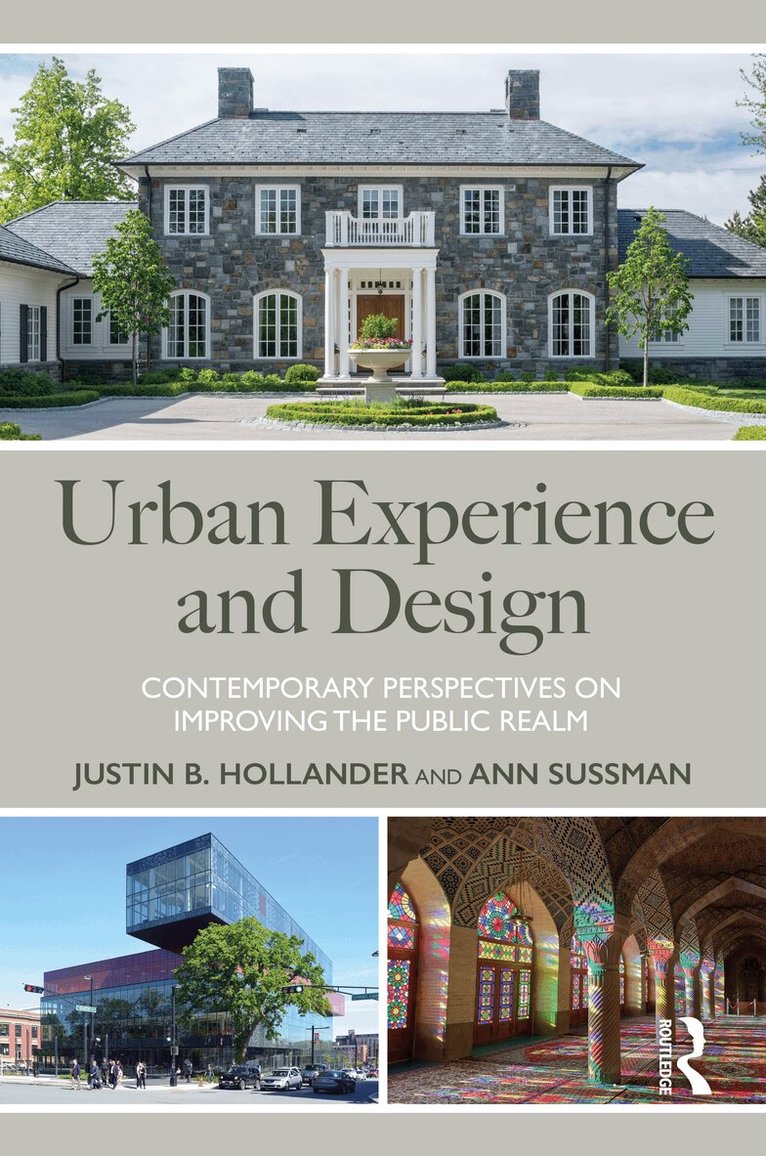
    Urban Experience and Design

    Contemporary Perspectives on Improving the Public Realm

    AvJustin B. Hollander,Ann Sussman

    Inbunden, Engelska, 2020

    2 493 kr

    Beställningsvara. Skickas inom 10-15 vardagar. Fri frakt över 249 kr.

    Beskrivning

    Embracing a biological and evolutionary perspective to explain the human experience of place, Urban Experience and Design explores how cognitive science and biometric tools provide an evidence-based foundation for architecture and planning. Aiming to promote the creation of a healthier and happier public realm, this book describes how unconscious responses to stimuli, outside our conscious awareness, direct our experience of the built environment and govern human behavior in our surroundings.This collection contains 15 chapters, including contributions from researchers in the US, the UK, the Netherlands, France and Iran. Addressing topics such as the impact of eye-tracking analysis and seeing beauty and empathy within buildings, Urban Experience and Design encourages us to reframe our understanding of design, including the narrative of how modern architecture and planning came to be in the first place. This volume invites students, academics and scholars to see how cognitive science and biometric findings give us remarkable 21st-century metrics for evaluating and improving designs, even before they are built.

    Produktinformation

    • Utgivningsdatum:2020-10-16
    • Mått:152 x 229 x undefined mm
    • Vikt:560 g
    • Format:Inbunden
    • Språk:Engelska
    • Antal sidor:252
    • Förlag:Taylor & Francis Ltd
    • ISBN:9780367435578

    Utforska kategorier

    • Arkitektur inom Kultur
    • Psykologi inom Psykologi och pedagogik
    • Biovetenskap inom Naturvetenskap och teknik

    Mer om författaren

    Justin B. Hollander is a professor of Urban and Environmental Policy and Planning and director of the C.A.G.S in Urban Justice and Sustainability at Tufts University. His research and teaching is in the areas of physical planning, big data, shrinking cities and the intersection between cognitive science and the design of cities. He is the author of seven other books on urban planning and design, including Cognitive Architecture: Designing for How We Respond to the Built Environment (with Ann Sussman) and Urban Social Listening: Potential and Pitfalls for Using Microblogging Data in Studying Cities, and was recently inducted as a fellow of the American Institute of Certified Planners. He hosts the Apple podcast 'Cognitive Urbanism.'Ann Sussman is a registered architect, researcher and college instructor. Her book, Cognitive Architecture: Designing for How We Respond to the Built Environment (Routledge, 2015), coauthored with Justin B. Hollander, won the Place Research Award from the Environmental Design Research Association (EDRA) in 2016. She currently teaches a new course on perception and the human experience of place, 'Architecture and Cognition,' at the Boston Architectural College (BAC). In 2020, she founded and became president of the nonprofit The Human Architecture + Planning Institute, Inc. (theHapi.org).

    Recensioner i media

    "As it happens, we understand very little about how human beings interact emotionally and physiologically with the world around us. This is beginning to change. The collection of essays in this recent book on Urban Experience and Design describes various studies ranging from biometric monitoring to way-finding surveys, providing unique insight into our cognitive processing of environmental stimuli… Taken together these contributions could indeed inform a new paradigm for the design professions."Woodworth, A.V. (n.d.). BOOK REVIEW: URBAN EXPERIENCE AND DESIGN: CONTEMPORARY PERSPECTIVES ON IMPROVING THE PUBLIC REALM, EDITED BY Justin B. Hollander and Ann Sussman. New Design Ideas, Vol.5, No.2, 2021, pp.224-226"Urban Experience and Design: Contemporary Perspectives on Improving the Public can be a useful source for scholars and students looking to introduce the topics of biophilic design and designing healthier buildings and urban spaces. Section I can best serve students as an introduction to urban planning and design concepts and theoretical foundations, as well as point to the future of potential research."Henry Hildebrandt (2022) Urban experience and design: Contemporary perspectives on improving the public realm, edited by Justin B. Hollander and Ann Sussman, Journal of Urban Affairs, 44:3, 440-442, DOI: 10.1080/07352166.2021.1955599"The editors and authors tell us that architecture and urban design must give people what they want, what they are comfortable with and what evolution has primed them to seek and appreciate. That message is likely to be received with some ambivalence in most schools of environmental design and in many professional associations… the editors and their collaborators rightly tell us that designers and planners stand to benefit from new biometric methods. A better understanding of the human mind, visual perception and user behaviour can only help. In the hands of a skilful designer, it can add to the complexity and contradiction that makes good architecture great."Raphaël Fischler (2021) Urban experience and design contemporary perspectives on improving the public realm, Journal of Urban Design, 26:5, 651-652, DOI: 10.1080/13574809.2021.1956710

    Innehållsförteckning

    • Introduction: The 21st-Century Paradigm Shift in Architecture and Planning Section 1: Historical and Theoretical Foundations of Architecture and Planning 1 Sense of Place: Looking Backward to Go Forward? 2 Classic Planning: The Power of Beauty for Human Architecture and Planning 3 Bonding with Beauty: The Connection Between Facial Patterns, Design and Our Well-Being 4 Neuroscience Experiments to Verify the Geometry of Healing Environments: Proposing a Biophilic Healing Index of Design and Architecture Section 2: Twenty-First-Century Tools: Biometrics and Measuring the Human Experience of Place 5 Identifying Biophilic Design Elements in Streetscapes: A Study of Visual Attention and Sense of Place 6 Exploring Eye-Tracking Technology: Assessing How the Design of Densified Built Environments Can Promote Inhabitants' Well-Being 7 Attention and Focus in the Perception of Persian Architecture Section 3 Explorations of the New Paradigm for Urban Experience and Design 8 Cognitive Mapping, Mobility Technologies and the Decoupling of Imageability and Accessibility 9 Emerging Transport Futures for Streets and How Eye Tracking Can Help Improve Safety and Design 10 Ecoempathetic Design: Moving Beyond Biophilia With Brain Science 11 Exploring Urban Form Through OpenStreetMap Data: A Visual Introduction 12 A Device-Free Mapping Approach for Quantifying User Activities in Indoor Environments 13 Being Seen, Feeling Heard: Designing Intimate-Scaled Spaces on Urban College Campuses Conclusion: Understanding Ourselves Better Reframes Architecture and Planning