• Fri frakt över 249 kr
  • •
  • Snabba leveranser
  • •
  • Billiga böcker
Kundservice

Du är på sajten för privatpersoner.

Företag, bibliotek eller offentlig verksamhet?

Du handlar på classic.bokus.com, där alla dina funktioner finns intakta.
Till classic.bokus.com
Bokus logotyp. Gå till startsidan.
  • Erbjudanden
  • Nyheter
  • Student
  • Topplistor
  • Barn & ungdom
  • Bokus Play
  • E-böcker
  • Pocketböcker
  • Spel & pussel

10% rabatt på allt med kod: NYSTART10 →

Sidfot

Mina sidor

    Hjälp

    • Kundservice
    • Vanliga frågor och svar
    • Frakt och leverans
    • Retur vid ångerrätt
    • Reklamera vara
    • Betalning
    • Köpvillkor
    • Allmänna villkor
    • Information om webbplatsens tillgänglighet

    Om Bokus

    • Om oss
    • Pressrum
    • För studenter
    • För företag
    • För bibliotek och offentlig verksamhet
    • För leverantörer
    • Hållbarhet

    Populärt

    • Aktuella erbjudanden
    • Presentkort
    • Studentlitteratur
    • Nya böcker
    • Topplistor
    • Signerade böcker
    • Engelska böcker

    Inspiration

    • Boktips
    • BookTok
    • Populära bokserier
    • Barnbokskaraktärer
    • Populära författare
    Logotyp för Bokus
    Följ oss på Facebook (extern länk)Följ oss på Instagram (extern länk)Följ oss på YouTube (extern länk)Följ oss på TikTok (extern länk)
    bokus @ CookiesAnpassa cookiesIntegritetspolicyKöpvillkor
    Till Citymail hemsida (extern länk)Till Budbee hemsida (extern länk)Till Postnord hemsida (extern länk)Till Schenker hemsida (extern länk)Till Early Bird hemsida (extern länk)Till Walleys hemsida (extern länk)
    1. Djur och Natur
    2. Naturböcker
    3. Växtböcker

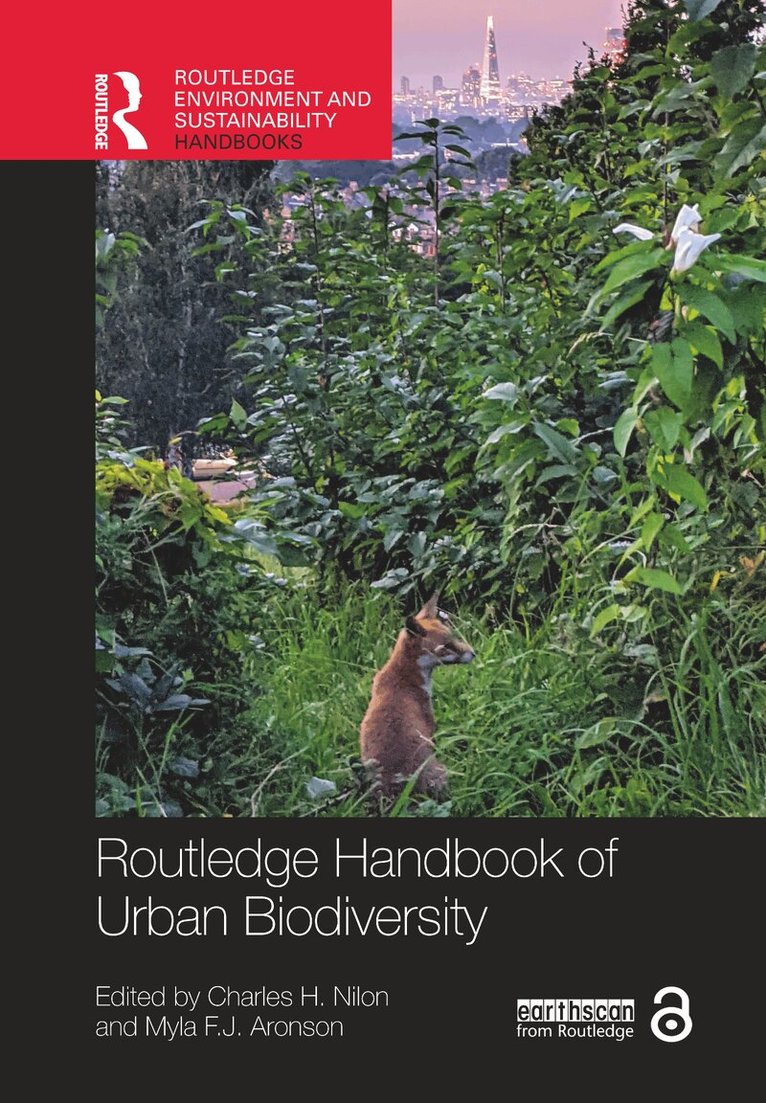
    Routledge Handbook of Urban Biodiversity

    AvCharles H. Nilon,Myla F.J. Aronson

    Inbunden, Engelska, 2023

    Del i serien Routledge Environment and Sustainability Handbooks

    3 331 kr

    Beställningsvara. Skickas inom 10-15 vardagar. Fri frakt över 249 kr.

    Beskrivning

    This handbook provides a state-of-the-art, comprehensive overview of the expanding field of urban biodiversity.The field of urban biodiversity has emerged from within the broad discipline of urban ecology in the past two decades and is now a significant field in its own right. In view of this, the Routledge Handbook of Urban Biodiversity presents a thorough treatment of this field detailing the history of urban biodiversity, theoretical foundations, current state of knowledge, and application of that knowledge. The handbook is split into four parts:Part I: Setting the Stage for Urban Biodiversity Research and PracticePart II: Foundational Concepts and Theory in Urban Biodiversity ResearchPart III: Population and Community Ecology of Key Urban TaxaPart IV: Urban Biodiversity Practice: Management, Planning, and Design for Healthy CommunitiesThis volume contains interdisciplinary and global contributions from established and early career academics as well as professionals and practitioners, addressing two key fields in urban biodiversity: fundamental research focused on answering questions about the mechanisms explaining the distribution of species among and within cities; and applied research and work by practitioners to address concerns about urban biodiversity conservation, restoration, planning, design, and public involvement.This handbook is essential reading for students, academics, and professionals interested and working in the fields of urban biodiversity, ecology, nature conservation, urban planning, and landscape architecture.Chapters 15 and 22 of this book are freely available as a downloadable Open Access PDF at http://www.taylorfrancis.com under a Creative Commons Attribution-Non Commercial-No Derivatives (CC-BY-NC-ND) 4.0 license.

    Produktinformation

    • Utgivningsdatum:2023-10-16
    • Mått:174 x 246 x 32 mm
    • Vikt:1 000 g
    • Format:Inbunden
    • Språk:Engelska
    • Serie:Routledge Environment and Sustainability Handbooks
    • Antal sidor:450
    • Förlag:Taylor & Francis Ltd
    • ISBN:9780367444549

    Utforska kategorier

    • Växtböcker inom Djur och Natur
    • Botanik inom Naturvetenskap och teknik
    • Landskapsarkitektur inom Kultur

    Mer om författaren

    Charles H. Nilon is a professor in the School of Natural Resources at the University of Missouri. His research and teaching focus on urban wildlife conservation, urban ecology, and the human dimensions of wildlife conservation. Dr. Nilon is a co-director of three urban biodiversity synthesis projects, including the "Urban Biodiversity Research Coordination Network" (UrBioNet), and is co-president of the International Urban Biodiversity and Design Network (URBIO).Myla F.J. Aronson is an assistant professor in the Department of Ecology, Evolution, and Natural Resources, at Rutgers, The State University of New Jersey. Her research and teaching focuses on the patterns, drivers, and management of biodiversity in human dominated landscapes, particularly plant population and community dynamics in urban areas. Dr. Aronson is co-director of three urban biodiversity synthesis projects, including the "Urban Biodiversity Research Coordination Network" (UrBioNet), and serves on the Advisory Board for the International Urban Biodiversity and Design Network (URBIO).

    Recensioner i media

    “The earliest roots of urban ecology lie in the study of wild and domestic organisms in cities. Nilonand Aronson show the depth and rigor of this research tradition, illustrate its crucial applicationto conservation of global biodiversity, and point to the continued need and creative future for urbanbiodiversity studies.”Steward T.A. Pickett, Distinguished Senior Scientist, Cary Institute ofEcosystem Studies, Millbrook, New York , USA“This is a blockbuster book for the urban century. From the fundamentals, science and theory ofurban biodiversity to practical management issues, Nilon and Aronson have produced a must-havethat should be on the bookshelf of every urban professional.”Karen C. Seto , Frederick C. Hixon Professor of Geography &Urbanization Science, Yale University, New Haven, Connecticut, USA“Rapid urbanization at global scale exerts serious threats to urban biodiversity which is of greatimportance for conservation in terms of implementing the Kunming-Montreal Global BiodiversityFramework; Urban development can not be successful unless its biodiversity is sustainablyutilized. The book offers readers opportunities to understand concepts and theory for urban biodiversityand learn best practices in using and conserving it.”Keping Ma , Vice Chair and Secretary General, Biodiversity Committee,Chinese Academy of Sciences, Beijing, China“Old concepts of cities and nature being two separate worlds have been overturned. Studies of theclose interplay of urban conditions and high biodiversity are yielding a new understanding of thestructure of urban nature and its importance to the human experience. This book sets a new standardfor explaining the ecological foundations of urban nature, the current state of knowledge, therole of human actions and management on city species, and a path forward for new research andnew collaborations. Cities are expanding rapidly across the globe; this Handbook will be a guideto incorporating modern ecological perspectives to the design of healthier, more resilient urbanlandscapes and improving conservation of the rich urban biodiversity.”Steven N. Handel , Distinguished Professor of Ecology, Rutgers,The State University of New Jersey, New Brunswick, New Jersey , USA

    Innehållsförteckning

    • Introduction to the Routledge Handbook of Urban Biodiversity Charles H. Nilon and Myla F.J. AronsonPART 1: Setting the stage for urban biodiversity research and practice History of urban biodiversity research and practiceCharles H. Nilon Comparative urban ecology and the gradient approach: extending knowledge by acknowledging the diversity of cities around the worldAmy K. Hahs Urban climate and the biophysical environmentPeter Ibsen, Dion Kucera, Stephanie Piper, and G. Darrel Jenerette Understanding land use, land cover, and landscape patterns of the world’s cities for sustainable biodiversity planningCynnamon Dobbs, Dagmar Haase, and Ulla MörtbergPART 2: Foundational concepts and theory in urban biodiversity research The application of landscape ecology and biogeography in the study of urban biodiversityChristopher A. Lepczyk and Frank A. La Sorte Community assembly and filtering of urban ecosystemsMyla F.J. Aronson, Christopher A. Lepczyk, and Karl L. Evans From filters to feedbacks: how do people influence biodiversity across scales?Riley Andrade, Paige S. Warren, and Sarel S. Cilliers People’s decisions shape urban habitatsDave Kendal, Emily Minor, and Monika Egerer Scaling-up the management and conservation of urban biodiversity Susannah B. Lerman, Josep Padullés Cubino, and Mark A. Goddard Connecting biodiversity and human wellbeingJessica C. Fisher, Maximilian Nawrath, Martin Dallimer, Katherine N. Irvine, and Zoe G. Davies Multidimensionality of biodiversity in urban social-ecological soil systemsLoren B. Byrne and Katalin Szlavecz Plant invasions in cities: patterns, processes, consequences, and managementMirijam Gaertner and Ingo Kowarik The importance of citizen science for understanding urban biodiversityChristopher A. Lepczyk and Timothy VargoPART 3: Population and community ecology of key urban taxa Patterns and drivers of plant biodiversity in urban and urbanizing landscapesSonja Knapp and Wayne Zipperer Urbanization shapes insect diversityEmily K. Meineke, Elsa Youngsteadt, Mia K. Lippey, and Katherine C.R. Baldock Birds in an urban world: community patterns across citiesChristine Rega-Brodsky and Ian MacGregor-Fors A cross-continental synthesis of urban insectivorous bat research and future directionsCaragh G. Threlfall and Kirsten Jung Impacts of urbanization on amphibians and opportunities for their conservation in citiesKirsten M. Parris Freshwater biodiversity in urban ecosystemsAugustin C. Engman and Allison H. RoyPART 4: Urban biodiversity practice: management, planning, and design for healthy communities Urban green infrastructure, biodiversity, poverty, and equityCharlie M. Shackleton Managing vegetation for urban biodiversityJun Yang, Sonja Knapp, and Wayne Zipperer The role of engineered green infrastructure in supporting urban biodiversityJ. Scott MacIvor, Nicholas S.G. Williams, and Jeremy Lundholm Global biodiversity requires integrating social and ecological goals for urban biodiversity: insights from ecological restoration Lea R. Johnson Cities are planning for biodiversity: a global survey of city plansKaren M. O’Neill, Myla F.J. Aronson, Charles H. Nilon, Sarel S. Cilliers, Cynnamon Dobbs, Laren J. Frazee, Mark A. Goddard, Debra Roberts, Emilie K. Stander, Peter Werner, and Ken P. Yocom Development and evolution of urban biodiversity indicators and assessment toolsYuta Uchiyama and Ryo Kohsaka Urban biodiversity: opportunities and challenges in the Paris RegionMarc Barra Regeneration of urban nature: from planning to actionDiana Wiesner Design for urban biodiversity: applying research on biodiversity of urban lawns into landscape design practiceMaria Ignatieva