• Fri frakt över 249 kr
  • •
  • Snabba leveranser
  • •
  • Billiga böcker
Kundservice

Du är på sajten för privatpersoner.

Företag, bibliotek eller offentlig verksamhet?

Du handlar på classic.bokus.com, där alla dina funktioner finns intakta.
Till classic.bokus.com
Bokus logotyp. Gå till startsidan.
  • Erbjudanden
  • Student
  • Topplistor
  • Barn & ungdom
  • Bokus Play
  • E-böcker
  • Ljudböcker
  • Pocketböcker
  • Spel och pussel

Pocketfynda! Hundratals böcker för 49 kr/st →

Sidfot

Mina sidor

    Hjälp

    • Kundservice
    • Vanliga frågor och svar
    • Frakt och leverans
    • Retur vid ångerrätt
    • Reklamera vara
    • Betalning
    • Köpvillkor
    • Allmänna villkor
    • Information om webbplatsens tillgänglighet

    Om Bokus

    • Om oss
    • Pressrum
    • För studenter
    • För företag
    • För bibliotek och offentlig verksamhet
    • För leverantörer
    • Hållbarhet

    Populärt

    • Aktuella erbjudanden
    • Presentkort
    • Studentlitteratur
    • Nya böcker
    • Topplistor
    • Signerade böcker
    • Engelska böcker

    Inspiration

    • Boktips
    • BookTok
    • Barnbokskaraktärer
    • Populära författare
    Logotyp för Bokus
    Följ oss på Facebook (extern länk)Följ oss på Instagram (extern länk)Följ oss på YouTube (extern länk)Följ oss på TikTok (extern länk)
    bokus @ CookiesAnpassa cookiesIntegritetspolicyKöpvillkor
    Till Citymail hemsida (extern länk)Till Budbee hemsida (extern länk)Till Postnord hemsida (extern länk)Till Schenker hemsida (extern länk)Till Early Bird hemsida (extern länk)Till Walleys hemsida (extern länk)
    1. Samhälle och politik
    2. Politik och statsskick
    3. Statsskick och politiska processer
    4. Statsskick: demokrati

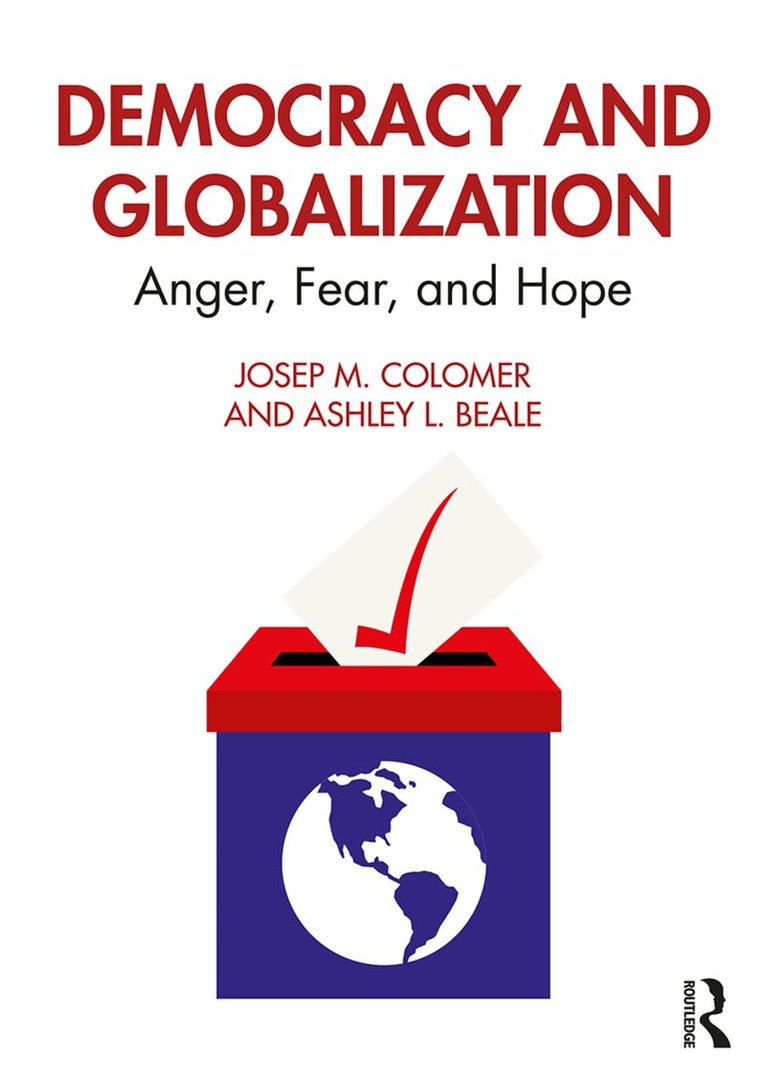
    Democracy and Globalization

    Anger, Fear, and Hope

    AvJosep M. Colomer,Ashley L. Beale

    Häftad, Engelska, 2020

    622 kr

    Beställningsvara. Skickas inom 10-15 vardagar. Fri frakt över 249 kr.

    Fler format och utgåvor

    Inbunden

    2 410 kr

    Beskrivning

    As democracy is disrupted by globalization, the solution is to globalize democracy. This book explores the causes of the current crisis of democracy and advocates new ways for more representative, effective, and accountable governance in an interdependent world.Part 1 analyzes the split of the middle class and the subsequent political polarization which underlies people’s dissatisfaction with the way democracy works in developed countries. It also addresses the role of political emotions, including disappointments about unmet expectations, anger incited from opposition candidates, fear induced from government, and hope wrapping up new proposals for reform and change. In Part 2, the authors argue that a more effective governance would require reallocations of power at local, national, continental and global levels with innovative combinations of direct democracy, representative government, and rule by experts.This book will be of interest to students and scholars of political science, comparative politics, international relations, political economy and democratic theory, as well as general readers interested in politics and current events.

    Produktinformation

    • Utgivningsdatum:2020-07-13
    • Mått:156 x 234 x 13 mm
    • Vikt:660 g
    • Format:Häftad
    • Språk:Engelska
    • Antal sidor:164
    • Förlag:Taylor & Francis Ltd
    • ISBN:9780367461928

    Utforska kategorier

    • Statsskick: demokrati inom Samhälle och politik
    • Regionalt styre och förvaltning inom Samhälle och politik

    Mer om författaren

    Josep M. Colomer is a political scientist and economist who has been a professor and researcher in his natal Barcelona, Mexico City, New York, and Washington. He is a member by election of the Academy of Europe and a life member of the American Political Science Association. Author of the reference textbook The Science of Politics and two-dozen books about democratization, comparative institutions, electoral systems, European politics, and global governance. Ashley L. Beale is a policy communications and public affairs professional currently at INGO GiveDirectly. She has worked for the US Senate, UNESCO in Paris, the Indian Parliament, and the Hillary Clinton presidential campaign team to drive issues around democracy, governance and international development.

    Recensioner i media

    "This is an enormously impressive update on what we need to know about democracy. Excellent analysis of democracy's many problems, but also a welcome outline of why we can have hope for a better global future. Really fascinating, insightful, and inspiring." — Arend Lijphart, former President of the American Political Science Association"Extremely timely and relevant, and likely to remain so. Exceptionally accessible and active for a scholarly book; it is the kind of book which could also have appeal beyond the academic world."— Benjamin Reilly, University of Western Australia, Australia"A quite unusual global coverage. Particularly appreciated is the inclusion of India, incredibly misconsidered in many international comparative works on democracy. The style is very clear and appealing for a wide audience beyond the academic circle."— Piero Ignazi, University of Bologna, Italy"This is a much-needed introduction to world affairs, one that ably combines themes in comparative and international politics in a thought-provoking way."— Alfred G. Cuzán, The University of West Florida, U.S.A

    Innehållsförteckning

    • Introduction: The crisis and the future of democracy Part 1: The Great Disruption: Anger and Fear 1. It is not about development, but effectiveness 2. Less bourgeoisie, less democracy 3. The split of the middle class 4. Nationalists against the European Union 5. Make America divided again 6. India, Indonesia: poor but delivering Part 2: The Global Future: Hope 7. High effectiveness requires multiple governments 8. Local government thrives in an open world 9. National democracy needs multi-party cooperation 10. Continental unions prosper: America, India, Europe 11. Global institutions prefigure a world government 12. There will be more democracies, but it may take a while Conclusion: Should we still call it “democracy”?