• Fri frakt över 249 kr
  • •
  • Snabba leveranser
  • •
  • Billiga böcker
Kundservice

Du är på sajten för privatpersoner.

Företag, bibliotek eller offentlig verksamhet?

Du handlar på classic.bokus.com, där alla dina funktioner finns intakta.
Till classic.bokus.com
Bokus logotyp. Gå till startsidan.
  • Erbjudanden
  • Nyheter
  • Student
  • Topplistor
  • Barn & ungdom
  • Bokus Play
  • E-böcker
  • Pocketböcker
  • Spel & pussel

10% rabatt på allt med kod: NYSTART10 →

Sidfot

Mina sidor

    Hjälp

    • Kundservice
    • Vanliga frågor och svar
    • Frakt och leverans
    • Retur vid ångerrätt
    • Reklamera vara
    • Betalning
    • Köpvillkor
    • Allmänna villkor
    • Information om webbplatsens tillgänglighet

    Om Bokus

    • Om oss
    • Pressrum
    • För studenter
    • För företag
    • För bibliotek och offentlig verksamhet
    • För leverantörer
    • Hållbarhet

    Populärt

    • Aktuella erbjudanden
    • Presentkort
    • Studentlitteratur
    • Nya böcker
    • Topplistor
    • Signerade böcker
    • Engelska böcker

    Inspiration

    • Boktips
    • BookTok
    • Populära bokserier
    • Barnbokskaraktärer
    • Populära författare
    Logotyp för Bokus
    Följ oss på Facebook (extern länk)Följ oss på Instagram (extern länk)Följ oss på YouTube (extern länk)Följ oss på TikTok (extern länk)
    bokus @ CookiesAnpassa cookiesIntegritetspolicyKöpvillkor
    Till Citymail hemsida (extern länk)Till Budbee hemsida (extern länk)Till Postnord hemsida (extern länk)Till Schenker hemsida (extern länk)Till Early Bird hemsida (extern länk)Till Walleys hemsida (extern länk)
    1. Naturvetenskap och teknik
    2. Geovetenskap
    3. Miljövetenskap och miljöpolitik

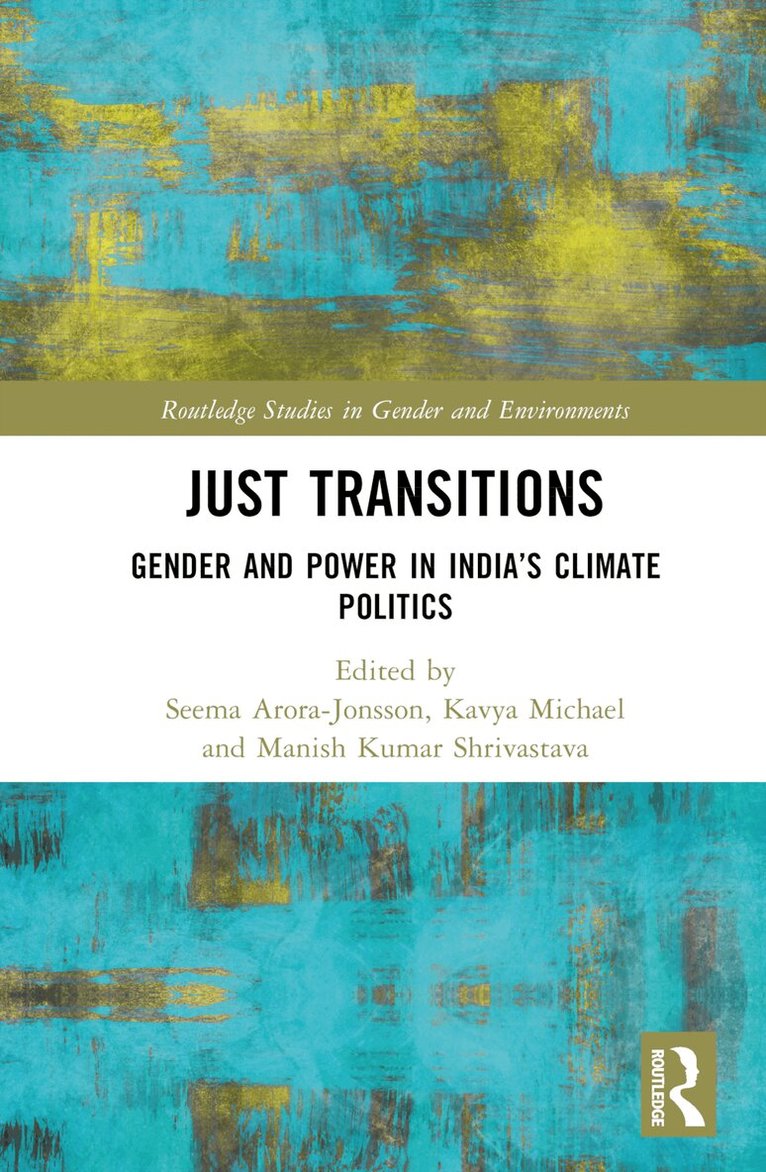
    Just Transitions

    Gender and Power in India’s Climate Politics

    AvSeema Arora-Jonsson,Kavya Michael

    Inbunden, Engelska, 2023

    Del i serien Routledge Studies in Gender and Environments

    2 423 kr

    Beställningsvara. Skickas inom 10-15 vardagar. Fri frakt över 249 kr.

    Beskrivning

    This book turns critical feminist scrutiny on national climate policies in India and examines what transition might really mean for marginalized groups in the country.A vision of “just transitions” is increasingly being used by activists and groups to ensure that pathways towards sustainable futures are equitable and inclusive. Exploring this concept, this volume provides a feminist study of what it would take to ensure just transitions in India where gender, in relation to its interesting dimensions of power, is at the centre of analysis. With case studies on climate mitigation and adaptation from different parts of India, the book brings together academics, practitioners and policymakers who provide commentary on sectors including agriculture, forestry and renewables. Overall, the book has relevance far beyond India’s borders, as India’s attempt to deal with its diverse population makes it a key litmus test for countries seeking to transition against a backdrop of inequality both in the Global North and South.This volume will be of great interest to students and scholars of climate policy, gender studies, sustainable development and development studies more broadly.

    Produktinformation

    • Utgivningsdatum:2023-10-04
    • Mått:156 x 234 x 20 mm
    • Vikt:560 g
    • Format:Inbunden
    • Språk:Engelska
    • Serie:Routledge Studies in Gender and Environments
    • Antal sidor:264
    • Förlag:Taylor & Francis Ltd
    • ISBN:9780367499686

    Utforska kategorier

    • Miljövetenskap och miljöpolitik inom Naturvetenskap och teknik
    • Genusvetenskap inom Samhälle och politik

    Mer om författaren

    Seema Arora-Jonsson is Professor in Rural Development at the Swedish University of Agricultural Sciences. She works with feminist thinking and questions of sustainability and justice in environmental governance, climate politics and rural development both in the Global South and Global North.Kavya Michael is an environmental- social scientist at Chalmers University of Technology, Sweden. Her research broadly examines environmental change and energy- related issues through a human rights and justice lens. She studies the multiple intersections of climate change, urban- inequality, informality, and inter and intra- regional migration with a focus on the Global South.Manish Kumar Shrivastava is a senior fellow at the Earth Sciences and Climate Change Division, TERI. His current research explores low-carbon transition in India from the perspectives of MSMEs, finance, gender justice, role of sub- national and non- state actors, and relevance of frugality in technological choices and governance for sustainability.

    Recensioner i media

    "If women (and other marginalised genders) hold up half the sky, then surely their perspectives on the crisis affecting the skies and the earth are crucial to forging pathways out of it? Yet most of the discussions around 'just climate transition' are not adequately gendered. This volume fills this huge gap, showing how a feminist viewpoint can not only challenge the superficiality of mainstream climate 'solutions' such as carbon markets and technofixes, but also provide genuine, transformatory pathways. This is rich material relevant not only for India but for the world as a whole."Ashish Kothari, Kalpavriksh, Vikalp Sangam, and Global Tapestry of Alternatives “For thirty years, since early 1990:s, national as well as international energy and climate policies (and politics) was mostly done in two different silos. Unfortunately, that divide has also been somewhat reflected in feminist research where gender scholarship was early to effect climate policies, but only in the last couple of years such scholarship has been connected with questions of energy. But, as Seema Arora-Jonsson, Kavya Michael and Manish Kumar Shrivastava so eloquently show in Just Transitions: Gender and Power in India’s Climate politics, with examples from forestry, small scale renewable electricity and more, the link was always there – but needed to be shown through interdisciplinary scholarship. When researchers around the globe early 2020:s come together in dialogues regarding Just Transitions, there is no longer any place to hide from the connection of energy and climate change. This book is a crucial contribution to such understanding, but even more important, it showcase paths forward diverging away from the fossil fueled road to ecocide we are currently on.”Martin Hultman, author of Climate Obstruction (Routledge), editor of Men, Masculinities and Earth and leader of the research program “Whose Body of Water. Rights of Nature as Environmental Guardianship in Sweden” “There are no jobs on a dead planet! Climate change is an existential crisis increasingly putting lives and livelihoods at risk. These perspectives from India reflect the challenge in all nations. If workers and communities are not at the tables in workplaces and in the halls of Government co-creating Just Transition solutions then trust will be elusive and impede both scale and spend vital to decarbonisation or adaptation. Jobs are at the heart of personal, family and community confidence in change but if jobs created preclude women this creates a risk for social and economic security. It is critical that we see transitions in all sectors are just and in that regard investment in ‘care’ must be recognised as a foundation of resilience against climate and other economic shocks.This book is a must read.”Sharan Burrow, Former General Secretary of the International Trade Union Confederation (ITUC)“This volume provides a powerful overview of what just transition means from a gender perspective: neither technological innovations nor market forces will create equity in access to the land, forests, and water that are essential to the everyday lives of so many people especially inrural areas.The essays in the book show that social and environmental justice are based on gender justice through all scales.”Christine Bauhardt, Professor of gender and globalization, Humboldt-Universität zu Berlin"An important and valuable book that debunks the illusion that the commitment for gender-just climate policy at the international level goes hand in hand with gender-just climate policy at the national level. The combination of policy field analysis, concrete experiences and recommendations makes the book exciting even for readers who have been working in the field of gender-just climate policy for a long time. The experiences of local initiatives in India offer many insights and suggestions for the Global North and thus form an important building block for a strong South-North exchange."Ulrike Röhr, genanet – gender, environment, sustainability, Germany"An exciting new collection which illuminates key dimensions of Just Transition politics by adopting a feminist approach to justice and inequality from within the "Global South". Intersecting questions of time, informality and invisibility, as well as collective care and repair action, the volume shows what transitions are already practiced on the ground, and what kind of climate governance is needed to support them."Stefania Barca, Distinguished Researcher "Beatriz Galindo" senior, University of Santiago de Compostela (ES)

    Innehållsförteckning

    • Table of ContentsPreface IntroductionSeema Arora-Jonsson, Kavya Michael and Manish Kumar ShrivastavaPart 1: Peace, Justice and strong institutionsClimate Diplomacy, Just Transitions, and Gender Mainstreaming: India’s Experiences Dhanasree Jayaram and Shirin ChoudharyGender and India’s Climate Policy: Bridging the DisconnectsManish Kumar Shrivastava, Seema Arora-Jonsson and Kavya MichaelVoices from the field: Working for a just climate in IndiaSeema Arora-Jonsson with Srestha Banerjee, Shloka Nath, Kalyani Raj, R.R. Rashmi, Ginny Shrivastava, Kavya Michael, and Manish Kumar Shrivastava Commentary Making the Change PossibleJayati GhoshPart 2: ‘No jobs on a dead planet’: Life on land and forestsHow just is the transition to organic farming from a gender lens?Aditi KapoorAdivasi and Forest Feminism: The path to Just Transitions through the Forest Rights Act Sanghamitra Dubey and Astha SaxenaCoal over forests, displacement over community rights?: Lessons for a just climate future from forest-dwelling communities in Hasdeo Aranya Ruchira TalukdarCommentary9 Transitions, policy, and implementation through a feminist lensEdward R. CarrPart 3: Clean and Affordable energy – for whom and at what cost?Negotiating a just transition: the case of utility-scale solar in semi-arid southern India Uttara Narayan, Vishwajeet Poojary, Tarul Jain and Ulka KelkarLow-carbon development and women entrepreneurs: A case study of fly-ash brick industry in BiharGitika Goswami, Manish Kumar Shrivastava, Ria Sinha and Alpana GuptaEngendering the energy value chain: Evidence from India Mini Govindan, Rashmi Murali and Dhairya DholakBarriers and Enablers of Gender Just Climate Action: Examples from IndiaKavya MichaelCommentaryEnergy Alternatives - A view from the global NorthSusan BuckinghamEpilogueEngendering Sustainability Transitions - A Prerequisite for a Just SocietyIndex