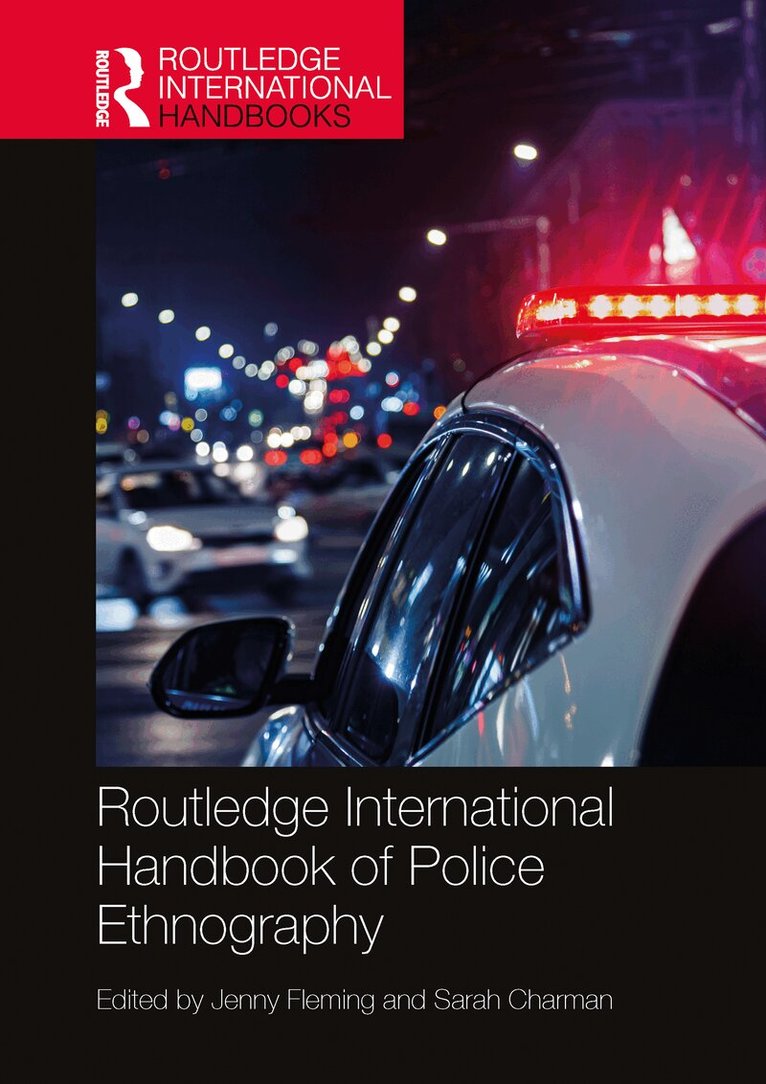
Routledge International Handbook of Police Ethnography
708 kr
Beställningsvara. Skickas inom 10-15 vardagar. Fri frakt över 249 kr.
Du är på sajten för privatpersoner.
708 kr
Beställningsvara. Skickas inom 10-15 vardagar. Fri frakt över 249 kr.
Jenny Fleming is Professor of Criminology and Director of the Institute of Criminal Justice Research at the University of Southampton, UK, and Editor-in-Chief of Policing and Society.Sarah Charman is Professor of Criminology at the University of Portsmouth, UK, and Editor-in-Chief of the International Journal of Law, Crime and Justice.
‘Ethnographers have long been motivated to explore the usually-secretive and often-violent world of policing. As this impressive volume demonstrates, there are rich insights to be gained from ethnographic encounters with the police, just as there are intractable dilemmas to be confronted. Showcasing the work of scholars from across the globe, The Routledge International Handbook of Police Ethnography will stand as a critical reference point for scholars hoping to artfully craft an effective and ethical relationship with the police in the everyday practice of their work.’Steve Herbert, Professor of Law, Societies, and Justice and Geography at the University of Washington, USA‘It was once said that criminology dwells alliteratively on cops, crimes and corrections, and cops, occupying a complex and contradictory world in which they exercise a virtual monopoly of legitimate violence, protect and control, signify and are signified, regulate diverse spaces, perform an assortment of tasks (including what has been called the ‘dirty work’ of society), and serve critically as mediators and gatekeepers, have long received a particularly close and fascinated ethnographic scrutiny. The outcome has been much fine writing. The Routledge International Handbook of Police Ethnography is a monumental work that draws on a succession of generations of scholars, from quite early pioneers to fresh young academics, to offer a near global overview of how that ethnography arose, what it entails, how and whence it is done and where it might yet progress. We should be more than grateful to its editors and authors for bringing such an important task to fruition.’Paul Rock, Emeritus Professor of Sociology, London School of Economics and Political Science, UK‘Policing practices usually bear little if any relationship to the shiny romantic images promulgated in media and political discourse. Once social scientists began to study policing from the early 1960s the key tool was ethnographic research, a set of deeply immersive methodologies for probing into the cultures and behaviours of these powerful and intriguing institutions. Varieties ethnographic techniques remain pivotal to shedding light on policing. At last, this central element of understanding police and policing has been done justice by this magnificent volume. The editors, distinguished researchers, and scholars in their own right, have assembled a wonderful array of contributors covering a comprehensive range of theoretical, methodological and substantive issues. They range from all the generations of policing research and are drawn from every continent. They include pioneering superstars of the classic era of police ethnographies to outstanding researchers in early stages of their careers. The intellectual quality of the contributions is consistently first rate, a testimony to the editor's knowledge and command of this rapidly growing field. The book is a must have not only for social science researchers but for practitioners and policy makers concerned with policing. It provides an indispensable global guide to this vital field.’Robert Reiner, Emeritus Professor of Criminology in the Law Department, London School of Economics and Political Science, UK‘I started doing ethnographic research on police as a young doctoral student. There was no course available to guide me, and supervisory input was limited. We now have what I consider to be the definitive handbook on police ethnography. Its value lies not simply in reviewing past ethnographies which have fundamentally shaped policing scholarship, but in generating new thinking about contemporary dilemmas and opportunities. It provides insight and valuable guidance into what it means to do police ethnography in a time of a pandemic, and in a digital era. It also invites the readers to consider ethnographic encounters that represent a shift away from condemnation to co-created knowledge. It provides a platform for deliberating how policy and practice align (or not), how to navigate dilemmas about whistleblowing and researcher positionality, and how to make sense of the web of nodal actors. Critically, it also talks to the vexed question of presenting and disseminating policing ethnographies that include sensitive information. This handbook may well become a classic text for all ethnographic research, with police and policing as a lens.’Monique Marks, Head of the Urban Futures Centre, Durban University of Technology, Durban, South Africa
Brett Smith, Andrew C. Sparkes
Häftad, 2018
910 kr
John Devaney, Caroline Bradbury-Jones, Rebecca J. Macy, Carolina Øverlien, Stephanie Holt
Häftad, 2022
713 kr
Brendan Hokowhitu, Aileen Moreton-Robinson, Linda Tuhiwai-Smith, Chris Andersen, Steve Larkin
Häftad, 2022
743 kr
Michael Hviid Jacobsen, Greg Smith
Häftad, 2024
708 kr
Nina Lykke, Tara Mehrabi, Marietta Radomska
Inbunden, 2025
3 836 kr
Joseph Baker, Stephen Cobley, Jörg Schorer, Nick Wattie
Inbunden, 2017
3 726 kr
David Androff, Janianton Damanik
Häftad, 2025
779 kr
Jenny Fleming, Sarah Charman
Inbunden, 2023
3 367 kr
Du är på sajten för privatpersoner.
708 kr
Beställningsvara. Skickas inom 10-15 vardagar. Fri frakt över 249 kr.
Jenny Fleming is Professor of Criminology and Director of the Institute of Criminal Justice Research at the University of Southampton, UK, and Editor-in-Chief of Policing and Society.Sarah Charman is Professor of Criminology at the University of Portsmouth, UK, and Editor-in-Chief of the International Journal of Law, Crime and Justice.
‘Ethnographers have long been motivated to explore the usually-secretive and often-violent world of policing. As this impressive volume demonstrates, there are rich insights to be gained from ethnographic encounters with the police, just as there are intractable dilemmas to be confronted. Showcasing the work of scholars from across the globe, The Routledge International Handbook of Police Ethnography will stand as a critical reference point for scholars hoping to artfully craft an effective and ethical relationship with the police in the everyday practice of their work.’Steve Herbert, Professor of Law, Societies, and Justice and Geography at the University of Washington, USA‘It was once said that criminology dwells alliteratively on cops, crimes and corrections, and cops, occupying a complex and contradictory world in which they exercise a virtual monopoly of legitimate violence, protect and control, signify and are signified, regulate diverse spaces, perform an assortment of tasks (including what has been called the ‘dirty work’ of society), and serve critically as mediators and gatekeepers, have long received a particularly close and fascinated ethnographic scrutiny. The outcome has been much fine writing. The Routledge International Handbook of Police Ethnography is a monumental work that draws on a succession of generations of scholars, from quite early pioneers to fresh young academics, to offer a near global overview of how that ethnography arose, what it entails, how and whence it is done and where it might yet progress. We should be more than grateful to its editors and authors for bringing such an important task to fruition.’Paul Rock, Emeritus Professor of Sociology, London School of Economics and Political Science, UK‘Policing practices usually bear little if any relationship to the shiny romantic images promulgated in media and political discourse. Once social scientists began to study policing from the early 1960s the key tool was ethnographic research, a set of deeply immersive methodologies for probing into the cultures and behaviours of these powerful and intriguing institutions. Varieties ethnographic techniques remain pivotal to shedding light on policing. At last, this central element of understanding police and policing has been done justice by this magnificent volume. The editors, distinguished researchers, and scholars in their own right, have assembled a wonderful array of contributors covering a comprehensive range of theoretical, methodological and substantive issues. They range from all the generations of policing research and are drawn from every continent. They include pioneering superstars of the classic era of police ethnographies to outstanding researchers in early stages of their careers. The intellectual quality of the contributions is consistently first rate, a testimony to the editor's knowledge and command of this rapidly growing field. The book is a must have not only for social science researchers but for practitioners and policy makers concerned with policing. It provides an indispensable global guide to this vital field.’Robert Reiner, Emeritus Professor of Criminology in the Law Department, London School of Economics and Political Science, UK‘I started doing ethnographic research on police as a young doctoral student. There was no course available to guide me, and supervisory input was limited. We now have what I consider to be the definitive handbook on police ethnography. Its value lies not simply in reviewing past ethnographies which have fundamentally shaped policing scholarship, but in generating new thinking about contemporary dilemmas and opportunities. It provides insight and valuable guidance into what it means to do police ethnography in a time of a pandemic, and in a digital era. It also invites the readers to consider ethnographic encounters that represent a shift away from condemnation to co-created knowledge. It provides a platform for deliberating how policy and practice align (or not), how to navigate dilemmas about whistleblowing and researcher positionality, and how to make sense of the web of nodal actors. Critically, it also talks to the vexed question of presenting and disseminating policing ethnographies that include sensitive information. This handbook may well become a classic text for all ethnographic research, with police and policing as a lens.’Monique Marks, Head of the Urban Futures Centre, Durban University of Technology, Durban, South Africa
Brett Smith, Andrew C. Sparkes
Häftad, 2018
910 kr
John Devaney, Caroline Bradbury-Jones, Rebecca J. Macy, Carolina Øverlien, Stephanie Holt
Häftad, 2022
713 kr
Brendan Hokowhitu, Aileen Moreton-Robinson, Linda Tuhiwai-Smith, Chris Andersen, Steve Larkin
Häftad, 2022
743 kr
Michael Hviid Jacobsen, Greg Smith
Häftad, 2024
708 kr
Nina Lykke, Tara Mehrabi, Marietta Radomska
Inbunden, 2025
3 836 kr
Joseph Baker, Stephen Cobley, Jörg Schorer, Nick Wattie
Inbunden, 2017
3 726 kr
David Androff, Janianton Damanik
Häftad, 2025
779 kr
Jenny Fleming, Sarah Charman
Inbunden, 2023
3 367 kr
Du är på sajten för privatpersoner.
708 kr
Beställningsvara. Skickas inom 10-15 vardagar. Fri frakt över 249 kr.
Jenny Fleming is Professor of Criminology and Director of the Institute of Criminal Justice Research at the University of Southampton, UK, and Editor-in-Chief of Policing and Society.Sarah Charman is Professor of Criminology at the University of Portsmouth, UK, and Editor-in-Chief of the International Journal of Law, Crime and Justice.
‘Ethnographers have long been motivated to explore the usually-secretive and often-violent world of policing. As this impressive volume demonstrates, there are rich insights to be gained from ethnographic encounters with the police, just as there are intractable dilemmas to be confronted. Showcasing the work of scholars from across the globe, The Routledge International Handbook of Police Ethnography will stand as a critical reference point for scholars hoping to artfully craft an effective and ethical relationship with the police in the everyday practice of their work.’Steve Herbert, Professor of Law, Societies, and Justice and Geography at the University of Washington, USA‘It was once said that criminology dwells alliteratively on cops, crimes and corrections, and cops, occupying a complex and contradictory world in which they exercise a virtual monopoly of legitimate violence, protect and control, signify and are signified, regulate diverse spaces, perform an assortment of tasks (including what has been called the ‘dirty work’ of society), and serve critically as mediators and gatekeepers, have long received a particularly close and fascinated ethnographic scrutiny. The outcome has been much fine writing. The Routledge International Handbook of Police Ethnography is a monumental work that draws on a succession of generations of scholars, from quite early pioneers to fresh young academics, to offer a near global overview of how that ethnography arose, what it entails, how and whence it is done and where it might yet progress. We should be more than grateful to its editors and authors for bringing such an important task to fruition.’Paul Rock, Emeritus Professor of Sociology, London School of Economics and Political Science, UK‘Policing practices usually bear little if any relationship to the shiny romantic images promulgated in media and political discourse. Once social scientists began to study policing from the early 1960s the key tool was ethnographic research, a set of deeply immersive methodologies for probing into the cultures and behaviours of these powerful and intriguing institutions. Varieties ethnographic techniques remain pivotal to shedding light on policing. At last, this central element of understanding police and policing has been done justice by this magnificent volume. The editors, distinguished researchers, and scholars in their own right, have assembled a wonderful array of contributors covering a comprehensive range of theoretical, methodological and substantive issues. They range from all the generations of policing research and are drawn from every continent. They include pioneering superstars of the classic era of police ethnographies to outstanding researchers in early stages of their careers. The intellectual quality of the contributions is consistently first rate, a testimony to the editor's knowledge and command of this rapidly growing field. The book is a must have not only for social science researchers but for practitioners and policy makers concerned with policing. It provides an indispensable global guide to this vital field.’Robert Reiner, Emeritus Professor of Criminology in the Law Department, London School of Economics and Political Science, UK‘I started doing ethnographic research on police as a young doctoral student. There was no course available to guide me, and supervisory input was limited. We now have what I consider to be the definitive handbook on police ethnography. Its value lies not simply in reviewing past ethnographies which have fundamentally shaped policing scholarship, but in generating new thinking about contemporary dilemmas and opportunities. It provides insight and valuable guidance into what it means to do police ethnography in a time of a pandemic, and in a digital era. It also invites the readers to consider ethnographic encounters that represent a shift away from condemnation to co-created knowledge. It provides a platform for deliberating how policy and practice align (or not), how to navigate dilemmas about whistleblowing and researcher positionality, and how to make sense of the web of nodal actors. Critically, it also talks to the vexed question of presenting and disseminating policing ethnographies that include sensitive information. This handbook may well become a classic text for all ethnographic research, with police and policing as a lens.’Monique Marks, Head of the Urban Futures Centre, Durban University of Technology, Durban, South Africa
Brett Smith, Andrew C. Sparkes
Häftad, 2018
910 kr
John Devaney, Caroline Bradbury-Jones, Rebecca J. Macy, Carolina Øverlien, Stephanie Holt
Häftad, 2022
713 kr
Brendan Hokowhitu, Aileen Moreton-Robinson, Linda Tuhiwai-Smith, Chris Andersen, Steve Larkin
Häftad, 2022
743 kr
Michael Hviid Jacobsen, Greg Smith
Häftad, 2024
708 kr
Nina Lykke, Tara Mehrabi, Marietta Radomska
Inbunden, 2025
3 836 kr
Joseph Baker, Stephen Cobley, Jörg Schorer, Nick Wattie
Inbunden, 2017
3 726 kr
David Androff, Janianton Damanik
Häftad, 2025
779 kr
Jenny Fleming, Sarah Charman
Inbunden, 2023
3 367 kr