• Fri frakt över 249 kr
  • •
  • Snabba leveranser
  • •
  • Billiga böcker
Kundservice

Du är på sajten för privatpersoner.

Företag, bibliotek eller offentlig verksamhet?

Du handlar på classic.bokus.com, där alla dina funktioner finns intakta.
Till classic.bokus.com
Bokus logotyp. Gå till startsidan.
  • Erbjudanden
  • Student
  • Topplistor
  • Barn & ungdom
  • Bokus Play
  • E-böcker
  • Ljudböcker
  • Pocketböcker
  • Spel och pussel

Skapa nya rutiner – hälsoböcker upp till 50% →

Sidfot

Mina sidor

    Hjälp

    • Kundservice
    • Vanliga frågor och svar
    • Frakt och leverans
    • Retur vid ångerrätt
    • Reklamera vara
    • Betalning
    • Köpvillkor
    • Allmänna villkor
    • Information om webbplatsens tillgänglighet

    Om Bokus

    • Om oss
    • Pressrum
    • För studenter
    • För företag
    • För bibliotek och offentlig verksamhet
    • För leverantörer
    • Hållbarhet

    Populärt

    • Aktuella erbjudanden
    • Presentkort
    • Studentlitteratur
    • Nya böcker
    • Topplistor
    • Signerade böcker
    • Engelska böcker

    Inspiration

    • Boktips
    • BookTok
    • Barnbokskaraktärer
    • Populära författare
    Logotyp för Bokus
    Följ oss på Facebook (extern länk)Följ oss på Instagram (extern länk)Följ oss på YouTube (extern länk)Följ oss på TikTok (extern länk)
    bokus @ CookiesAnpassa cookiesIntegritetspolicyKöpvillkor
    Till Citymail hemsida (extern länk)Till Budbee hemsida (extern länk)Till Postnord hemsida (extern länk)Till Schenker hemsida (extern länk)Till Early Bird hemsida (extern länk)Till Walleys hemsida (extern länk)
    1. Naturvetenskap och teknik
    2. Matematik och naturvetenskap
    3. Matematik
    4. Optimering

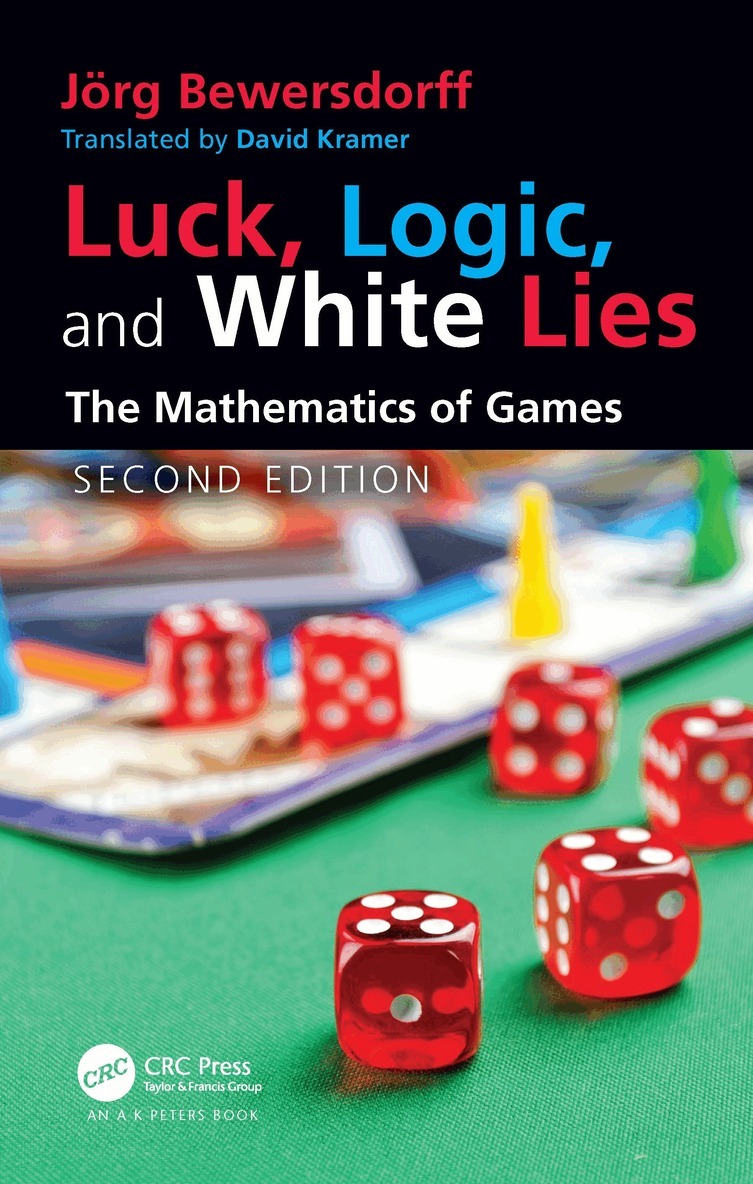
    Luck, Logic, and White Lies

    The Mathematics of Games

    AvJörg Bewersdorff

    Inbunden, Engelska, 2021

    Del i serien AK Peters/CRC Recreational Mathematics Series

    2 052 kr

    Beställningsvara. Skickas inom 10-15 vardagar. Fri frakt över 249 kr.

    Fler format och utgåvor

    Häftad

    763 kr

    Beskrivning

    Praise for the First Edition"Luck, Logic, and White Lies teaches readers of all backgrounds about the insight mathematical knowledge can bring and is highly recommended reading among avid game players, both to better understand the game itself and to improve one’s skills."– Midwest Book Review"The best book I've found for someone new to game math is Luck, Logic and White Lies by Jörg Bewersdorff. It introduces the reader to a vast mathematical literature, and does so in an enormously clear manner. . ."– Alfred Wallace, Musings, Ramblings, and Things Left Unsaid"The aim is to introduce the mathematics that will allow analysis of the problem or game. This is done in gentle stages, from chapter to chapter, so as to reach as broad an audience as possible . . . Anyone who likes games and has a taste for analytical thinking will enjoy this book."– Peter Fillmore, CMS NotesLuck, Logic, and White Lies: The Mathematics of Games, Second Edition considers a specific problem—generally a game or game fragment and introduces the related mathematical methods. It contains a section on the historical development of the theories of games of chance, and combinatorial and strategic games.This new edition features new and much refreshed chapters, including an all-new Part IV on the problem of how to measure skill in games. Readers are also introduced to new references and techniques developed since the previous edition.Features Provides a uniquely historical perspective on the mathematical underpinnings of a comprehensive list of games Suitable for a broad audience of differing mathematical levels. Anyone with a passion for games, game theory, and mathematics will enjoy this book, whether they be students, academics, or game enthusiasts Covers a wide selection of topics at a level that can be appreciated on a historical, recreational, and mathematical level.Jörg Bewersdorff (1958) studied mathematics from 1975 to 1982 at the University of Bonn and earned his PhD in 1985. In the same year, he started his career as game developer and mathematician. He served as the general manager of the subsidiaries of Gauselmann AG for more than two decades where he developed electronic gaming machines, automatic payment machines, and coin-operated Internet terminals.Dr. Bewersdorff has authored several books on Galois theory (translated in English and Korean), mathematical statistics, and object-oriented programming with JavaScript.*Here is the list of Errata for the second edition of Luck, Logic, and White Lies: The Mathematics of Games: http://bewersdorff-online.de/LLWL-errata.pdf

    Produktinformation

    • Utgivningsdatum:2021-04-28
    • Mått:156 x 234 x 32 mm
    • Vikt:980 g
    • Format:Inbunden
    • Språk:Engelska
    • Serie:AK Peters/CRC Recreational Mathematics Series
    • Antal sidor:568
    • Upplaga:2
    • Förlag:Taylor & Francis Ltd
    • ISBN:9780367552961

    Utforska kategorier

    • Optimering inom Naturvetenskap och teknik
    • Matematikens grunder inom Naturvetenskap och teknik
    • Kombinatorik och grafteori inom Naturvetenskap och teknik

    Mer om författaren

    Jörg Bewersdorff (1958) studied mathematics from 1975 to 1982 at the University of Bonn and earned his PhD in 1985. In the same year, he started his career as game developer and mathematician. He served as the general manager at the subsidiaries of the Gauslmann AG for more than two decades where he developed electronic gaming machines, automatic payment machines and coin operated internet terminals.Jörg Bewersdorff has authored several books on Galois theory (translated in English and Korean), mathematical statistics and object-orientated programming with JavaScript.

    Recensioner i media

    "The book presents mathematical explanation of problems related to playing games of chance, combinatorial and strategic games, with descriptions of their historical perspectives and recreational aspects. [. . .] The author notes that people play games investigating the unknown outcomes, in amusement and hope of winning in conditions of uncertainty caused by three possible mechanisms: chance, a large number of combinations of various moves, and different states of information among the individual players. Respectively, the games can be divided to three classes: games of chance (e.g., dice, cards, roulette) where the random processes dominate the players decisions; combinatorial games (chess, go) where the uncertainty rests on the multiplicity of possible moves; and strategic games (rock-paper-scissors) where the players’ uncertainty arises from imperfect information. Many games have mixed features (backgammon, poker, skat), and the degree of influence of the three main causes of uncertainty defines specifics of each game. The book introduces mathematical methods developed for description and solutions of games: the games of chance can be analyzed with the help of probability theory, the combinatorial games are considered by variety of methods used in particular problems, and the strategic games are studied by the game theory models for decision-making in the interactive optimizing economic processes. The book is organized in four parts containing 51 chapters on various topics.[. . .] All topics are illustrated by multiple figures and numerical tables. [. . .] It can be useful to instructors, students, and readers wishing to extend understanding of the games’ intrinsic features needed to improve ability to win in actual playing."- Stan Lipovetsky, Technometrics"As the title indicates, Bewersdorff’s book is intended to span the mathematics of games in general – not only games of chance but also including strategic and skill games. The author covers all the big categories of games – casino, tournament, and house or social games. In fact, the skill-strategic dimension of the games balanced with the chance-uncertainty dimension is the central element around which the author presents games as an important field of application of mathematics; he takes them as a good opportunity to advocate for the beauty and power of mathematics. To that point, the book is written so as to be both popular and scholarly, and these attributes are not at all inconsistent with each other for such a general topic, content, and style. [. . .] The book leaves the impression of its author’s being a skilled advocate of the unlimited power of mathematics, shown through the examples of games. Not only is mathematics able to describe the games and the way we play them, but it is entitled to address fundamental questions beyond the problem-solving aspects of games and gaming. It is mainly game theory and probability theory that grant mathematics such a virtue. [. . .] Although the chapters can mostly be read independent of each other, and the mathematical content is not systematized throughout the book, the mathematically-inclined reader can put things together to have an objective overview of one of the most interesting fields in application of mathematics – games – which themselves shaped the development of mathematics."– International Gambling Studies"The author provides a great deal of insight into a wide variety of games, all inspected from a mathematical point of view. He develops the prerequisites mathematically, so that someone with a good high-school background in mathematics and a willingness to learn will be able to build up the necessary tools for successful play. Moreover, the author’s arguments are often very detailed, so that even a novice can easily follow them. The numerous diagrams also help.I find Bewersdorff's writing to be clear and detailed. He has taken care in the presentation of the ideas. The book, the size of which has now grown to 568 pages, provides a great deal of information, and the reader can easily pick and choose topics of interest without having to absorb the entire treatise. The level of Mathematical skill needed, however, does vary greatly from chapter to chapter. When necessary, the reader can make use of previous chapters to develop the required background to proceed. To the prospective reader, good luck, and may your play be a winning one!"– The Mathematical IntelligencerThis book, successor to the first edition (2005) and translated from the 7th German edition, treats games of chance (“luck”), combinatorial games (“logic”), and games of strategy (bluff, or “white lies”). The first part develops succinctly the needed theory of probability and investigates the nature of randomness. The second part explores minimax optimization, Grundy values, Conway’s theory of games, and complexity theory. The third part is based on the fact that in a symmetric two-person zero-sum game, the players are guaranteed optimal mixed strategies; for some games, finding such strategies can be done by linear programming. This edition adds a fourth part that investigates measuring the proportion of skill in a game, with particular application to poker. The reader needs to be comfortable with algebra and summation signs, and infinite series make appearances; end-of-chapter notes and footnotes contribute further mathematical depth.– Mathematics Magazine, MAA“Overall, this is a well-written and entertaining text, which should be useful when teaching probability courses at school or college. Some chapters are surprising (e.g. the discussion of how to turn a biased coin into a fair one by repeated trials), and the discussion of Markov chains in connection with various games and the treatment of blackjack is excellent.”— René L. Schilling, The Mathematical Gazette"Exceptionally well written, organized and presented, Luck, Logic, and White Lies: The Mathematics of Games is a unique and unreservedly recommended addition to professional, community, college, and university library Game Theory & Mathematics collections."– Midwest Books Review"A great variety of games are analyzed in an accessible way. The treatment of blackjack, in particular, is superb."– Stewart Ethier, Professor Emeritus, University of Utah and author of The Doctrine of Chances: Probabilistic Aspects of Gambling "People play games for fun and for profit. To become better at a game, you need to study it. In Luck, Logic and White Lies, Jörg Bewersdorff takes you, almost imperceptibly, from the history of numerous concrete games to their mathematical analysis. This touches upon a wide range of techniques, not only in mathematics, but also in computing and psychology. If you get the hang of it, you can apply these techniques to other areas of life, such as business, economics, biology, and sociology."– Tom Verhoeff, Dept. Math & CS, Eindhoven University of TechnologyPraise for the First Edition"Luck, Logic, and White Lies teaches readers of all backgrounds about the insight mathematical knowledge can bring and is highly recommended reading among avid game players, both to better understand the game itself and to improve one's skills."– Midwest Book Review"The best book I've found for someone new to game math is Luck, Logic and White Lies by Jörg Bewersdorff. It introduces the reader to a vast mathematical literature, and does so in an enormously clear manner. . ."– Alfred Wallace, Musings, Ramblings, and Things Left Unsaid"The aim is to introduce the mathematics that will allow analysis of the problem or game. This is done in gentle stages, from chapter to chapter, so as to reach as broad an audience as possible [. . .] Anyone who likes games and has a taste for analytical thinking will enjoy this book."– Peter Fillmore, CMS Notes

    Innehållsförteckning

    • I. Games of Chance. 1. Dice and Probability. 2. Waiting for a Double. 3. Tips on Playing the Lottery: More Equal Than Equal? 4. A Fair Division: But How? 5. The Red and the Black: The Law of Large Numbers. 6. Asymmetric Dice: Are They Worth Anything? 7. Probability and Geometry. 8. Chance and Mathematical Certainty: Are They Reconcilable? 9. In Quest of the Equiprobable. 10. Winning the Game: Probability and Value. 11. Which Die Is Best? 12. A Die Is Tested. 13. The Normal Distribution: A Race to the Finish! 14. And Not Only at Roulette: The Poisson Distribution. 15. When Formulas Become Too Complex: The Monte Carlo Method. 16. Markov Chains and the Game Monopoly. 17 Blackjack: A Las Vegas Fairy Tale. II. Combinatorial Games. 18. Which Move Is Best? 19. Chances of Winning and Symmetry. 20. A Game for Three. 21. Nim: The Easy Winner! 22. Lasker Nim: Winning Along a Secret Path. 23. Black-and-White Nim: To Each His (or Her) Own. 24. A Game with Dominoes: Have We Run Out of Space Yet? 25. Go: A Classical Game with a Modern Theory. 26. Misere Games: Loser Wins! 27. The Computer as Game Partner. 28. Can Winning Prospects Always Be Determined? 29. Games and Complexity: When Calculations Take Too Long. 30. A Good Memory and Luck: And Nothing Else? 31. Backgammon: To Double or Not to Double? 32. Mastermind: Playing It Safe. III. Strategic Games. 33. Rock–Paper–Scissors: The Enemy's Unknown Plan. 34. Minimax Versus Psychology: Even in Poker? 35. Bluffing in Poker: Can It Be Done Without Psychology? 36. Symmetric Games: Disadvantages Are Avoidable, but How? 37. Minimax and Linear Optimization: As Simple as Can Be. 38. Play It Again, Sam: Does Experience Make Us Wiser? 39. Le Her: Should I Exchange? 40. Deciding at Random: But How? 41. Optimal Play: Planning Efficiently. 42. Baccarat: Draw from a Five? 43. Three-Person Poker: Is It a Matter of Trust? 44 QUAAK! Child's Play? 45 Mastermind: Color Codes and Minimax. 46. A Car, Two Goats–and a Quizmaster. IV. Epilogue: Chance, Skill, and Symmetry. 47. A Player's Inuence and Its Limits. 48. Games of Chance and Games of Skill. 49. In Quest of a Measure. 50. Measuring the Proportion of Skill. 51. Poker: The Hotly Debated Issue.
    Hoppa över listan

    Mer från samma författare

    Jörg Bewersdorff - Objektorientierte Programmierung mit JavaScript, Häftad

    Objektorientierte Programmierung mit JavaScript

    Jörg Bewersdorff

    Häftad, 2018

    317 kr

    Jörg Bewersdorff - Glück, Logik und Bluff, Häftad

    Glück, Logik und Bluff

    Jörg Bewersdorff

    Häftad, 2018

    408 kr

    Jörg Bewersdorff - Algebra für Einsteiger, Häftad

    Algebra für Einsteiger

    Jörg Bewersdorff

    Häftad, 2019

    388 kr

    Jörg Bewersdorff - Statistik – wie und warum sie funktioniert, Häftad

    Statistik – wie und warum sie funktioniert

    Jörg Bewersdorff

    Häftad, 2021

    388 kr

    Jörg Bewersdorff - RSA- und Elliptic-Curve-Kryptographie, Häftad
    • Nyhet

    RSA- und Elliptic-Curve-Kryptographie

    Jörg Bewersdorff

    Häftad, 2026

    238 kr

    Hoppa över listan

    Mer från samma serie

    John Stillwell - Roads to Infinity, Häftad

    Roads to Infinity

    John Stillwell

    Häftad, 2024

    721 kr

    Aaron Montgomery - Mathematics of Tabletop Games, Häftad

    Mathematics of Tabletop Games

    Aaron Montgomery

    Häftad, 2024

    413 kr

    Elwyn R. Berlekamp, John H. Conway, Richard K. Guy - Winning Ways for Your Mathematical Plays, Volume 2, Häftad

    Winning Ways for Your Mathematical Plays, Volume 2

    Elwyn R. Berlekamp, John H. Conway, Richard K. Guy

    Häftad, 2003

    973 kr

    Elwyn R. Berlekamp, John H. Conway, Richard K. Guy - Winning Ways for Your Mathematical Plays, Volume 3, Häftad

    Winning Ways for Your Mathematical Plays, Volume 3

    Elwyn R. Berlekamp, John H. Conway, Richard K. Guy

    Häftad, 2003

    1 127 kr

    Elwyn R. Berlekamp, John H. Conway, Richard K. Guy - Winning Ways for Your Mathematical Plays, Volume 4, Häftad

    Winning Ways for Your Mathematical Plays, Volume 4

    Elwyn R. Berlekamp, John H. Conway, Richard K. Guy

    Häftad, 2004

    973 kr

    Robin Pemantle, Julian Joseph Gould - I Wish They'd Taught Me That, Häftad

    I Wish They'd Taught Me That

    Robin Pemantle, Julian Joseph Gould

    Häftad, 2025

    497 kr

    John Stillwell - Yearning for the Impossible, Häftad

    Yearning for the Impossible

    John Stillwell

    Häftad, 2018

    581 kr

    John H. Conway, Heidi Burgiel, Chaim Goodman-Strauss - Magic Theorem, Häftad

    Magic Theorem

    John H. Conway, Heidi Burgiel, Chaim Goodman-Strauss

    Häftad, 2025

    424 kr

    Robert J. Lang - Origami 4, Inbunden

    Origami 4

    Robert J. Lang

    Inbunden, 2017

    2 948 kr

    John Montroll - Origami Polyhedra Design, Häftad

    Origami Polyhedra Design

    John Montroll

    Häftad, 2009

    572 kr

    Hoppa över listan

    Du kanske också är intresserad av

    Jörg Bewersdorff - Luck, Logic, and White Lies, Häftad

    Luck, Logic, and White Lies

    Jörg Bewersdorff

    Häftad, 2021

    763 kr

    Jörg Bewersdorff - RSA- und Elliptic-Curve-Kryptographie, Häftad
    • Nyhet

    RSA- und Elliptic-Curve-Kryptographie

    Jörg Bewersdorff

    Häftad, 2026

    238 kr

    Jörg Bewersdorff - Algebra für Einsteiger, Häftad

    Algebra für Einsteiger

    Jörg Bewersdorff

    Häftad, 2019

    388 kr

    Jörg Bewersdorff - Statistik – wie und warum sie funktioniert, Häftad

    Statistik – wie und warum sie funktioniert

    Jörg Bewersdorff

    Häftad, 2021

    388 kr

    Jörg Bewersdorff - Objektorientierte Programmierung mit JavaScript, Häftad

    Objektorientierte Programmierung mit JavaScript

    Jörg Bewersdorff

    Häftad, 2018

    317 kr

    Jörg Bewersdorff - Glück, Logik und Bluff, Häftad

    Glück, Logik und Bluff

    Jörg Bewersdorff

    Häftad, 2018

    408 kr

    Mats Ahlstedt, Veronica Ahlstedt McCleave - Visselblåsaren, Pocket
    • -51%
    Del 1

    Visselblåsaren

    Mats Ahlstedt, Veronica Ahlstedt McCleave

    Pocket, 2025

    3,5 utav 5 stjärnor. Totalt antal röster:(2)

    49 kr99 kr

    Mats Ahlstedt, Veronica Ahlstedt McCleave - Svindlarna, Pocket
    • -51%
    Del 2

    Svindlarna

    Mats Ahlstedt, Veronica Ahlstedt McCleave

    Pocket, 2025

    3,0 utav 5 stjärnor. Totalt antal röster:(1)

    49 kr99 kr

    Carola Häggkvist - SIGNERAD - Jag är Carola, Inbunden
    • Signerad!

    SIGNERAD - Jag är Carola

    Carola Häggkvist

    Inbunden, 2026

    269 kr

    Anne Holt - Tolv otämjda hästar, Pocket
    • -51%

    Tolv otämjda hästar

    Anne Holt

    Pocket, 2025

    3,9 utav 5 stjärnor. Totalt antal röster:(29)

    49 kr99 kr