• Fri frakt över 249 kr
  • •
  • Snabba leveranser
  • •
  • Billiga böcker
Kundservice

Du är på sajten för privatpersoner.

Företag, bibliotek eller offentlig verksamhet?

Du handlar på classic.bokus.com, där alla dina funktioner finns intakta.
Till classic.bokus.com
Bokus logotyp. Gå till startsidan.
  • Erbjudanden
  • Nyheter
  • Student
  • Topplistor
  • Barn & ungdom
  • Bokus Play
  • E-böcker
  • Pocketböcker
  • Spel & pussel

10% rabatt på allt med kod: NYSTART10 →

Sidfot

Mina sidor

    Hjälp

    • Kundservice
    • Vanliga frågor och svar
    • Frakt och leverans
    • Retur vid ångerrätt
    • Reklamera vara
    • Betalning
    • Köpvillkor
    • Allmänna villkor
    • Information om webbplatsens tillgänglighet

    Om Bokus

    • Om oss
    • Pressrum
    • För studenter
    • För företag
    • För bibliotek och offentlig verksamhet
    • För leverantörer
    • Hållbarhet

    Populärt

    • Aktuella erbjudanden
    • Presentkort
    • Studentlitteratur
    • Nya böcker
    • Topplistor
    • Signerade böcker
    • Engelska böcker

    Inspiration

    • Boktips
    • BookTok
    • Populära bokserier
    • Barnbokskaraktärer
    • Populära författare
    Logotyp för Bokus
    Följ oss på Facebook (extern länk)Följ oss på Instagram (extern länk)Följ oss på YouTube (extern länk)Följ oss på TikTok (extern länk)
    bokus @ CookiesAnpassa cookiesIntegritetspolicyKöpvillkor
    Till Citymail hemsida (extern länk)Till Budbee hemsida (extern länk)Till Postnord hemsida (extern länk)Till Schenker hemsida (extern länk)Till Early Bird hemsida (extern länk)Till Walleys hemsida (extern länk)
    1. Naturvetenskap och teknik
    2. Teknik och industri
    3. Elektronik och kommunikationer

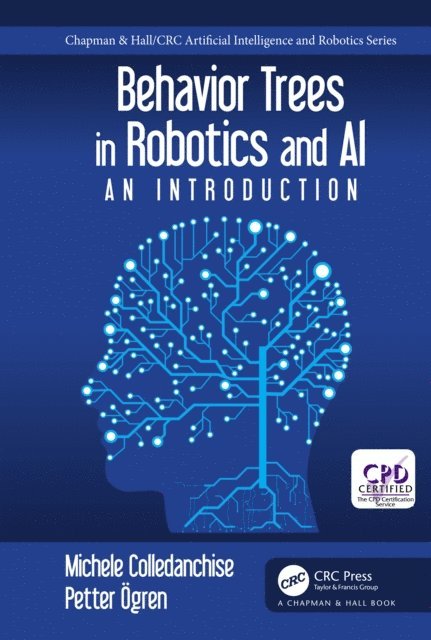
    Behavior Trees in Robotics and AI

    An Introduction

    AvMichele Colledanchise,Petter Ögren

    Häftad, Engelska, 2020

    Del i serien Chapman & Hall/CRC Artificial Intelligence and Robotics Series

    709 kr

    Beställningsvara. Skickas inom 10-15 vardagar. Fri frakt över 249 kr.

    Fler format och utgåvor

    Inbunden

    1 466 kr

    Beskrivning

    Behavior Trees (BTs) provide a way to structure the behavior of an artificial agent such as a robot or a non-player character in a computer game. Traditional design methods, such as finite state machines, are known to produce brittle behaviors when complexity increases, making it very hard to add features without breaking existing functionality. BTs were created to address this very problem, and enables the creation of systems that are both modular and reactive. Behavior Trees in Robotics and AI: An Introduction provides a broad introduction as well as an in-depth exploration of the topic, and is the first comprehensive book on the use of BTs.This book introduces the subject of BTs from simple topics, such as semantics and design principles, to complex topics, such as learning and task planning. For each topic, the authors provide a set of examples, ranging from simple illustrations to realistic complex behaviors, to enable the reader to successfully combine theory with practice.Starting with an introduction to BTs, the book then describes how BTs relate to, and in many cases, generalize earlier switching structures, or control architectures. These ideas are then used as a foundation for a set of efficient and easy to use design principles. The book then presents a set of important extensions and provides a set of tools for formally analyzing these extensions using a state space formulation of BTs. With the new analysis tools, the book then formalizes the descriptions of how BTs generalize earlier approaches and shows how BTs can be automatically generated using planning and learning. The final part of the book provides an extended set of tools to capture the behavior of Stochastic BTs, where the outcomes of actions are described by probabilities. These tools enable the computation of both success probabilities and time to completion.This book targets a broad audience, including both students and professionals interested in modeling complex behaviors for robots, game characters, or other AI agents. Readers can choose at which depth and pace they want to learn the subject, depending on their needs and background.

    Produktinformation

    • Utgivningsdatum:2020-06-30
    • Mått:156 x 234 x 15 mm
    • Vikt:380 g
    • Format:Häftad
    • Språk:Engelska
    • Serie:Chapman & Hall/CRC Artificial Intelligence and Robotics Series
    • Antal sidor:206
    • Förlag:Taylor & Francis Ltd
    • ISBN:9780367571337

    Utforska kategorier

    • Elektronik och kommunikationer inom Naturvetenskap och teknik
    • Artificiell intelligens inom Data och IT

    Mer om författaren

    Michele Colledanchise is currently a postdoctoral researcher in the iCub Facility at the Italian Institute of Technology, Genoa, Italy. He received his Ph.D. degree in computer science from the Royal Institute of Technology (KTH), Stockholm, Sweden, in 2017. In the spring of 2016, he visited the Control and Dynamical Systems, Californa Institute of Technology (Caltech), Pasadena, CA. His research interests include control systems, system architectures, and automated planning, with a strong focus on robotic applications.Petter Ögren was born in Stockholm, Sweden, in 1974. He received theM.S. degree in engineering physics and the Ph.D. degree in applied mathematics from the Royal Institute of Technology (KTH), Stockholm, Sweden, in 1998 and 2003, respectively. In the fall of 2001, he visited the Mechanical Engineering Department, Princeton University, Princeton, NJ. From 2003 to 2012 he worked as a senior scientist and deputy research director in Autonomous Systems at the Swedish Defence Research Agency (FOI). He is currently an Associate Professor at the Robotics, Perception and Learning lab (RPL) at KTH. His research interests include robot control architectures and multi-agent coordination.

    Innehållsförteckning

    • 1. What are Behavior Trees? 2. How Behavior Trees Generalize and Relate to Earlier Ideas 3. Design principles 4. Extensions of Behavior Trees 5. Analysis of Efficiency, Safety, and Robustness 6. Formal Analysis of How Behavior Trees Generalize Earlier Ideas 7. Behavior Trees and Automated Planning 8. Behavior Trees and Machine Learning 9. Stochastic Behavior Trees 10. Concluding Remarks